
Garlic can start a family fight. A Catholic schoolgirl can become convinced Satan is hiding in her bedroom. And sometimes the easiest way to understand your family is to turn all of it into a story.
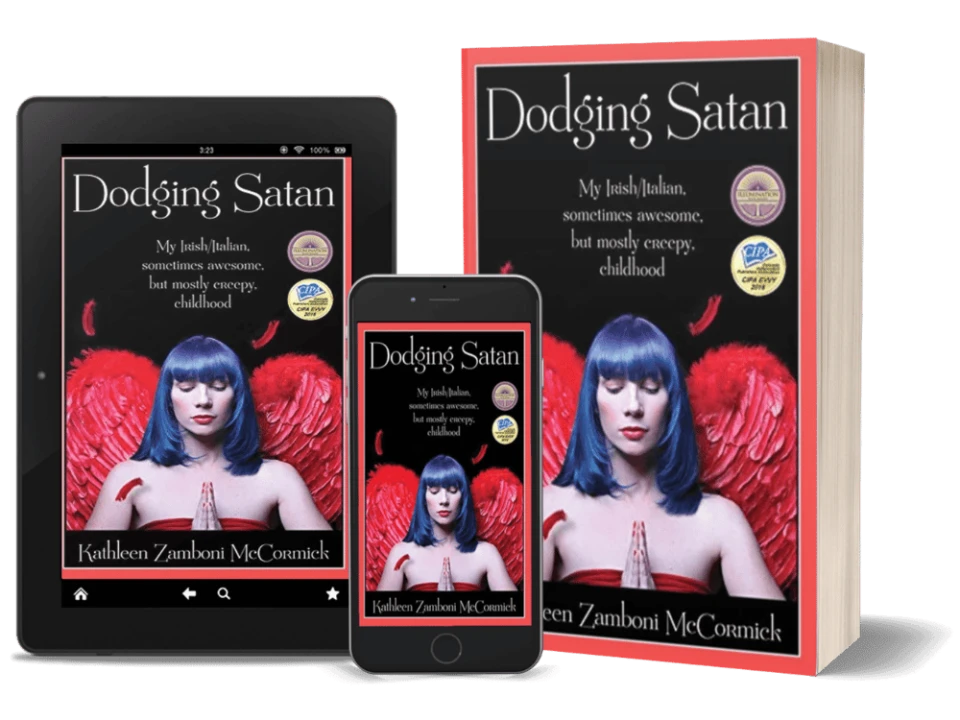
That is the wonderfully strange world Kathleen Zamboni McCormick created in Dodging Satan: My Irish/Italian, Sometimes Awesome, but Mostly Creepy Childhood, her award-winning coming-of-age novel rooted in the Catholic world of the 1960s and 1970s.
Now, Bridget Flaherty, the precocious young heroine at the center of the novel, has a literal voice.
The audiobook edition of Dodging Satan, narrated by award-winning actress and audiobook performer Marni Penning, was released September 15, giving listeners a new way to experience a story shaped by Italian-American family life, Catholicism, humor, and the complicated history of growing up both Italian and Irish in America.
Growing up Italian and Irish
McCormick grew up surrounded by storytellers.
Family gatherings were filled with relatives whose voices, rhythms, and dramatic flourishes could command a room or dissolve tension in laughter. “I told stories years before I started writing them,” she has said.
Those voices eventually found their way into Dodging Satan.
The novel follows Bridget from early childhood into high school as she tries to make sense of religion, family conflict, sexuality, and the often-confusing logic of adults. She copes by creating elaborate interpretations of Bible stories, saints, Satan, the Virgin Mary, and God Himself.
Underneath the comedy is another story familiar to many Italian Americans: the complicated merging of immigrant cultures.
McCormick grew up hearing real tensions between her Italian and Irish relatives. Her Irish grandfather dismissed Italians as “low class,” while her mother once instructed her not to tell people in their Irish parish that she was half Italian. Those memories became part of Bridget’s world.
Today, Irish-Italian families may seem commonplace. McCormick points out that earlier generations often carried deeply rooted ethnic prejudices, even while living in the same neighborhoods, attending the same churches, and eventually marrying into one another’s families.
She has seen how instantly recognizable that history can be. At one book fair, people approached her booth, confirmed that she was “the Irish-Italian one,” and simply started laughing. They already understood the family dynamic.
Rediscovering her Italian-American identity
McCormick’s connection to Italian-American culture also shaped her academic career.
A Professor Emerita of Literature and Writing at Purchase College, SUNY, she has written and edited works on literature, reading, James Joyce, and Italian-American culture. She co-edited Teaching Italian American Literature, Film, and Popular Culture and received the Elena Lucrezia Cornaro Award, which honors Italian-American scholars for contributions to their professions and communities.
She has also spoken about how Italian-American women’s identities can sometimes become less visible when Italian heritage comes through their mothers and their surnames reflect another side of the family.
Connecting with Italian-American scholars, writers and artists helped McCormick more fully embrace that part of her own identity and ultimately influenced both her scholarship and fiction.
Hearing Bridget come alive
Creating the audiobook brought another surprise.
McCormick had performed readings from Dodging Satan herself and had a strong sense of how Bridget should sound. Penning’s interpretation was initially different from the voice she had imagined.
That reaction quickly changed.
“Very soon in listening to Marni, it became clear to me that she really ‘got’ the book,” McCormick said.
Penning gives the characters distinct voices and brings new energy to their conversations. McCormick even found herself laughing at moments she had written years earlier.
She believes listeners may also hear something deeper in the performance.
“I think hearing Bridget’s story performed aloud will definitely give listeners an even stronger sense of the humor in the book, and possibly of the sadness that often underlies that humor.”
That combination has always been central to Dodging Satan. The novel explores family conflict, sexism, religion, fear, immigrant identity and the expectations placed on women, while allowing Bridget’s imagination to transform those experiences into something funny, strange and unexpectedly moving.
For a novel born from an Irish-Italian family’s stories, arguments, exaggerations and laughter, hearing those voices come alive feels like a fitting next chapter.