

On Sicily’s southwestern coast, less than 100 miles from Tunisia, Mazara del Vallo feels less like the edge of Europe than the center of the Mediterranean. Here, Italian and Tunisian cultures do not simply coexist – they overlap, converse and continually reshape one another.
Mazara’s relationship with North Africa began long before modern migration. Probably founded as a Phoenician trading post, the city later passed through Carthaginian and Roman hands. In 827, Arab forces landed near Mazara and began the Muslim conquest of Sicily. Under Arab rule, the city became an important commercial and administrative center and gave its name to the Val di Mazara, one of the island’s major historical districts.
The most visible legacy of that era is the Casbah, the old quarter near the mouth of the Mazaro River. Its narrow, winding alleys, enclosed courtyards and irregular street plan resemble the medinas of North Africa. Ceramic decorations, murals and brightly painted doors now enliven a neighborhood that remains a living community rather than an open-air museum.
The modern connection with Tunisia developed during the late 1960s and 1970s, when Tunisian workers began arriving to join Mazara’s expanding fishing industry. Many came from coastal areas such as Mahdia, a Tunisian city with its own deep maritime traditions. Workers settled permanently, reunited with their families and created one of Italy’s oldest and most established Tunisian communities.
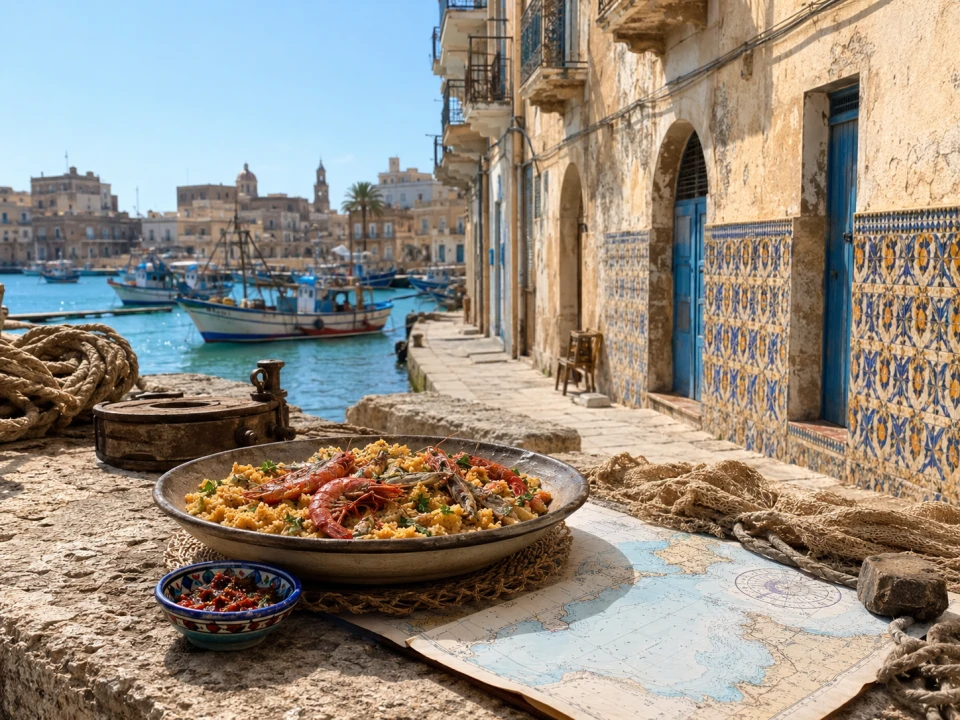
Walking through Mazara today, visitors may hear Italian, Sicilian dialect and Arabic within a few blocks. Store signs, conversations and restaurant menus reflect this multilingual environment. Couscous shares the table with pasta, while Sicilian seafood is prepared with North African spices. Second-generation residents often move naturally between different languages and identities, feeling connected to both Sicily and Tunisia.
Fishing remains the economic and symbolic link between the communities. Mazara has long been one of Italy’s leading deep-sea fishing centers, with vessels operating across the Strait of Sicily and farther into the Mediterranean. Sicilian and Tunisian fishermen have worked on the same boats, facing long voyages, dangerous waters and changing international boundaries. The city’s celebrated red shrimp has become an emblem of this maritime economy.
The sea has also delivered Mazara’s greatest archaeological treasure. In March 1998, the fishing vessel Capitan Ciccio recovered the bronze Dancing Satyr from a depth of about 1,640 feet between Pantelleria and Tunisia. Now displayed in the former Church of Sant’Egidio, the ancient Greek sculpture embodies the cultural circulation that shaped the Mediterranean for millennia.
Mazara’s identity contains many layers: Phoenician commerce, Greek art, Roman authority, Arab urban planning, Norman Christianity, Sicilian traditions and modern Tunisian migration. Church bells, Arabic voices, Baroque façades and North African foods belong to the same urban landscape.
This coexistence is not without economic pressures or social difficulties. Yet Mazara remains one of Europe’s most revealing Mediterranean laboratories – a city demonstrating that cultures separated by the sea can also be connected by it.