
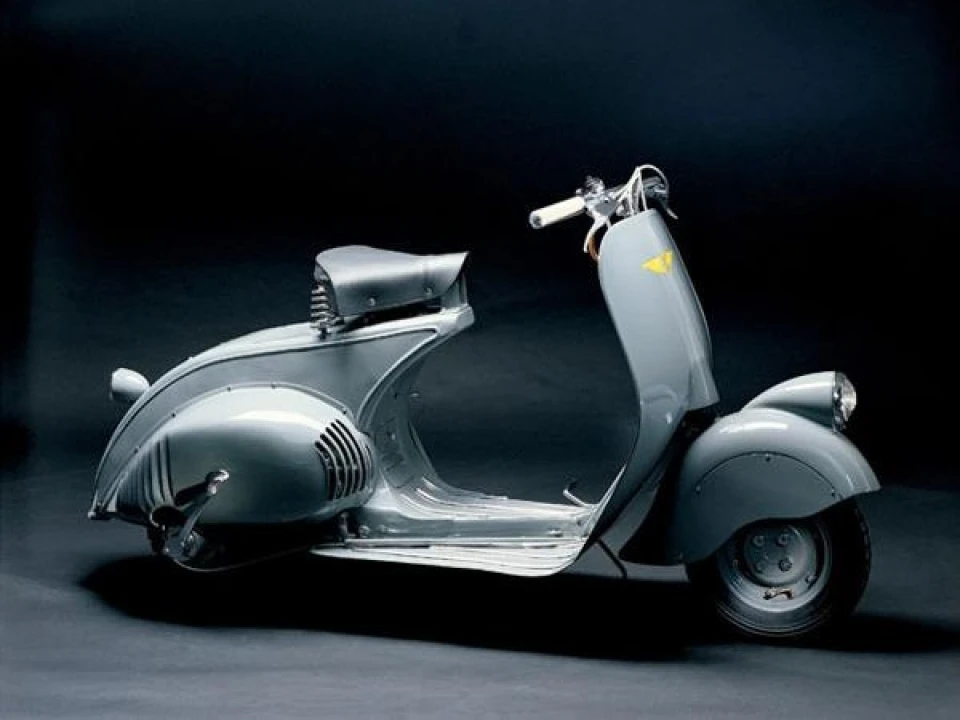

The Vespa, whose patent was filed on April 23, 1946, has turned 80. Piaggio’s legendary scooter has become an enduring icon, occupying a unique place at the crossroads of transportation, design, art, and popular culture. More than just a vehicle, the Vespa is a symbol of Italy itself – an embodiment of the Italian way of life and a remarkable piece of the nation’s history.
To fully understand what the Vespa has meant to the Italian imagination, it is necessary to begin with its origins.
In the aftermath of World War II, Italy was a nation in ruins, struggling to rebuild both its economy and its spirit. Industries that had devoted themselves to wartime production were forced to reinvent their future.
Piaggio, long known for manufacturing aircraft engines and railroad equipment, boldly entrusted the design of a new scooter to aeronautical engineer Corradino D’Ascanio, a helicopter specialist.
The innovative nature of the project was evident from the very beginning. D’Ascanio was chosen precisely because – paradoxically – he disliked motorcycles. According to popular legend, he found it inconvenient to swing a leg over a motorcycle and hated getting grease on his pants.
As a result, he created a vehicle unlike anything that existed at the time. Its self-supporting body was inspired by aircraft fuselages, featuring a flat floorboard, a front suspension derived from airplane landing gear, and a gearshift conveniently mounted on the handlebars.
The scooter was based on an aeronautical engineering principle: a lightweight yet sturdy monocoque structure that enclosed the engine while protecting its mechanical components.
The result was unlike any two-wheeled vehicle of its era. The engine was hidden from view, the wheels were small and partially covered, the front fender supported a headlight that resembled a watchful eye, and the rear fender almost skimmed the pavement. Riders could simply step aboard without climbing over a frame or staining their clothes with oil. Sitting upright in complete comfort, they controlled every function from the handlebars.
The scooter’s name originated from what has become an almost legendary story. It is said that Enrico Piaggio, upon seeing the prototype with its narrow waist and rounded body, exclaimed, “It looks like a wasp!” In Italian, wasp is vespa, and the name immediately stuck.
From the very beginning, the Vespa captured the imagination of Italians eager to embrace the future with optimism and mobility. It quickly became far more than a means of transportation. It represented freedom, hope, modernity, and a distinctive lifestyle, especially for younger generations.
The Vespa also forged an extraordinary relationship with the arts, particularly cinema.
Although it appeared in several Italian films after the war, its transformation into a global icon came with William Wyler’s 1953 masterpiece Roman Holiday. Gregory Peck riding through Rome on a Vespa, with Audrey Hepburn seated behind him, created one of the most memorable images in film history.
The scene celebrated not only romance and the beauty of the Eternal City but also an entire philosophy of life, with the Vespa playing an unforgettable supporting role.
The scooter was immortalized again in Federico Fellini’s 1960 classic La Dolce Vita, starring Marcello Mastroianni and Anita Ekberg. Equally iconic are the scenes featuring swarms of paparazzi racing through Rome aboard their Vespas.
The Vespa became one of the defining symbols of an Italy emerging from the hardships of World War II and entering the extraordinary years of the Economic Miracle. Born from Enrico Piaggio’s vision and Corradino D’Ascanio’s engineering genius, it evolved into a cultural phenomenon, crossing the invisible boundary between industrial design and fine art.
Its legacy is celebrated at the Piaggio Museum in Pontedera, housed in the former tool workshop of the company’s historic factory. Covering more than 5,000 square meters and displaying over 250 vehicles, it is Italy’s largest museum dedicated to motorcycles and scooters.
Over the decades, the Vespa has become one of the world’s greatest ambassadors of Italian design. It is displayed in museums across the globe, from the United States to Asia.
A special place belongs to New York’s Museum of Modern Art, where a 1955 Vespa GS150, designed by Corradino D’Ascanio, is part of the museum’s permanent collection.
The Vespa has accompanied the entire history of the Italian Republic. Born just weeks apart in 1946, the scooter and the Republic have grown side by side for eight decades.
Today, both the Vespa and the Italian Republic proudly celebrate their 80th anniversaries.
Film director Dino Risi often quoted French writer Paul Léautaud: “The secret is to make it past 80. After that, it’s all downhill.”
May both the Vespa and the Italian Republic continue traveling a long, happy road together – hopefully one that is, indeed, downhill.