
Design is steadily expanding its scope of activity.
For several decades now, in addition to its traditional role in the field of style, design has taken on innovative functions in technology (thus moving into territory adjacent to that of invention patents) and communication (positioning itself alongside branding).
As I have previously written in one of my essays, “contemporary design is characterized by its ability to influence three distinct aspects of the objects being designed: Form, Function, and Meaning” (Il Design Crisalide, Edizioni Mincione, 2019, p. 163).
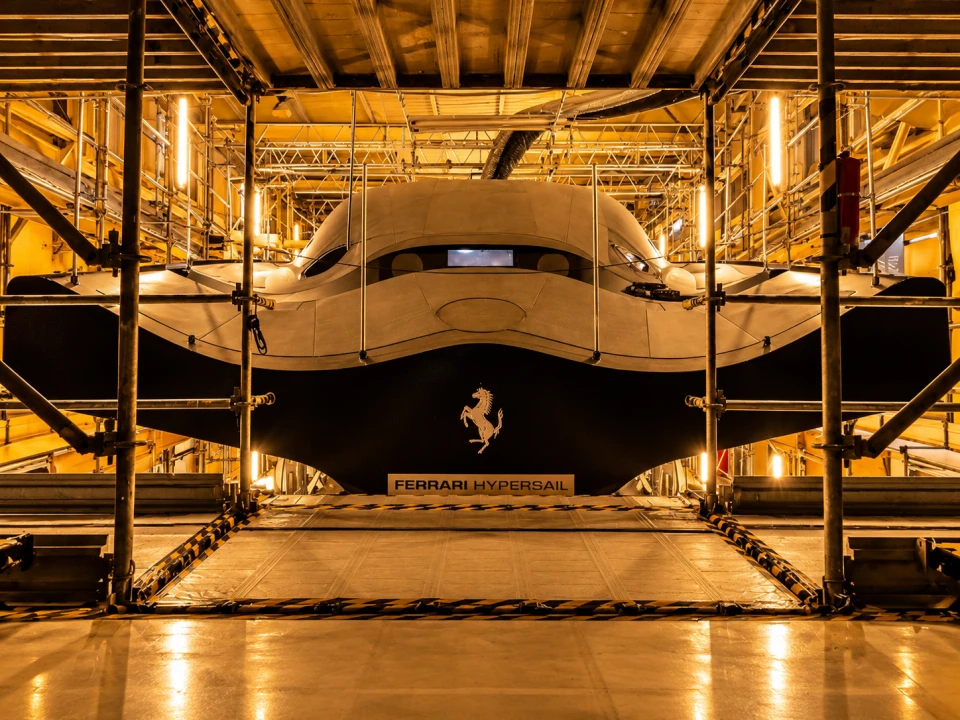
I would like to shine a spotlight on an exciting business initiative that brings these concepts together in an almost tangible way: the launch of Ferrari Hypersail, the first sailing vessel developed by the iconic company of the Prancing Horse.
In today's ocean racing landscape, competitive sailboats are undergoing a rapid and profound transformation.
Speed is becoming just one of several variables. The new and complex challenge involves multiple dimensions: materials innovation, hydrodynamic efficiency, energy sustainability, and adaptability.
These vessels are evolving into genuine experimental platforms, where composite materials, moving geometries, and predictive control systems interact to overcome the limitations of traditional monohulls.
Against this stimulating backdrop, the Maranello-based company has decided to embark on a new challenge, launching the Hypersail project, a futuristic prototype designed to pursue the Jules Verne Trophy, the historic sailing challenge that rewards the fastest nonstop, unassisted circumnavigation of the globe by a crew.
Hypersail represents much more than a vessel: it is a brand manifesto, a statement of intent in which Ferrari's expertise in high-performance sports cars is brought into the nautical world, creating a foiling monohull capable of flying above the water with stability, precision, and control.
The project incorporates a series of extreme engineering solutions: three points of lift, with a central foil paired with a canting keel, a second foil integrated into the rudder, and two lateral foils operating alternately.
This configuration allows the hull to rise above the water and travel long distances while minimizing hydrodynamic drag. The entire system is designed to operate with energy autonomy, thanks to an integrated onboard energy generation and management system.
The design of Hypersail has been entrusted to Guillaume Verdier, one of the world's leading specialists in the development of next-generation racing yachts.
Giovanni Soldini played a key role in the initial design and construction phase of Ferrari Hypersail, contributing his extensive experience in offshore sailing, ocean crossings, and record-breaking achievements. His involvement concluded with the completion of that phase. Since April 2026, Enrico Voltolini has served as the project's new Project Leader, overseeing the next stage of development, including the installation and validation of technological systems, their functional integration, and the optimization of the monohull's performance.
The project's ambition is to introduce a genuinely new paradigm in the nautical industry, creating an innovative synthesis of structural strength, lightness, aerodynamics, and mechanical intelligence.
With Hypersail, Ferrari is taking its culture of extreme performance beyond the automotive world and into an environment where every element and variable – wind, sea, and structure – demands complex engineering solutions.
At the launch of the project, John Elkann explained:
“Hypersail is a new challenge that pushes us beyond our boundaries and expands our technological horizons. At the same time, it follows in the Ferrari tradition, drawing inspiration from our Hypercar, a three-time winner of the 24 Hours of Le Mans.
Designing a boat for offshore sailing is perhaps the ultimate expression of endurance.”
The decisions concerning the location and construction of the facility where the project is physically taking shape are equally rich in significance.
Ferrari has chosen Livorno as the home of Hypersail, establishing its operational hub within the facilities of Azimut Yachts, another outstanding representative of Italian nautical excellence and design.
The headquarters are part of a broader agreement between Ferrari and Azimut. As Technical Partner of the project, Azimut will develop a 72-foot towboat designed to pull the prototype during its initial flight tests, when the vessel will not yet be equipped with a mast, rigging, or sails.
The relative proximity to Maranello, the beating heart and symbolic capital of Emilia-Romagna's Motor Valley, is both strategic and emblematic, providing an ideal location for maintaining continuous interaction with Ferrari's headquarters.
The facility will accommodate offices for engineers and the shore team, gyms and athletic training areas, as well as laboratories dedicated to hydraulic, electrical, and mechanical components and 3D printing.
The building has been designed by the Ferrari Design Studio, led by Flavio Manzoni. Its Hypersail Gray and Fly Yellow colors will echo those of the vessel, while the technical silhouette of the monohull will be reproduced at the entrance and on the roof.
“This facility was created to be the true home of the Ferrari Hypersail project, a place designed for the team's daily work and to welcome everyone involved in the initiative,” explains Enrico Voltolini, emphasizing that its location provides “the ideal conditions to further accelerate the innovation process.”
The perfect conclusion to these reflections can be found in the words of Flavio Manzoni:
“Design is not merely a formal expression, but a tool capable of generating innovation through a virtuous process of cross-pollination among different disciplines.”