
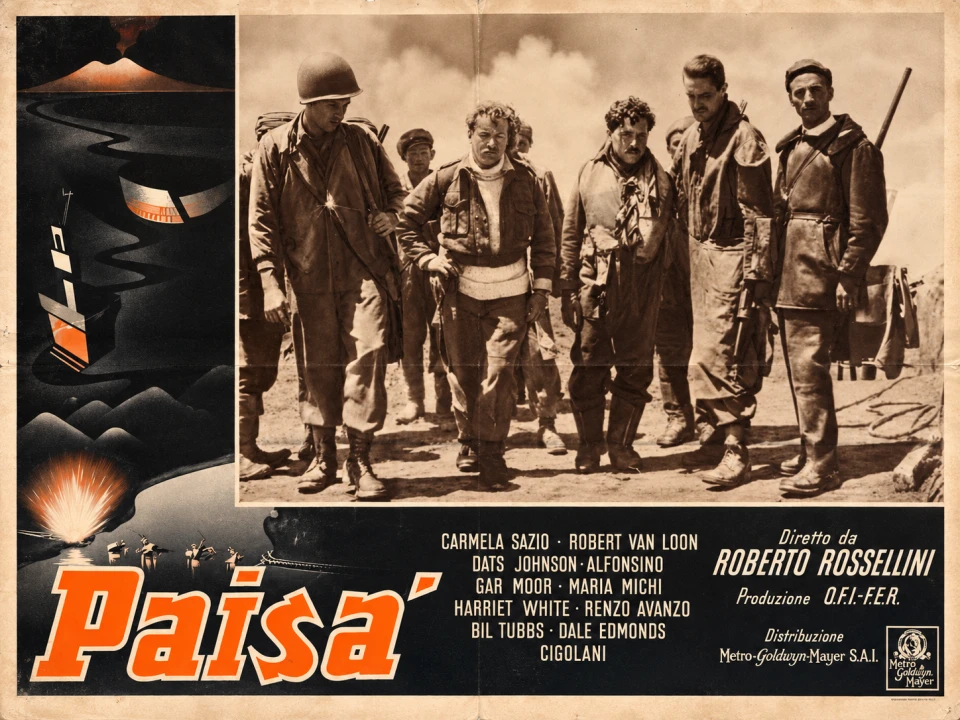

Eighty years ago, Roberto Rossellini released a film that seemed to dismantle the rules of moviemaking while the camera was rolling. “Paisà,” first presented in Venice on September 18, 1946, was neither a conventional war movie nor a traditional drama. It was cinema built from fragments – six stories, six locations, changing characters and a country that becomes the movie’s real protagonist.
Coming immediately after “Rome, Open City,” Rossellini’s international breakthrough, “Paisà” became the second chapter of the director’s celebrated War Trilogy, later completed by “Germany Year Zero.” Yet its structure was strikingly different. Instead of asking viewers to follow one group of characters, Rossellini follows the Allied advance through Italy, moving geographically from Sicily through Naples, Rome, Florence and the Apennines before reaching the Po Delta.
The result is approximately 2 hours of cinema that often looks as though fiction has accidentally wandered into a documentary.
That impression was deliberate. Rossellini filmed extensively on location and mixed professional performers with people who had little or no acting experience. Italians and Americans appear together, and their inability to understand one another becomes almost as important as the military events surrounding them. Language is not polished away for the audience’s convenience. Confusion, translation, accents and silence become dramatic material.
The filmmaking itself reinforces that rawness. Otello Martelli’s black-and-white cinematography observes bombed cities, streets, countryside and ordinary people without turning destruction into spectacle. Eraldo Da Roma edited the film, while Renzo Rossellini composed the music. The writing credits involved an extraordinary collection of talent, including Sergio Amidei and a young Federico Fellini, who also worked as an assistant director. Fellini would later become one of world cinema’s defining filmmakers.
Each episode changes the emotional temperature. In Sicily, an American soldier and a local woman struggle to communicate. Naples pairs a Black American military policeman with a street child. Rome turns a chance encounter between a soldier and a woman into a melancholy story about memory and recognition. Florence places its characters inside an urban battle. A monastery offers a quieter collision of faiths, while the final Po Delta episode strips the war down to survival and death.
What connects these stories is not plot but filmmaking. Rossellini repeatedly creates the expectation that two people might finally understand each other, then allows circumstances to interfere. Characters meet briefly and disappear. Relationships remain incomplete. There is rarely the emotional resolution audiences had been trained to expect from studio cinema.
That makes “Paisà” particularly fascinating 80 years later. Its importance is not limited to what it records about 1944–45 Italy. The film helped demonstrate that a feature could be episodic, geographically expansive and dramatically powerful without depending on stars, elaborate sets or a tightly engineered screenplay.
Its influence also traveled far beyond Italy. What became known internationally as Italian Neorealism offered filmmakers another way of looking at the world – real locations, unfamiliar faces, available light, social reality and stories discovered in ordinary life rather than imposed upon it.
The film’s international recognition followed. “Paisà” received an Academy Award nomination for its writing at the 22nd Oscars, with Alfred Hayes, Federico Fellini, Sergio Amidei, Marcello Pagliero and Roberto Rossellini credited by the Academy. Decades later, its reputation remains remarkably strong: in the 2022 Sight and Sound critics’ poll, it ranked joint No. 196 among the greatest films ever made.
And the movie itself remains accessible rather than trapped in film history. A restored version has circulated internationally, including a restoration associated with Cineteca di Bologna and CSC – Cineteca Nazionale, while Criterion has made the full original-release version available to contemporary audiences.
Eight decades after its premiere, “Paisà” still has the nervous energy of something newly invented. Rossellini did not simply make a movie about a shattered Italy. He found a cinematic language capable of looking directly at that shattered world – and trusted the camera to find stories inside it.