

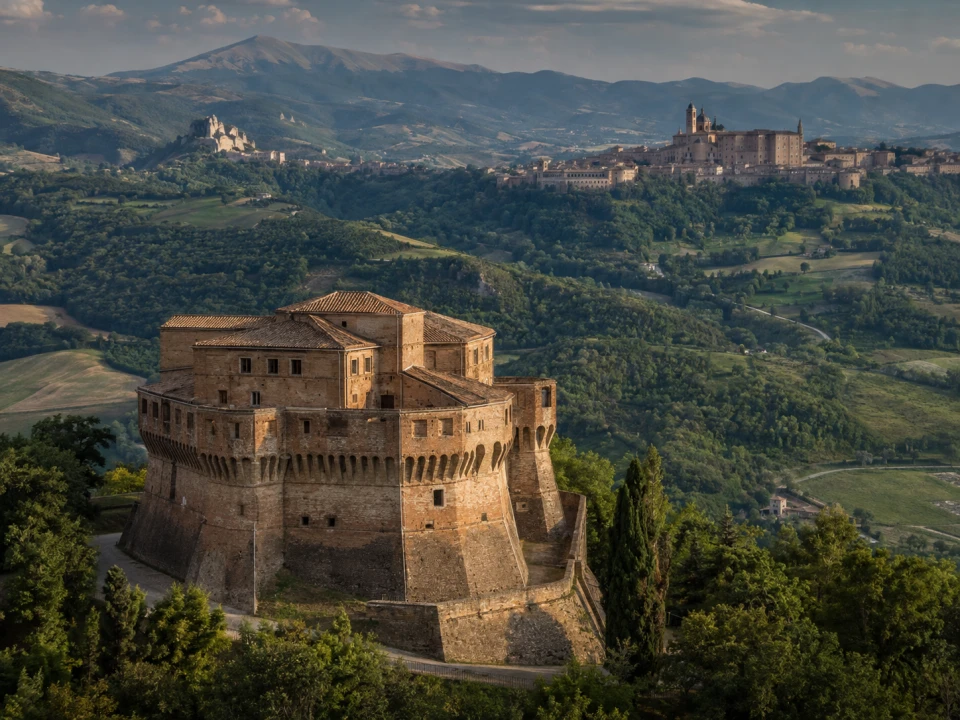

Urbino is the celebrated capital of the Italian Renaissance, but the civilization associated with Federico da Montefeltro extends far beyond its palace walls. Across the northern Marche, a landscape of ridges, valleys, fortresses and small communities preserves the geography of a state built through diplomacy, warfare and architecture.
The Montefeltro is a historical region rather than a modern administrative unit. Today, it is divided among the Marche, Emilia-Romagna, Tuscany and the Republic of San Marino. Its geographic center is formed by the Apennine hills surrounding Monte Carpegna, which rises to approximately 4,640 feet. For centuries, this difficult terrain stood between the Papal States, Tuscany and the territories controlled by the Malatesta family of Rimini.
Federico da Montefeltro, born in 1422, transformed this borderland into one of Renaissance Italy’s most sophisticated courts. A successful military commander, he used the wealth earned through warfare to support artists, architects and scholars. He became Duke of Urbino in 1474, but his power depended upon controlling roads, passes and fortified towns throughout the surrounding territory.
This political geography remains visible at Sassocorvaro. Its Rocca Ubaldinesca, designed with the involvement of Sienese architect Francesco di Giorgio Martini, has an unusual compact form often compared to a turtle. The building was associated with Ottaviano degli Ubaldini, Federico’s trusted adviser and half-brother. Its curved defensive surfaces reveal a period when military architects were adapting fortresses to withstand increasingly powerful artillery.
Centuries later, the Rocca acquired another cultural role. During World War II, superintendent Pasquale Rotondi used it as one of the secret shelters for thousands of Italian artworks threatened by bombing, theft and destruction. A Renaissance fortress created to defend territory thus helped defend Italy’s artistic memory.
Farther west, Frontino occupies a ridge overlooking the Mutino Valley. Stone houses, narrow lanes and defensive walls demonstrate how settlement patterns followed the demands of security. Nearby, the restored watermill of Ponte Vecchio recalls the agricultural economy that supported these fortified communities.
Macerata Feltria adds Roman and medieval layers to the landscape. Near the modern town are remains associated with ancient Pitinum Pisaurense, while its hilltop center reflects the instability of later centuries. Carpegna, beneath the mountain bearing its name, became the seat of a noble family whose history was closely connected to the wider Montefeltro world.
The landscape unites these places. Wooded mountains give way to cultivated slopes, pastures and river valleys. Every fortress commands a route, and almost every village occupies a defensible elevation. Architecture here cannot be separated from geography.
Traveling through the Marche’s Montefeltro therefore reveals the Renaissance as more than an artistic movement centered in Urbino. It was also a system of roads, farms, castles, alliances and carefully controlled borders. Federico’s most enduring creation was not simply a court – it was a territory in which political ambition became part of the landscape itself.