
A transatlantic research project between Italy and the United States is providing a revealing picture of how artificial intelligence is transforming the printing, converting and packaging industries on both sides of the Atlantic.
The joint study was conducted by Alliance Insights in the United States and Centro Studi Printing of Italy’s Stratego Group, using the same questionnaire in both countries. Nathan Safran, Vice President of Research at Alliance Insights, and Stefano Portolani, Senior Analyst at Centro Studi Printing, compared the results, creating a rare direct comparison between 2 important printing markets.
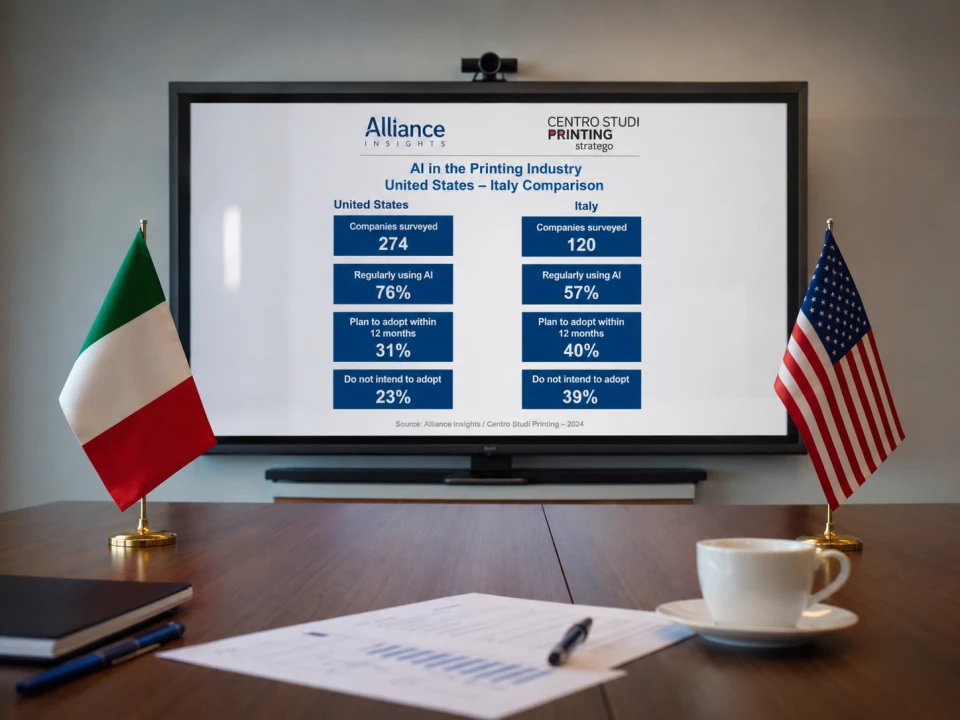
The study surveyed 274 U.S. companies and 120 Italian companies. The numbers show that American businesses currently have a clear lead: 76% of U.S. respondents say they regularly use AI, compared with 57% in Italy – a 19-percentage-point gap.
However, the Italian numbers suggest that this difference could narrow. Among companies that have not yet adopted AI, 40% of Italian respondents expect to introduce it within the next 12 months, compared with 31% in the United States.
Another revealing figure concerns companies that remain resistant to the technology. In Italy, 39% of businesses currently not using AI say they do not intend to adopt it, while the equivalent figure in the United States is 23%.
The comparison also shows that the gap is largely connected to the timing of adoption. Among companies that have been using AI for more than 5 years, the percentages in Italy and the United States are similar. The difference becomes larger among more recent adopters, reflecting America’s earlier embrace of the technology.
Beyond the individual percentages, the study demonstrates the value of Italy–U.S. cooperation in understanding technological change. Applying an identical research model to 394 companies across 2 different industrial systems makes it possible to identify both national differences and common challenges.
The United States may currently lead in AI adoption, but Italy appears to be accelerating. Together, the 2 markets offer a valuable transatlantic laboratory for understanding how artificial intelligence is moving from experimentation to a competitive tool for the printing industry.