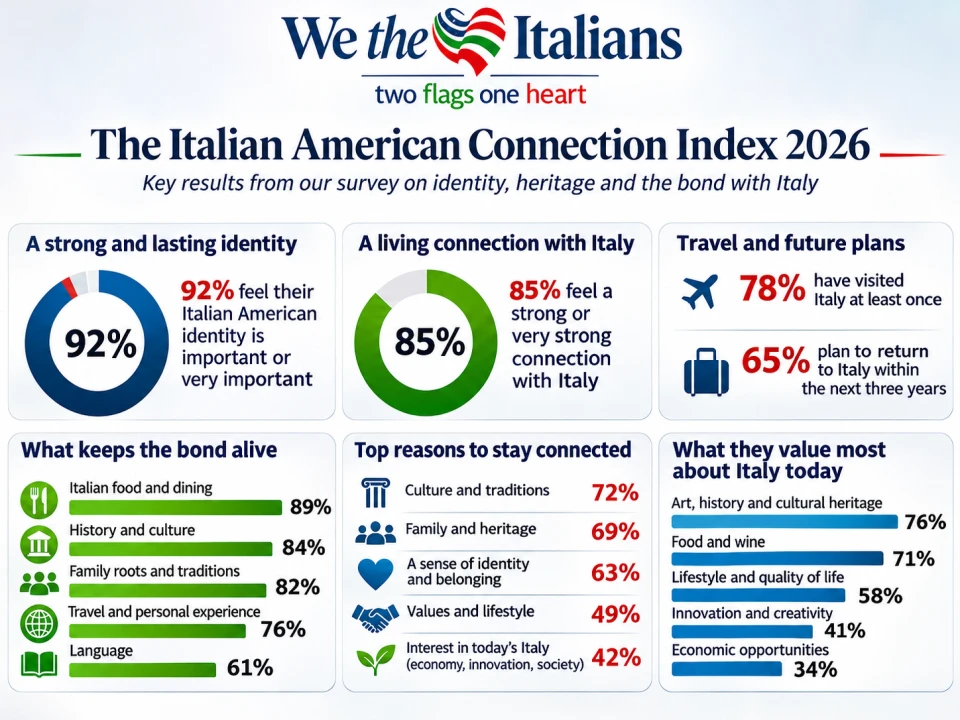
How strong is the relationship between Italian Americans and Italy today? What keeps this connection alive across generations, and what could make it stronger in the future? These questions inspired We the Italians to launch the Italian American Connection Index 2026, an initiative designed to explore how Italian heritage continues to shape identity, cultural participation, travel, language, and relationships with contemporary Italy.
Through a 10-question survey, We the Italians invited Italian Americans to share their experiences and expectations. The objective was not simply to measure pride in Italian ancestry, but to identify opportunities for cultural organizations, institutions, businesses, and communities on both sides of the Atlantic to develop stronger relationships.
The findings offer a valuable picture of the people who chose to participate. They should not be interpreted as statistically representative of the entire Italian American population. Nevertheless, the responses reveal interesting patterns, important expectations, and several possible directions for future initiatives.
Italian heritage remains a powerful part of personal identity
Among respondents, the emotional importance of Italian ancestry is unmistakable. An overwhelming 85.7% consider their Italian heritage very important, while 12.2% describe it as somewhat important. Only 2% consider it slightly important, and just 0.1% say it is not important.
This strong attachment to ancestral identity is one of the most striking findings of the survey. For the participants, Italian heritage is clearly much more than a distant historical reference.
However, an important distinction emerges when respondents are asked about their relationship with contemporary Italy. While 36.8% feel very connected to today's Italy and 37.3% somewhat connected, 20.7% feel only slightly connected and 5.2% report no connection.
The difference between attachment to Italian heritage and engagement with contemporary Italy deserves particular attention. It suggests that celebrating ancestry and strengthening relationships with the country as it exists today are related but distinct objectives.
Italian American identity can be deeply rooted in family traditions, historical memories, and cultural experiences passed down through generations. Building a relationship with modern Italy, however, may require additional opportunities to encounter its people, institutions, economy, language, and evolving society.
For organizations working to connect the two countries, this distinction represents an important opportunity.
Cultural participation is already part of everyday life
The survey also reveals a high level of cultural engagement among participants.
Some 62.9% engage with Italian or Italian American culture at least once a week, while 19% do so monthly. Another 14% participate a few times a year, and only 4% rarely or never engage.
These figures describe a particularly active group of respondents, for whom Italian culture is not confined to occasional celebrations.
The ways participants stay informed about Italy are equally revealing. Digital platforms are the primary source for 56.2%, followed by Italian or Italian American organizations and events at 22.6%. Family and friends account for 14%, while newspapers and television represent 7.2%.
The prominence of digital information suggests that online communication can play a significant role in maintaining transatlantic relationships, particularly when it provides access to reliable information about contemporary Italian life.
Digital platforms also offer opportunities to connect people who do not live near established Italian American communities or who cannot regularly attend cultural events.
At the same time, the importance of organizations and personal relationships demonstrates that the connection with Italy remains both digital and deeply human.
The generational challenge: preserving heritage while reaching younger Italian Americans
One of the most important aspects of the survey is the age distribution of its participants.
A substantial 76.8% were born before 1965, while 18.2% were born between 1965 and 1980. Only 4.3% were born between 1981 and 1996, and just 0.7% between 1997 and 2012.
This distribution requires careful interpretation. It does not demonstrate that younger Italian Americans are less interested in their heritage. Rather, it shows that younger generations were considerably less represented among those who responded to this particular survey.
Consequently, the findings primarily reflect the experiences and priorities of older participants.
That distinction matters because Italian American identity has developed through different historical experiences.
For many older Italian Americans, the connection with Italy may be associated with parents or grandparents who emigrated, family stories, traditional celebrations, regional customs, and organizations that have served communities for decades.
Younger generations may encounter their heritage through different channels, including university programs, digital communities, contemporary Italian culture, professional exchanges, study abroad, travel, and personal research into family origins.
These possibilities should be explored through additional research rather than assumed from the present results.
The survey therefore raises an important question for future editions of the Italian American Connection Index: how do younger Italian Americans define their relationship with Italy, and which opportunities would encourage them to strengthen it?
A more balanced generational sample, together with comparisons between age groups, could help identify differences in language proficiency, cultural participation, travel habits, and expectations.
For Italian American organizations, reaching younger audiences is not simply a question of replacing traditional activities with digital alternatives. It may involve creating opportunities that connect heritage with education, careers, entrepreneurship, creativity, and contemporary experiences.
The challenge is to ensure that Italian American identity remains meaningful not only as a memory of the past, but also as a source of opportunities for the future.
Ancestral geography: the importance of Italy's regions
The survey offers an especially interesting picture of the geographic origins reported by participants.
Sicily leads with 34.8%, followed by Campania at 23.5%, Calabria at 16.9%, and Abruzzo at 14%. Puglia accounts for 8.4%, while Lazio and Tuscany each represent 5.4%.
Other reported origins include Basilicata (5.2%), Molise (4.1%), Marche (3.1%), Veneto (2.7%), Emilia-Romagna and Liguria (2.6% each), Lombardy (2.4%), Piedmont (2.1%), Friuli Venezia Giulia (1.9%), Umbria and Sardinia (0.9% each), Trentino-Alto Adige (0.7%), and Valle d'Aosta (0.3%).
Another 2.6% were uncertain about their ancestral region.
Since participants could indicate multiple regions, the percentages do not total 100%.
The strong presence of Sicily, Campania, Calabria, and Abruzzo is consistent with the historical importance of southern Italy in migration to the United States, although the survey's distribution cannot be used to establish the geographic composition of Italian American ancestry as a whole.
What makes these findings particularly interesting is the relationship between regional origins and travel preferences.
When asked which destinations they would prioritize in Italy, 59.8% selected their ancestral region. Another 15.9% expressed no particular geographic preference, 14.3% favored small towns and rural areas, and 10% preferred major cities.
For a substantial share of respondents, therefore, traveling to Italy is closely associated with discovering or rediscovering the places connected to their family history.
This preference creates opportunities for Italian regions, municipalities, tourism organizations, and cultural institutions.
Traditional tourism promotion often emphasizes Italy's internationally famous destinations. Yet the interest expressed by survey participants suggests that ancestral travel could also direct attention toward smaller communities and territories that receive less international visibility.
A journey to an ancestral village can involve much more than sightseeing. It may include discovering family documents, visiting churches and cemeteries, meeting distant relatives, learning about local traditions, and understanding the historical circumstances that led previous generations to emigrate.
These experiences can transform an inherited identity into a direct personal relationship with a specific Italian territory.
Travel as a bridge between heritage and contemporary Italy
The participants' travel histories show different levels of direct experience with Italy.
Some 29.8% visited the country during the previous 12 months, while 25.6% traveled there within the past five years. Another 30.3% last visited more than five years ago, and 14.3% have never been to Italy.
These results indicate that many respondents have firsthand experience with their ancestral homeland, while others have not visited recently or have never had the opportunity.
The combination of strong emotional attachment and different travel histories suggests potential for initiatives designed to make visits more accessible, meaningful, and connected to local communities.
Programs could bring together ancestral research, regional cultural experiences, language learning, and opportunities to establish relationships with residents.
For participants who have never visited Italy, introductory heritage journeys could provide a first opportunity to discover both their family origins and the country today.
For those who have already traveled, more specialized experiences could encourage return visits, including longer stays, regional itineraries, educational programs, and professional exchanges.
There is also potential for cooperation between Italian American associations and Italian municipalities, particularly in communities historically connected to emigration.
Such initiatives could benefit both sides: Italian Americans would gain access to meaningful experiences, while Italian territories could develop enduring international relationships.
Language: a connection worth strengthening
Language is another important element of the relationship with Italy.
Among survey participants, 48.1% report basic knowledge of Italian, 16.2% conversational ability, and 19.2% good or fluent proficiency. Another 16.6% did not provide an answer.
These figures indicate different levels of linguistic familiarity, but they also suggest considerable potential interest in language-related initiatives.
Italian language education can serve multiple purposes. It can help people communicate with relatives, travel more independently, access Italian cultural content, and develop a closer relationship with contemporary society.
Language learning may also offer opportunities for intergenerational engagement.
Courses designed specifically for Italian Americans could combine practical communication with family history, regional traditions, and contemporary Italian culture.
Online programs could make these opportunities accessible beyond the major metropolitan areas traditionally associated with Italian American communities.
At the same time, language initiatives could be connected to travel, encouraging participants to practice Italian during visits to their ancestral regions.
The objective would not necessarily be fluency for everyone, but rather providing different pathways for strengthening the relationship with Italy according to individual interests and abilities.
Community organizations: an opportunity to engage more people
Italian American organizations have historically played an important role in preserving cultural traditions, promoting solidarity, and maintaining relationships with Italy.
The survey suggests that they remain relevant among respondents, while also highlighting opportunities for greater participation.
Some 28.5% are active members of Italian American organizations, and another 19% participate occasionally.
Perhaps the most interesting figure is the 38.9% who are not currently members but would consider joining. Only 13.6% express no interest.
This means that almost four in ten respondents represent a potential audience for organizations seeking to expand their membership and activities.
Their interest should not automatically be interpreted as a commitment to join, but it indicates openness to greater involvement.
The challenge for organizations may therefore be not only to preserve their traditional activities, but also to communicate clearly the benefits of participation.
Educational initiatives, cultural exchanges, networking opportunities, travel programs, and activities connected to contemporary Italy could complement established celebrations and community events.
The survey also provides direct indications of which activities respondents believe could strengthen their relationship with Italy.
Italian American community events lead with 30.9%, followed by cultural and language programs at 25.5%. Travel, relocation, study, or business opportunities account for 23.5%, while news about contemporary Italy represents 20.2%.
These preferences suggest that respondents value both community-based activities and direct opportunities for engagement with Italy.
They also point toward a broader understanding of what Italian American organizations can offer.
Preserving heritage remains important, but connecting people to educational, cultural, professional, and personal opportunities may become an increasingly valuable part of their mission.
Family relationships continue to connect the two countries
Family ties remain another important dimension of the connection with Italy.
Among respondents, 32.3% regularly communicate with close relatives living in Italy, while 17.7% have close relatives there but communicate infrequently.
Another 29.6% report having other relatives in Italy, and 20.3% have none.
These figures reveal different forms of family connection, ranging from regular personal contact to more distant genealogical relationships.
For those who maintain direct communication, family relationships can provide an ongoing connection with Italian society.
For others, the relationship may depend more heavily on cultural organizations, travel, language programs, or independent research into family history.
This distinction creates another opportunity for institutions interested in strengthening transatlantic relationships.
Genealogical research, local archives, community partnerships, and programs connecting descendants of emigrants with their ancestral municipalities could help individuals develop relationships with Italy even when direct family contacts are limited or absent.
Who participated in the survey?
Understanding the respondents' characteristics is essential to interpreting the results.
Geographically, participants were distributed across the East (19.6%), New York (18.3%), South (17.2%), West (16.9%), Midwest (14.4%), and New England (12.6%). Another 1% participated from outside the United States.
Men represented 54.6% of respondents and women 45.4%.
Regarding citizenship, 82.1% reported holding only US citizenship, while 17.9% held dual Italian-US citizenship.
These characteristics provide useful context but should not be interpreted as reflecting the broader Italian American population.
In particular, the strong concentration of older respondents may influence the patterns observed in cultural engagement, organizational participation, family relationships, and travel.
Future editions could benefit from additional outreach to younger generations and from more detailed comparisons across geographic areas, age groups, and levels of connection with Italy.
Such developments would help distinguish the preferences of different groups and provide more targeted guidance for organizations and institutions.
From survey results to concrete initiatives
Beyond describing the experiences of participants, the Italian American Connection Index 2026 can serve as a starting point for identifying practical initiatives.
Several possibilities emerge from the responses.
First, Italian American organizations could develop more structured partnerships with Italian regions and municipalities, particularly those historically connected to emigration.
These partnerships could support heritage tourism, cultural exchanges, local history projects, and opportunities for direct interaction between Italian Americans and residents of their ancestral territories.
Second, Italian language programs could be expanded through digital platforms, community organizations, universities, and cultural institutions.
Third, travel initiatives could combine ancestral discovery with experiences of contemporary Italy, allowing participants to explore family history while engaging with the country's present-day culture and society.
Fourth, organizations could develop activities specifically designed to attract younger generations, including professional networking, educational exchanges, entrepreneurship programs, and opportunities connected to Italian innovation and creativity.
Fifth, greater access to news and information about contemporary Italy could help bridge the distance between inherited cultural identity and direct knowledge of the country today.
Finally, Italian American organizations could explore new forms of participation for people who express interest in joining but have not yet become members.
Flexible membership models, online activities, collaborative projects, and programs with tangible educational or professional benefits could help translate potential interest into sustained engagement.
These initiatives are possible responses to the interests expressed in the survey, rather than programs whose effectiveness has already been demonstrated by its findings.
Their development would require cooperation among Italian American organizations, Italian institutions, universities, businesses, cultural associations, and local communities.
Looking ahead: a relationship that can continue to grow
The Italian American Connection Index 2026 highlights a strong attachment to Italian heritage among those who participated.
It also reveals a relationship with contemporary Italy that varies in intensity, different levels of language proficiency and travel experience, substantial cultural engagement, and openness to new opportunities for participation.
The findings offer several useful lessons.
Italian heritage remains deeply meaningful to this group of respondents, but preserving cultural identity and developing direct relationships with contemporary Italy are not necessarily the same thing.
Regional origins represent a particularly promising connection, especially when ancestral travel can bring people into contact with the communities from which their families originated.
Community organizations remain important, while the interest expressed by potential new members suggests room for expansion.
Digital communication offers additional opportunities to reach people beyond traditional organizational networks.
And perhaps most importantly, the limited participation of younger generations in this survey highlights the need for further research and new approaches to engagement.
For We the Italians, the Index represents a listening initiative that can be developed over time. Future editions could broaden participation, explore generational differences more systematically, and measure how relationships with Italy evolve.
The objective is not to assume that all Italian Americans share the same experiences, priorities, or expectations. It is to understand the diversity of those relationships and identify ways to strengthen them.
The responses collected in 2026 suggest that, for many participants, Italy is much more than the country from which their ancestors departed.
It is a place they continue to identify with, visit, learn about, and seek to understand.
The opportunity for the future is to transform that attachment into an increasingly active relationship between people, communities, institutions, and territories on both sides of the Atlantic.
Because the connection between Italy and Italian America is not only a story of the past. It can also be a project for the future.
Two Flags, One Heart.