

Transatlantic Enlightenment explores the shared Enlightenment heritage linking Italy and the United States, from the eighteenth century to the present. Each article examines the ideas, people, institutions, that have shaped this enduring transatlantic dialogue. (Edited by Amedeo Arena)
«Sapere aude!» — “dare to know,” or “have the courage to use your own intelligence.” With these words, borrowed from Horace and made famous by Immanuel Kant, an entire age announced its ambition. The Enlightenment would be, above all, an act of intellectual courage.
In England, it took shape in the decades that followed the Glorious Revolution of 1688–89. The deposition of James II ushered in a climate of tolerance, a freer press and an appetite for new ideas, and the eighteenth century soon earned its title as the “century of light.”
Isaac Newton had already laid its scientific foundations with the Mathematical Principles of Natural Philosophy (1687). In France, Voltaire defended tolerance and assailed religious obscurantism, Rousseau reimagined politics and education around social equality, and Diderot — together with d’Alembert — devoted two decades, between 1751 and 1772, to the Encyclopédie, that vast enterprise meant to gather and diffuse the whole of human knowledge. “Ignorance,” Diderot wrote in 1769, “is less distant from the truth than prejudice.” The aim was at once simple and revolutionary: to place knowledge within everyone’s reach, and so to improve society.
In Italy, the movement matured in the second half of the century, turning its energies to administrative and economic reform against the entrenched power of the Church and the privileges of nobility and clergy. Its geography was as fragmented as the peninsula itself. Habsburg Lombardy became one of its brightest centers: in Milan the Verri brothers and Cesare Beccaria gathered around the journal Il Caffè, and Beccaria’s On Crimes and Punishments (1764) would furnish Thomas Jefferson with inspiration for the laws of the new American republic. In the Grand Duchy of Tuscany, Peter Leopold of Habsburg-Lorraine became, in 1786, the first ruler in the world to abolish the death penalty. The Bourbon Kingdom of Naples and Sicily sought to curb the Church and reform taxation, though it labored against a deep feudal backwardness, while the Savoyard Kingdom of Sardinia, the conservative Papal State, the oligarchic republics of Venice and Genoa, and the minor duchies of Parma and Modena each met the new ideas in their own measure.
Across the Atlantic, the pre-Enlightenment decades of the seventeenth and early eighteenth centuries found the continent divided into thirteen colonies, founded between 1607 and 1732 and ranged along three distinct regions. The northern colonies of New England — Massachusetts, New Hampshire, Connecticut and Rhode Island — were marked by a conservative society and a rigid Puritan fundamentalism. The middle colonies — New York, New Jersey, Pennsylvania and Delaware — prospered through mixed agriculture and busy commercial centers. The southern colonies — Virginia, Maryland, the Carolinas and Georgia — rested on a backward economy of tobacco plantations and the exploitation of enslaved labor.
The turn towards Enlightenment came in the eighteenth century, when Benjamin Franklin championed secular education and scientific academies and so prepared the ground for the American Revolution. Franklin would be remembered, alongside Thomas Jefferson, as a Founding Father who rebuilt the nation upon the cardinal principles of the age: reason, liberty and progress.
The architecture of those early colonies told the same story of necessity before beauty. Predominantly rural, it answered the demands of climate and survival rather than any strict aesthetic canon. The first homes of English and Dutch settlers — built from the early seventeenth century into the nineteenth — followed the materials at hand. The Early English period favored timber-framed buildings with steeply pitched roofs and massive central chimneys, such as Salem’s Corwin House of 1660, their windows small and leaded for want of glass. Dutch settlers in the Hudson Valley raised the gambrel and double-sloped roofs that still mark the region. In the south and along the Mississippi, Spanish and French builders adapted to the heat with deep porches, broad galleries and locally quarried stone — the coquina of Florida from around 1700, or the raised, pillared houses of the Louisiana valley such as Destrehan Plantation.
The shift to Georgian architecture around 1700, and then to the Palladian manner of the 1740s and 1750s, announced the Enlightenment’s arrival in American building. Its inspiration was Andrea Palladio, the Italian architect born in Padua in 1508, who had worked through the Renaissance to become one of the supreme masters of his art. Renaissance and Enlightenment were the two cultural cornerstones that set human reason at the center of the world, yet to different ends: where the Renaissance exalted man’s creative power, the Enlightenment turned science to the reform of society.
Palladio’s hold on Enlightenment thought sprang from an architecture grounded in rationality, geometry and function. In his buildings and in his treatise, The Four Books of Architecture, the thinkers of the eighteenth century found an authenticity and a moral discipline that stood in deliberate contrast to the decorative exuberance of the Baroque.
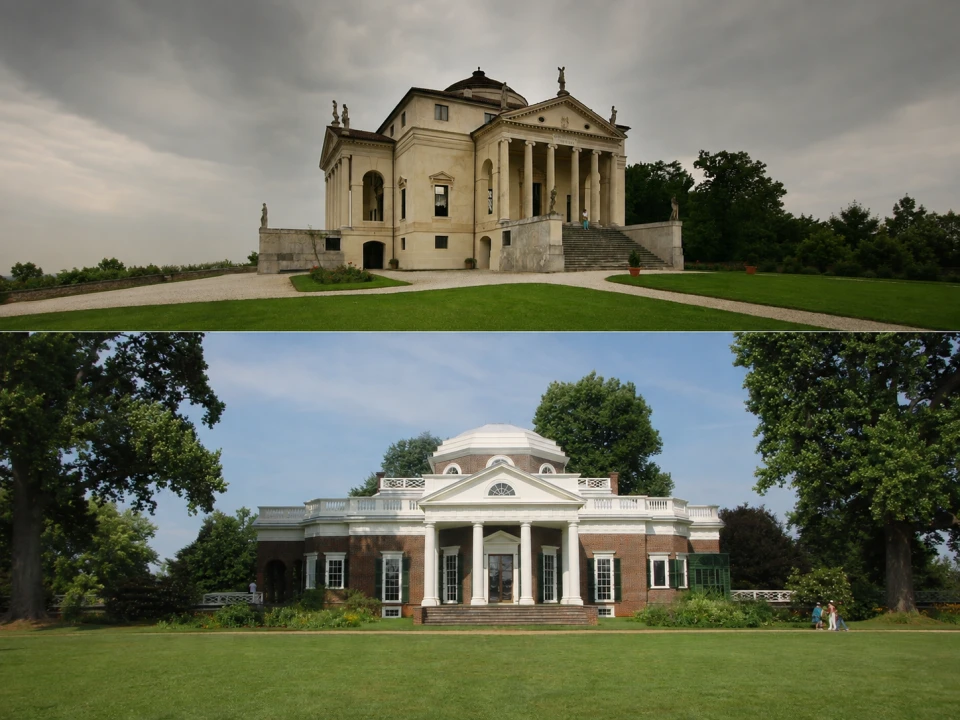
Arguably, nowhere was the bond between Palladian form and Enlightenment ideals stronger than in America, and in America no figure embodied it more fully than Thomas Jefferson. The third President of the United States looked to Palladio as a guide, seeing in classical architecture the perfect expression of democracy, secularism, order and republican virtue. His journey to Italy in 1787 further nourished his fascination with Italian art and architecture. The Villa Rotonda near Vicenza would become one of the great models behind his own house at Monticello, in Virginia. In the closing decades of the century, he became the foremost American champion of Palladianism, regarding it as the ideal architectural language for the young republic. His later designs for the University of Virginia remain a landmark in the encounter between Palladio’s Italian architecture and American neoclassicism.
* Architect; Past President of the “Pantheon” Chapter of the Order Sons and Daughters of Italy in America
Image: Villa La Rotonda, designed by Andrea Palladio, Vicenza, Veneto, Italy (above), and Monticello, Thomas Jefferson’s home, Charlottesville, Virginia, USA (below). Source: Wikipedia.