



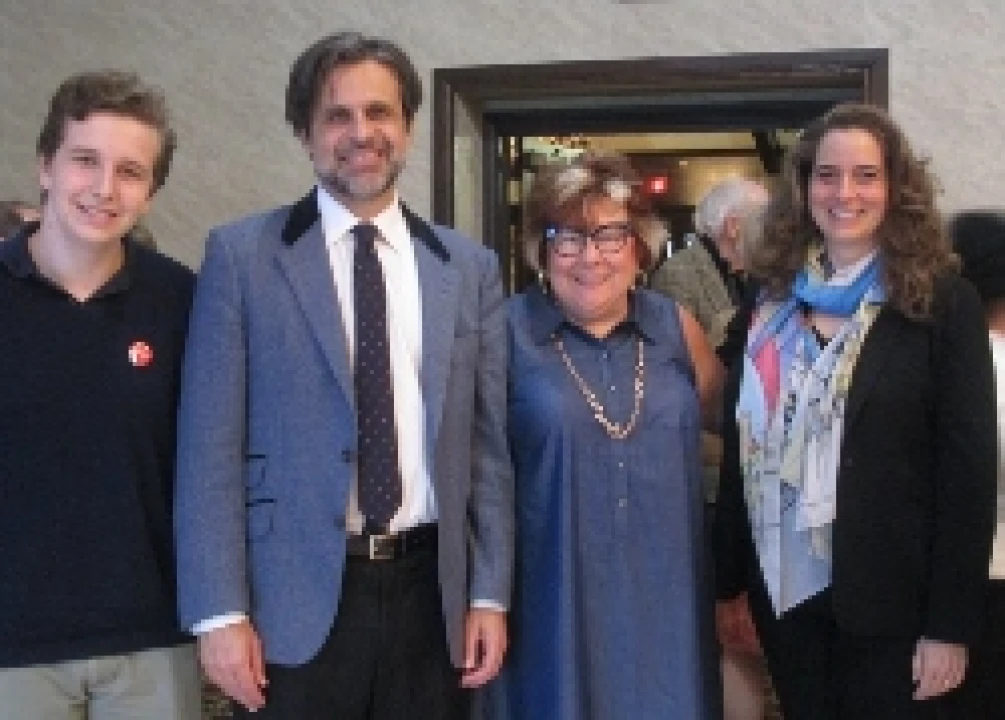
by Sandra Tornberg
Dr. Salvador Salort-Pons, Director, President and CEO of the Detroit Institute of Arts, visited the Italian American Cultural Society Banquet and Conference Center on June 9. He shared his background and described the path that led him to the DIA. A native of Madrid, he has a Master's Degree in geography and history from the University of Madrid. He spent six years studying and working in Italy, earning a doctorate in Art History from the University of Bologna before returning to Spain, where he took a position as Assistant Professor of Geography and History at the University of Madrid.
When presented with the opportunity to come to the United States to work in a museum, Dr. Salort-Pons seized it, though it meant giving up what would have been a lifelong position at the University. He accepted the position of senior curator at Meadows Museum at Southern Methodist University in Dallas, and also pursued a Master's in Business Administration while there. He shared that the MBA has helped him immensely in his career, noting that museums in the U.S. are run like businesses, unlike in Europe where funding is guaranteed by the state.
In 2008 Dr. Salort-Pons came to the DIA as assistant curator of European paintings, commenting that he spent his first three months working in the basement storage area. He was named head of the European art department in 2011, adding the role of executive director of Collection Strategies and Information in 2013. He was appointed director, president and CEO in October 2015, succeeding Graham W. J. Beal, who retired as director on June 30, 2015.
Dr. Salort-Pons told the audience that the DIA was the first museum in the U.S. to acquire a Van Gogh and a Matisse, and that he considers the Diego Rivera frescoes "the Sistine Chapel of Detroit." The DIA has an African American art collection second only to the Metropolitan Museum of Art in New York. In 2015, the Wall Street Journal named the DIA the world's most visitor-friendly museum. Dr. Salort-Pons feels that one day in the future, Detroit will be regarded as a center f art the way we view Florence today.
He stated that the passage of the tri-county millage has changed the culture of the DIA, giving it an outward focus. The museum's local and regional communities are engaged with such programs as Inside Out, which brings reproductions of great treasures from the DIA to the communities, DIA Away: Think Like an Artist, a free, mobile interactive classroom and a creative exploration space for people of all ages,
and Senior Thursdays.
Dr. Salort-Pons informed the audience that many discoveries were made during the bankruptcy process. One example is that The Wedding Dance, a 1566 oil-on-panel painting by the Flemish artist Pieter Bruegel the Elder, is invaluable. It was discovered by DIA director William R. Valentiner in England in 1930 and purchased for $35,075. Another fact that came to light was in regard to the Robert Tannahill collection of 400 paintings. There was a restriction on the gift stating that none of the paintings could be sold, or the entire collection would have to move to the Art Institute of Chicago.
Dr. Salort-Pons cited three positive consequences of the bankruptcy. The DIA is now independent of the city of Detroit, for the first time since 1919. The museum received an enormous amount of free publicity, and
has been recognized as a powerful force in the city's revitalization. In addition he shared the following goals: to achieve financial stability, growing the endowment from $127 million to $400 million in the next seven years; to become the art museum "industry leader"; and to expand the visitor centered approach and make the collection relevant to a broad and diverse audience.
Dr. Salort-Pons envisions the DIA as the main square of the community, similar to an Italian piazza, where all will be welcomed, represented and united.
