



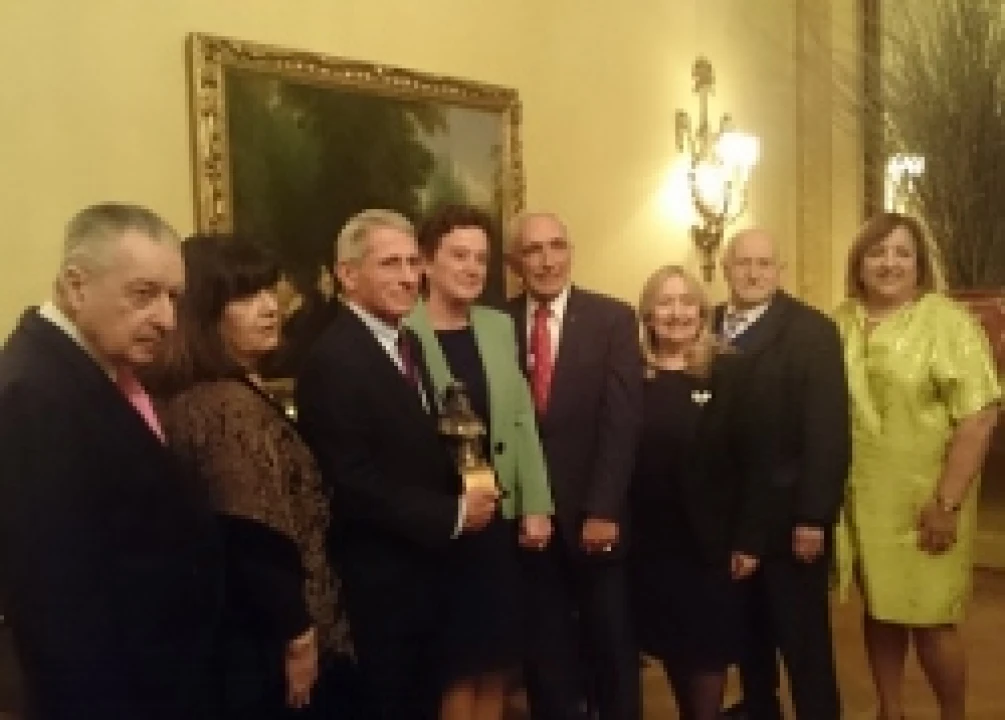
The Italian Heritage and Culture Committee of New York, Inc. (IHCC-NY) took part in a memorable evening in the presence of the distinguished Italian American scientist Dr. Anthony S. Fauci in May 2016, at a well-attended, reception at the Columbus Citizens Foundation in New York City. On the occasion of Dr. Fauci's visit to New York, the committee was able to present in person its DaVinci award that was conferred upon Dr. Fauci previously.
This annual award is given to accomplished Italian or Italian Americans in recognition of their significant contributions in varied fields of endeavor. Some of the previous awardees have included Giulio Terzi di Sant'Agata, former Italian Minister of Foreign Affairs; Gr. Uff. Matilda Raffa Cuomo, founder of Mentoring, USA; Michael Massimino, astronaut; and Cav. Prof Mario Fratti, International author and Tony award winning playwright, among others.
Dr. Fauci was recognized by the IHCC-NY for his renowned research and study in the field of immunology. His research has involved efforts to prevent, diagnose, and treat established infectious diseases such as HIV/AIDS, respiratory infections, diarrheal diseases, tuberculosis and malaria, and more recently the emerging diseases, Ebola and Zika. Dr. Fauci's impressive medical achievements that assist millions of people worldwide are an ongoing and enduring testimony to his belief that everyone has the moral responsibility for others.
Joseph Sciame, chair/president of the IHCC-NY, Inc., who was joined in the presentation of the award with members of the Board of Directors, commented: "We were delighted to present this award to Dr. Fauci in view of his contributions to the field of science, for in the past we have held themes in that regard. He is the quintessential recipient of such an award, and to be in his presence made it so very special for our Board members and me. I have always considered Dr. Fauci, one of America's real heroes for the saving of lives of so many."
Dr. Fauci, one of New York's own, was born in Brooklyn, New York. He attended Regis High School in New York City and went on to attend the College of the Holy Cross. He received his medical degree from Cornell University Medical College in 1966. He then completed an internship and residency at The New York Hospital-Cornell Medical Center.
In 1968, he began his career at the National Institutes of Health (NIH). After other appointments at NIH, he became Director of the National Institute of Allergy and Infectious Diseases (NIAID) in 1984. Dr. Fauci has made many significant contributions to basic and clinical research on the pathogenesis and treatment of immune‐related and infectious diseases, particularly HIV/AIDS. He has made seminal contributions to the understanding of how HIV destroys the body's defenses leading to its susceptibility to deadly infections.
Further, he has been instrumental in developing highly effective strategies for the therapy of patients living with HIV/AIDS, as well as for a vaccine to present HIV infection. Dr. Fauci was one of the principal architects of the President's Emergency Plan for AIDS Relief (PEPFAR), which has already been responsible for saving millions of lives throughout the developing world. NIAID also supports research on transplantation and immune-related illnesses, including autoimmune disorders, asthma and allergies.
Dr. Fauci has delivered major lectures all over the world and is the recipient of numerous prestigious awards, including the Presidential Medal of Freedom, the National Medal of Science, the George M. Kober Medal of the Association of American Physicians, the Mary Woodard Lasker Award for Public Service, the Albany Medical Center Prize in Medicine and Biomedical Research, the Robert Koch Gold Medal, the Prince Mahidol Award. He has received 42 honorary doctoral degrees from universities in the United States and abroad!
Dr. Fauci is a member of the National Academy of Sciences, the American Academy of Arts and Sciences, the Institute of Medicine, and the American Philosophical Society, as well as other professional societies including the American College of Physicians, The American Society for Clinical Investigation, the Association of American Physicians, the Infectious Diseases Society of America, the American Association of Immunologists, and the American Academy of Allergy, Asthma & Immunology. He serves on the editorial boards of many scientific journals; as an editor of Harrisonʹs Principles of Internal Medicine; and as author, coauthor, or editor of more than 1,280 scientific publications, including several textbooks.
