
Transatlantic Enlightenment explores the shared Enlightenment heritage linking Italy and the United States, from the eighteenth century to the present. Each article examines the ideas, people, institutions, that have shaped this enduring transatlantic dialogue. (Edited by Amedeo Arena)
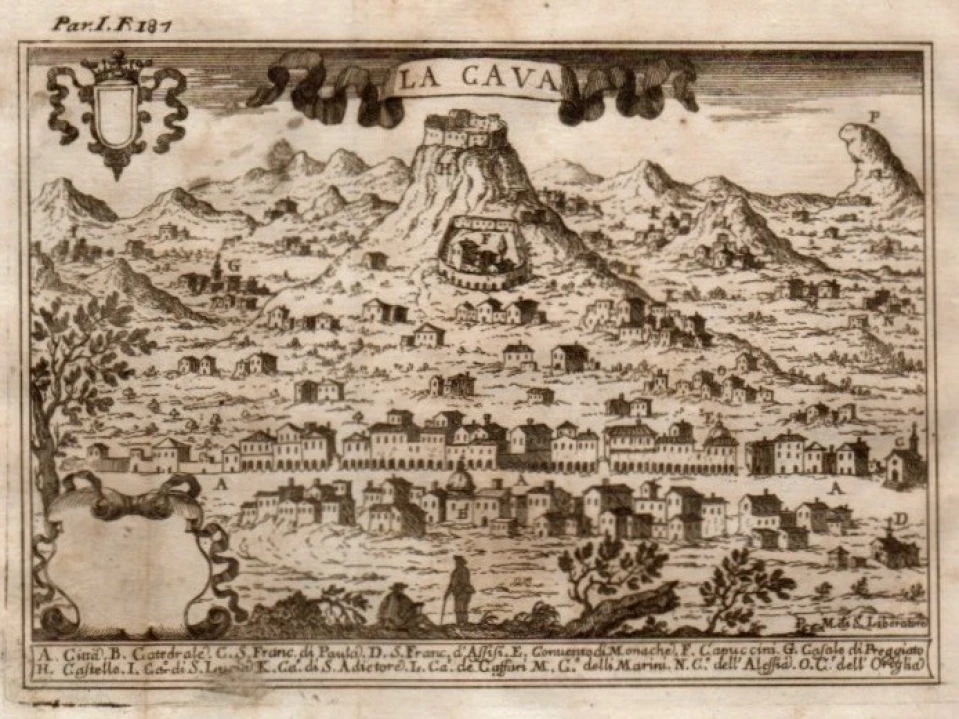
On 27 July 1783, shortly after their wedding, Gaetano Filangieri and Charlotte Frendel set out for Cava de’ Tirreni. “La Cava”, as it was then known, lay about twenty-five miles from Naples, in a picturesque valley between the Amalfi Coast and the fertile hinterland of the Agro Nocerino-Sarnese. For Filangieri, this was, in a sense, a return to his roots: his family claimed descent from Angerio, a Norman knight said to have held the castle of Sant’Adjutore in Cava in the eleventh century.
Built in the Lombard era, the castle survived for centuries before being destroyed in 1943 during Operation Avalanche, amid fierce fighting between German troops and the advancing Anglo-American forces. Many of the fallen were left unburied. In the following years, a local woman, Lucia Apicella – affectionately known as “Mamma Lucia” – undertook to recover their remains and arrange their return to their homelands. Her humanitarian work earned her the Gold Medal for Civil Merit. Rebuilt after the war, the castle once again overlooks the town and its porticoed Borgo Scacciaventi, which formed part of an important route linking Naples and Salerno.
Long before those events, Cava and its landscape had enchanted eighteenth-century travellers on the Grand Tour. Among them was Johann Wolfgang von Goethe, who met Filangieri in Naples and discussed with him the Science of Legislation, along with the works of Montesquieu, Beccaria and Giambattista Vico. In an entry in his Italian Journey dated 5 March 1787, Goethe observed that Filangieri “shines with great grace in his every word and gesture”, striving “for the good of mankind joined with an honest freedom”.
Filangieri’s presence made Cava a place of pilgrimage for European scholars and writers. Among his visitors was the Danish theologian and Freemason Friedrich Münter, a member of the Bavarian Illuminati. In Naples, Münter formed ties with figures who would shape the reforms and revolutionary movements of the following decades: Francesco Mario Pagano, who would draft the constitution of the Neapolitan Republic of 1799, Eleonora de Fonseca Pimentel, Domenico Cirillo (the first Italian member of the American Philosophical Society), Donato Tommasi and Filangieri himself. Years later, Münter recalled: “I had the good fortune to win [Filangieri’s] friendship and trust, and to spend many happy days with him in Naples and in the countryside around Cava”.
Charles Dupaty, a senior judge at the Parlement of Bordeaux, also visited Cava in the hope of meeting Filangieri. Like Filangieri in the third book of the Science of Legislation, Dupaty denounced the lack of safeguards for defendants in criminal proceedings. In his Lettres sur la procédure criminelle de la France, he argued that true law “watches over the happiness” of all members of society. In his Lettres sur l’Italie, he remembered Cava as “an enchanted land”, declaring that “it is there that one can be happy”.
For Filangieri, too, Cava offered the prospect of happiness, far from the court intrigues he found so intolerable, as he had confided to Franklin in a letter of 2 December 1782. Less than a year later, Franklin sent Filangieri a precious gift: the constitutions of the thirteen newly independent American states. Filangieri thanked him in October 1783, writing from La Cava. There he devoted himself to the fourth book of the Science of Legislation, concerning education, morals and public instruction. Engaging critically with Locke, Helvétius and Rousseau, he presented public education as a duty of the state. His vision embraced universal access and emphasised merit over inherited status, making lifelong civic education a means of advancing the wellbeing of the whole community.
On Christmas Eve 1785, Filangieri wrote to Franklin again from La Cava, sending him a copy of the fourth book so that his American correspondent could judge, “more than anyone else”, whether his “ideas” on education were “sound”. In the same letter, he hailed Franklin as “the author of liberty, the avenger of the wrongs” of the American people. Writing from Philadelphia in October 1787, Franklin described the Science of Legislation as an “invaluable Work”, echoing his assessment of its first two books four years earlier. Their correspondence, which continued until 1787, reveals a deep mutual esteem. Filangieri shared not only his intellectual work but also his private hopes, his disillusionment with the Neapolitan monarchy and his admiration for the United States.
Life in Cava also offered Filangieri the pleasures of friendship and scientific curiosity. Among his friends were the Benedictine monks Carlo and Ignazio Mazzacane. Like Franklin, Carlo had studied electricity. In his Lettere sopra lo elettricismo, he referred to the “theories of the famous Franklin” and to Franklin’s “tableau magique”, a device capable of delivering an electric shock to those taking part in the demonstration. In 1784, Ignazio organised another striking experiment at Filangieri’s residence: the launch of an aerostatic balloon, which rose into the sky and disappeared from view.
Filangieri’s years in Cava were further brightened by the births of his three children, Carlo, Roberto and Adelaide. The townspeople grew deeply attached to him. Following his death in Vico Equense on 21 July 1788, a Mass was celebrated in his honour in Cava Cathedral. The bishop and the town’s vicar recalled that “on feast days, convinced that before God all are common people, he would take part in the sacred mysteries mingled with the lowest of the populace and lost among the humble folk… in the simplest and most ordinary manner”. In his daily life, Filangieri had given expression to the ideal he set out in the Science of Legislation: the philosopher must be “a citizen of all places, a contemporary of all ages”.
Ever since childhood, Filangieri told Franklin in December 1782, Philadelphia had seemed to him “the only country where I could be happy”. He never reached America. Yet the happiness he imagined across the Atlantic was perhaps closest to hand in Cava – “a most blissful sojourn for him”, as the Neapolitan magazine Omnibus Pittoresco would describe it decades later. For a thinker who made human happiness “the supreme law” of governments, Cava offered a setting in which that public ideal could also become a private experience. It is a legacy the town still cherishes.
---
Alfonso Maria Di Somma, PhD Candidate in History of Law (University of Salerno); Member of the Italian Society for Legal History; Trainee Lawyer.