
In 2026, We the Italians celebrates “Two Anniversaries, One Heart” – the 250th anniversary of the United States and the 80th anniversary of the Italian Republic. This article is part of the “Happy Birthday USA: Italy’s Role in America’s Greatness” project, in which we tell the stories of 18 well-known figures of Italian heritage who helped make the United States great.
---
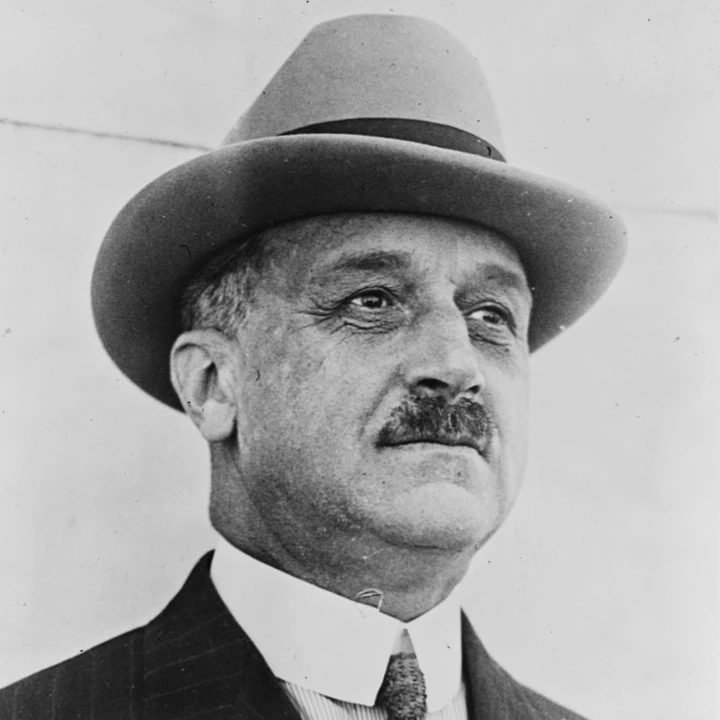
Amadeo Giannini, the Ligurian who changed banking in America
Amadeo Pietro Giannini is one of the great Italians who left a profound and positive mark on the history of the United States. He did not simply found a new bank – he transformed the relationship between the financial system and American society, opening access to credit to millions of people who had previously been excluded. Immigrants, workers, farmers, small business owners, and ordinary families finally found someone willing to judge them not only by the wealth they possessed, but also by their honesty, their willingness to work, and the strength of their plans.
His bank offered loans to people who, like Giannini himself at the beginning of his career, had little more than an idea, a plan, and the determination to work, build something, and pursue a dream. He understood that this was where true value could be found – something worth believing in and investing in.
Giannini was born on May 6, 1870, in San Jose, California, to Luigi Giannini and Virginia Demartini, Ligurian immigrants from Favale di Malvaro, a small town in the inland Tigullio area. His father had first traveled to California during the Gold Rush era before returning to Liguria, marrying, and leaving again for the United States with his wife. The family settled in the Santa Clara Valley, where they purchased land and established a farming business.
His Ligurian roots played a central role in shaping Amadeo’s character. From his family he inherited frugality, a willingness to make sacrifices, an entrepreneurial spirit, and a strong belief in hard work. The violent death of his father, when Giannini was only seven years old, also forced him to confront life’s hardships at a very young age. He left school as a teenager and began working in the produce business with his stepfather. Thanks to his energy and his ability to understand people, he quickly became a successful businessman.
After retiring from the produce business while still a young man, Giannini joined the board of a small financial institution in San Francisco. There he realized that traditional banks primarily served wealthy customers while largely ignoring immigrants and working people. When his fellow board members rejected his proposal to extend credit to ordinary people as well, he decided to create a bank based on his own principles.
On October 17, 1904, he opened the Bank of Italy in San Francisco. Its headquarters were located in a former saloon in North Beach, the heart of the city’s Italian community. Giannini personally walked the neighborhood streets, speaking with merchants, craftsmen, and families and encouraging them to deposit their savings. He made relatively small loans and placed great importance on the personal reputation of those seeking credit.
The defining moment in Giannini’s career came with the 1906 San Francisco earthquake and fires. As much of the city was being destroyed, he managed to save the bank’s money and records by moving them out of the devastated area. While other financial institutions remained closed, he temporarily reopened his business and began financing the reconstruction. He lent money to families and small business owners, sometimes on the strength of little more than a handshake. The trust he demonstrated during those weeks enabled many people to start over and made a tangible contribution to San Francisco’s rebirth.
The Bank of Italy subsequently expanded throughout California and in 1930 took the name Bank of America, reflecting a mission that had by then become national in scope.
Giannini’s bank contributed to the development of several sectors that would help define modern America – California agriculture, commerce, construction, and small business. It financed the motion picture industry when movies were still considered an excessively risky investment and supported productions that would make history, including Walt Disney’s “Snow White and the Seven Dwarfs.” During the Great Depression, his bank purchased bonds that helped make the construction of the Golden Gate Bridge possible. During World War II, it also financed major industrial activities essential to America’s wartime production effort.
By the time Giannini died on June 3, 1949, he had helped create one of the largest financial institutions in the world. But his legacy extends far beyond the size of Bank of America. Amadeo Giannini changed the United States because he placed his trust in people who had rarely been given that opportunity, transforming banking into a service accessible to a much broader segment of society. A son of Liguria and a protagonist of the American story, he demonstrated that the values brought to America by Italian immigrants could contribute directly to the nation’s growth and modernization.
Vision, courage, and a sense of social responsibility – I believe these are the words that best describe Giannini’s extraordinary personal and entrepreneurial story. They were reflected, on the one hand, in his unique ability to see the possibility of rebirth even in the darkest and most difficult moments and, on the other, in his determination to put his talent at the service of individuals and the community.
I am convinced that Giannini’s life carries a powerful message and that the values it embodies can serve as an example and an inspiration, especially today, at a complex historical moment marked by tensions. His story points to a model: investing in people’s talent, abilities, and hard work – in their ambitions, their aspirations, and their desire to improve their lives – is one of the most effective ways to create growth and prosperity for everyone.
Believing in people, even when the obstacles appear insurmountable, is the path to overcoming challenges that seem impossible.
Looking back at Giannini’s entrepreneurial story, I believe we can say that it was both profoundly Ligurian and profoundly American. First and foremost, Giannini was the son of people who came from our region, and he grew up in a Ligurian environment, even though it had been transplanted across the Atlantic. He was therefore immersed in the values typical of our land – hard work, commitment, sacrifice, and dedication. These are the same guiding principles that, over the centuries, enabled our people to create farmland by terracing miles of hillsides and to build a great maritime and commercial power from a rugged and challenging land.
Nor can we forget the great banking tradition of Genoa and Liguria. The Banco di San Giorgio was one of the earliest institutions of modern banking, capable not only of generating innovations that transformed the sector and later spread around the world, but also of serving as an engine of the greatness of the Republic of Genoa – a foundation upon which it built its maritime prosperity and commercial empire.
This is an important legacy that remains alive in the region today. Liguria has a strong entrepreneurial and banking tradition, and echoes of that heritage can undoubtedly be found in Giannini’s life.
At the same time, it is clear that the qualities and genius of a man of Giannini’s stature were able to flourish and produce extraordinary results because he operated in a place where he found the right conditions. This is the essence of America – a country where I lived and worked for many years and which remains an extraordinary source of inspiration for me.
Here, too, we can find an important lesson, one that can and should serve as a point of reference, particularly for those who hold public office. The only way to build a future of growth and prosperity is to create the conditions that allow the best energies within society to express their full potential. This requires simplification, less bureaucracy, and support for businesses. Above all, however, it requires every stakeholder in a community – institutions, associations, businesses, and the financial system – to embrace a shared vision and work in the same direction.
Following Giannini’s example means recognizing and supporting people’s hard work, talent, ideas, and strength, beginning with their concrete needs – the needs we can see before us, every single day, with our own eyes.