
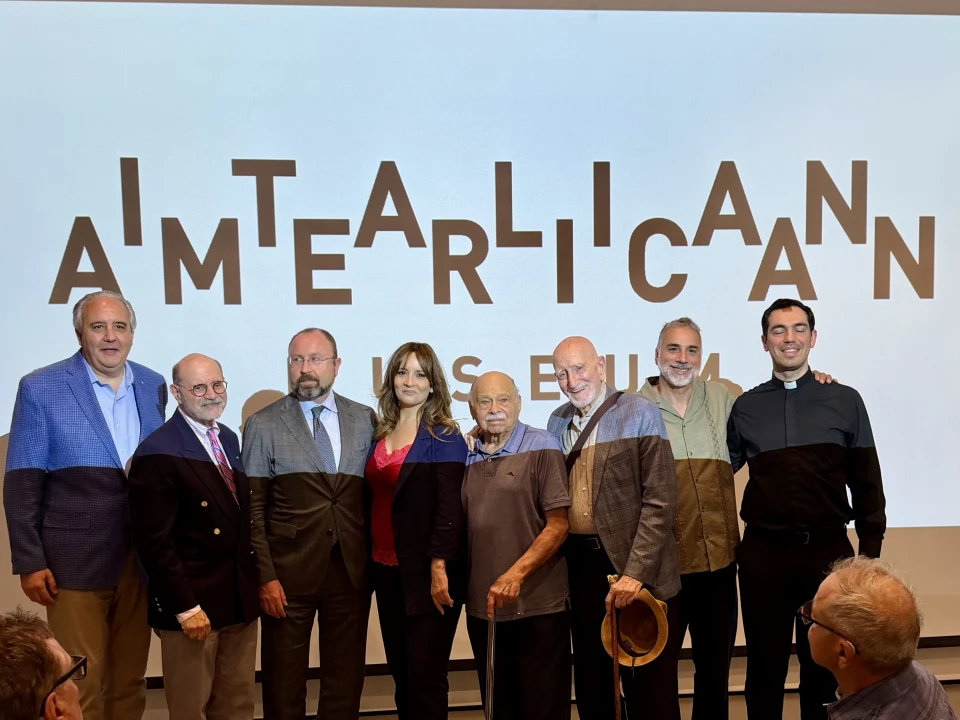
The Italian American Museum in New York hosted an evening celebrating the memory of Italian immigration while opening a new chapter in cultural relations between Naples and the United States.
Attended by Consul General of Italy in New York Giuseppe Pastorelli, representatives of Italian and Italian American institutions, leading cultural figures, and an engaged capacity audience, the presentation demonstrated that In Sanguine Foedus: Nuovo Mondo has become much more than a work of art. It is an expanding cultural initiative designed to strengthen the relationship between two communities united by a shared history.
At the center of the event was Germana Valentini, who conceived and developed the project with Francesco Andoli. Valentini retraced the origins of In Sanguine Foedus: Nuovo Mondo, the monumental mural created by Neapolitan artist Vittorio Valiante in collaboration with INWARD, Italy’s National Observatory on Urban Creativity.
Covering more than 10,000 square feet in the Port of Naples, the work occupies the place from which millions of Italians departed between the late 19th and 20th centuries in search of a new life in the United States. Through art, this deeply symbolic location has begun telling that extraordinary human story again, becoming an ideal bridge between Naples and New York.
From the first images shown during the evening, the audience experienced the mural’s narrative power. Its portraits, stories, and expressions of hope evoke the experiences of those who left their homeland dreaming of building a better future across the Atlantic.
Warm and repeated applause accompanied Valentini’s presentation. She discussed not only the mural’s creation, but also the vision behind it: transforming the memory of Italian immigration into a contemporary instrument of dialogue between Italy and the United States.
The videos shown during the presentation were also particularly well received. They took the audience on a journey into the heart of the project and conveyed the extraordinary scale of the mural inaugurated in Naples.
A video message from Eliseo Cuccaro, president of the Central Tyrrhenian Sea Port Authority, generated considerable interest. Cuccaro emphasized the symbolic importance of the Port of Naples, from which millions of Italian immigrants once departed, and the need to restore a central role to a place so profoundly connected to Italy’s collective memory.
In his remarks, Consul General Pastorelli expressed strong appreciation for an initiative that promotes Italian culture in the United States through the universal languages of art and memory. He noted that projects of this kind make a meaningful contribution to strengthening dialogue between Italy and the United States.
Among the guests was John Calvelli, chairman of the National Italian American Foundation, who has been a major supporter of the project and one of the first to visit the mural in Naples. Calvelli observed that works of this scale can tell the story of Italian immigration with exceptional effectiveness, transforming it into a shared legacy for new generations of Italians and Italian Americans.
The evening became even more moving through the personal accounts of Robert Zerilli, owner of the historic Veniero’s pastry shop, and Vincent Zeccardi, owner of Caffè Roma. Both spoke emotionally about seeing their ancestors portrayed in the mural.
Their stories demonstrated more powerfully than any formal explanation that In Sanguine Foedus is not simply an artwork. It is also an extensive archive of Italian immigrant memory, through which thousands of families may rediscover part of their own history.
Professor Joseph V. Scelsa, founder and president of the Italian American Museum, shared his enthusiasm for the project and reaffirmed the importance of expanding the museum’s collaboration with Valentini and the initiative’s other organizers.
The museum also announced a major forthcoming initiative dedicated to the Treasure of San Gennaro. The project is expected to create another cultural bridge between Naples and New York while further enriching the dialogue between the two institutions.
One of the evening’s most anticipated moments was the announcement of the second phase of In Sanguine Foedus.
Following the completion of the monumental mural in Naples, the project will arrive in the heart of New York’s Little Italy. A new large-scale mural dedicated to San Gennaro will be created on the exterior wall of Grotta Azzurra, the historic restaurant that has long served as a landmark of the Italian presence in New York.
At the same time, a statue of San Gennaro created by sculptor Dante Mortet will be donated to the Italian American community. Inspired by the statue installed at Naples’ Molo San Vincenzo, the new work will be entrusted to Father Luigi Portarulo.
The statue will offer a tangible expression of the spiritual and cultural bond connecting Naples with Little Italy’s Italian community, becoming one of the most significant symbols of the In Sanguine Foedus project.
The announcements continued when Father Portarulo previewed a major collaboration with the Cathedral of Naples. Although full details will be released in the coming months, the initiative represents another important step in a project that views San Gennaro as a unifying figure at the intersection of faith, culture, and identity.
The evening concluded with a moment of rare emotional intensity.
Celebrated Italian American actor Dominic Chianese, best known for his unforgettable portrayal of Corrado “Junior” Soprano on The Sopranos and for his role in The Godfather Part II, paid tribute to his roots with an extraordinary a cappella performance of the beloved Neapolitan song “Santa Lucia Luntana.”
The room remained silent throughout his performance. When the final note faded, that silence gave way to a long and heartfelt ovation.
The audience’s enthusiastic response to the presentations and the many initiatives announced during the evening confirmed that In Sanguine Foedus is entering a new phase of its development.
Created to preserve and communicate the memory of Italian immigration, the project is now looking toward the future. It is generating new opportunities for collaboration among institutions, museums, artists, religious communities, and Italian and Italian American organizations.
Driven by Germana Valentini’s passion, In Sanguine Foedus continues to evolve into an international cultural laboratory capable of building new bridges between Naples and New York.
The project demonstrates that memory does not belong only to the past. It can become a living force—one that brings people together, inspires new partnerships, and strengthens, day after day, the profound connection between Italy and the United States through the history and identity of the Italian American community.