
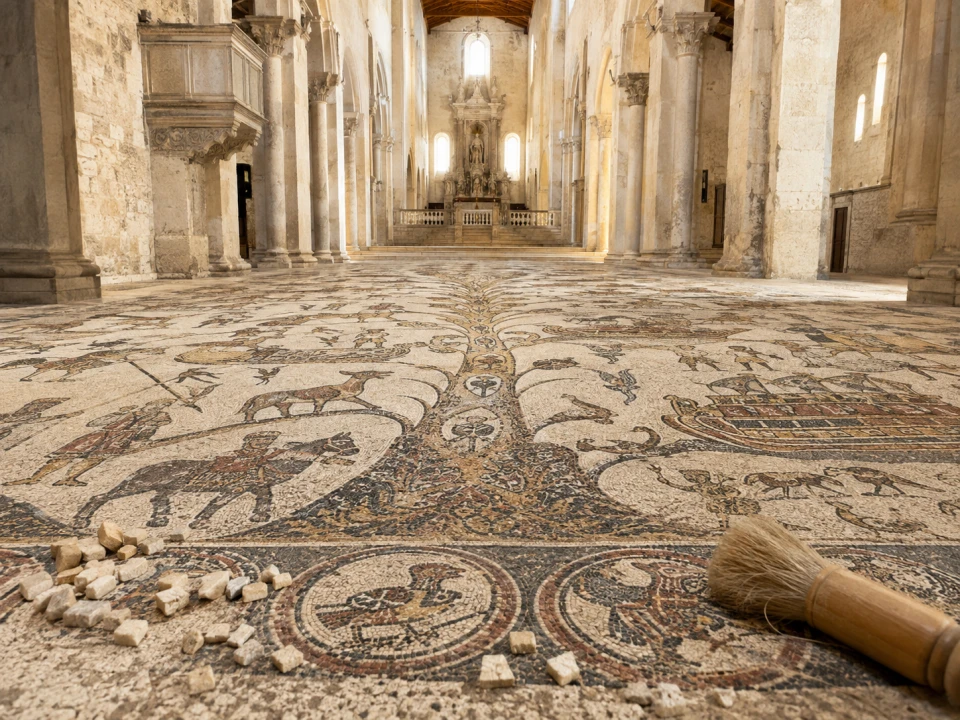

Visitors entering the Cathedral of Santa Maria Annunziata in Otranto may initially look upward, toward its arches, columns, and painted ceiling. Yet the building’s greatest artistic treasure lies beneath their feet. Covering almost the entire floor is an immense medieval mosaic that transforms the cathedral into a stone encyclopedia of faith, history, mythology, nature, and human imagination.
The mosaic was created between 1163 and 1165 under Archbishop Gionata. Its principal author was Pantaleone, a priest traditionally associated with the nearby Monastery of San Nicola di Casole. Once an important center of Greek learning, Casole possessed a celebrated library and scriptorium. Pantaleone may therefore have had access to biblical writings, classical literature, chronicles, bestiaries, and stories transmitted between the Latin West and Byzantine East.
At the center of his composition stands an enormous tree. Its trunk extends along the cathedral’s nave, while its branches provide a structure for dozens of different narratives. It is generally interpreted as the Tree of Life, although its symbolism remains open to discussion. Depending on the direction in which it is read, it can also suggest the Tree of Knowledge, humanity’s fall, or the difficult journey from sin toward salvation.
Biblical episodes appear throughout the mosaic. Adam and Eve are expelled from Eden, Cain attacks Abel, Noah receives his divine instructions, and animals enter the Ark. The Tower of Babel warns against pride, while agricultural activities associated with the months and the zodiac present human labor as part of a divinely ordered universe.
The mosaic’s most surprising images, however, come from outside the Bible. Alexander the Great rises toward the sky with the assistance of 2 griffins, an episode taken from medieval versions of his legendary adventures. King Arthur appears riding an animal, accompanied by the identifying words “Rex Arturus.” This is considered one of the earliest surviving visual representations of the British ruler anywhere in Europe.
Elephants, centaurs, mermaids, lions, dragons, monkeys, and other real or imaginary creatures populate the branches. Some were inspired by medieval bestiaries, in which animals carried moral or religious meanings. A creature was rarely included merely because it was decorative. Its behavior, appearance, or legendary characteristics could become a lesson about virtue, temptation, wisdom, or danger.
Pantaleone did not organize these figures according to a simple modern narrative. Sacred history, classical legend, chivalric culture, natural observation, and fantasy coexist without rigid separation. For medieval viewers, these worlds were not necessarily contradictory. Together, they could illuminate humanity’s place within creation.
Otranto’s geographical position helps explain this extraordinary mixture. Located on the Adriatic coast of Puglia, the city faced the eastern Mediterranean and had long served as a meeting point for Greek, Byzantine, Latin, Norman, and other cultural traditions. The mosaic reflects this frontier identity.
Created from hundreds of thousands of small limestone tesserae, the floor has survived wars, invasions, restorations, and almost 9 centuries of history. Its meanings continue to be debated because no single interpretation explains every figure.
The mosaic beneath Otranto Cathedral is therefore more than an exceptional decorative surface. It is a map of the medieval imagination – a world in which Scripture, mythology, science, morality, and storytelling grow together from the branches of one mysterious tree.