
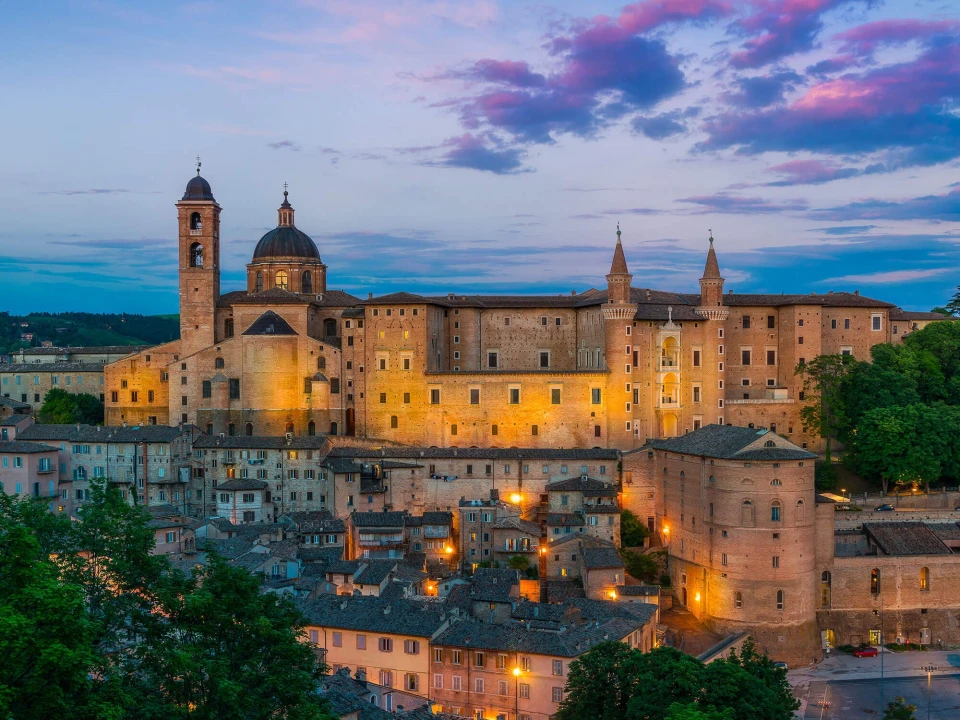

Nestled atop a hill in Italy’s Marche region, the city of Urbino invites all who wander its winding streets into a journey back to the heart of the Renaissance. The town’s urban fabric remains remarkably intact–streets, walls and rooftops still retain the character they gained during the 15th‑century cultural explosion.
One of the city’s defining monuments is the Palazzo Ducale - a masterpiece of Renaissance architecture commissioned by Duke Federico da Montefeltro. From its elegant façades and towers to the grand loggias and refined courtyard, the palace embodies the concept of a “city in the shape of a palace” and stands as a symbol of how art, power and place merged in Urbino’s golden age.
The historic centre of Urbino was recognised as a UNESCO World Heritage site in 1998 in light of its outstanding urban and architectural heritage–and especially for its role in nurturing artists, scholars and humanists who reshaped European culture. Within the city’s walls one sees the result: the Cathedral, monasteries, oratories, stately homes and fortifications all forming a coherent ensemble.
Moving through the narrow alleys, you’ll spot stone‑paved ramps and stepped walkways that link the slopes of the hill. Houses lean gently into each other; there are small medieval towers, Renaissance palazzos, and peerless views across the green undulating landscape of the Appennines. The vista from the city’s fortifications gives a sweeping panorama of red tile roofs and valley below - an image that seems frozen in time.
Art remains central here. The National Gallery housed in the Palazzo Ducale holds works by masters of the Renaissance era, offering visitors glimpses of portraits, landscapes and sacred scenes that once inspired the court and city alike. Meanwhile the birthplace of Raphael Sanzio lies within the old town - a modest home today turned museum, reminding us that this UNESCO town was not only a political seat but also a seedbed of art.
Urbino is also home to one of Italy's oldest universities, founded in 1506 but with origins that trace back to the 12th century. The University of Urbino has long been a center of education and scholarship, drawing students from across Italy and beyond. Its presence in the town adds to the lively atmosphere, where the streets and piazzas are filled with young minds engaging in intellectual pursuits. The university has been instrumental in preserving and enhancing Urbino's cultural heritage, and its historic buildings blend seamlessly with the town’s Renaissance architecture, making it an integral part of the city’s charm.
Time in Urbino moves at a gracious pace. Outside the art‑filled interiors, cafés line tiny squares, students from the local university mingle with tourists, and the rhythm of daily life remains unhurried. The preservation of the urban layout and historical volume means that architecture, street life and topography merge seamlessly.
If you plan to visit, allow yourself to climb the slopes connecting one quarter to another, pausing at vantage points where you can look back on the rooftops and onward to the horizon. Consider visiting the palace at a meal break, then wander toward the museum or the cathedral. In the evening the town quiets, lights come on, and the silhouette of the Palazzo stands out against twilight–serene, elegant and slightly remote from the bustle of modern travel.
In short, Urbino is more than a city to tick off a list - it is a living relic of the Renaissance, preserved in stone and atmosphere. It offers visitors the rare chance to walk within a world shaped by humanist ideals, architectural ambition and artistic excellence–and to feel how that legacy still lingers in narrow lanes, lofty loggias and silent courtyards.