

Puglia, the long, sunlit region stretching along Italy’s southeastern edge, has always been more than a geographic boundary. It is a threshold – a meeting point between worlds. Facing the Balkans and the eastern Mediterranean, with Albania less than 80 kilometers away across the Adriatic at its narrowest point, Puglia has historically functioned as a bridge between East and West. Its identity was shaped not by isolation, but by constant movement – of people, goods, and ideas.
Long before modern Italy existed, this region was already deeply connected to the wider Mediterranean. As early as the 8th century BCE, Greek settlers arrived along the southern coasts, establishing colonies that would become part of Magna Graecia, or “Greater Greece.” Cities like Taranto, founded by Spartan colonists around 706 BCE, emerged as powerful urban centers. At its peak, Taranto is estimated to have had a population of over 200,000 inhabitants, making it one of the largest cities in the ancient Greek world outside mainland Greece.
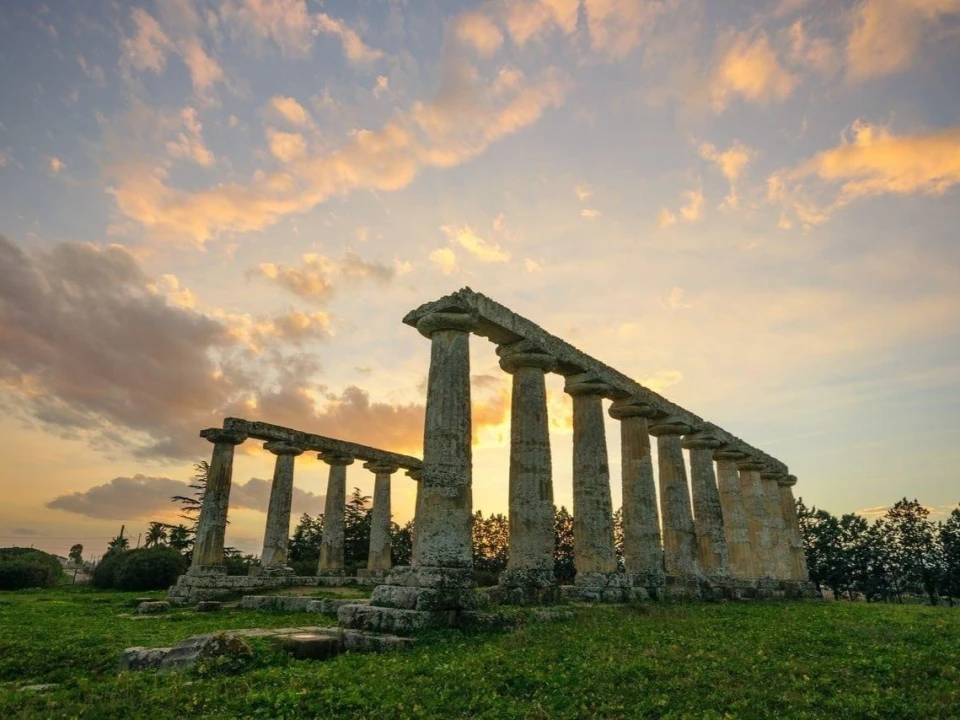
The influence of Greek civilization in Puglia was not superficial. It shaped language, urban planning, religion, and philosophy. The nearby site of Metapontum became associated with Pythagoras, the Greek philosopher and mathematician, who is believed to have spent part of his life in the region during the 6th century BCE. Archaeological remains – temples, pottery, coins – still testify to a deeply rooted Hellenic presence. Even today, traces of Greek heritage survive in dialects and cultural practices, particularly in the Salento area, where a small community still speaks Griko, a language with ancient Greek origins.
Yet Puglia’s role as a crossroads did not end with Magna Graecia. Its strategic position continued to attract empires and travelers for centuries. Under Roman rule, the region became a critical hub for trade and military movement. The port of Brindisi, for example, served as the eastern terminus of the Via Appia, one of the most important roads of the Roman Empire. From here, ships departed toward Greece, Asia Minor, and beyond. By the 2nd century BCE, Brindisi had become one of the busiest ports in the Mediterranean, facilitating the movement of thousands of people and tons of goods each year.
In the Middle Ages, Puglia’s role as a gateway intensified. The city of Otranto, located at the easternmost point of Italy, became a symbolic and practical “door to the East.” During the Crusades, thousands of knights and pilgrims passed through its harbor on their way to the Holy Land. It is estimated that between the 11th and 13th centuries, tens of thousands of crusaders embarked from ports along the Apulian coast, including Brindisi and Bari. These movements brought not only military expeditions but also cultural exchange, introducing new artistic styles, technologies, and culinary influences.
This continuous interaction with different civilizations – Greek, Roman, Byzantine, Norman, and later Aragonese – gave Puglia a layered identity. Byzantine rule, in particular, left a lasting imprint between the 6th and 11th centuries CE, reinforcing ties with the Eastern Mediterranean. Churches with Greek inscriptions, mosaics, and iconography can still be found across the region, reflecting a blend of Eastern Orthodox and Western Christian traditions.
Today, Puglia’s historical role as a bridge is increasingly visible again. In recent decades, the region has become a point of arrival for migrants crossing the Adriatic, echoing ancient patterns of movement. At the same time, tourism has surged, with international arrivals increasing by over 30% in the past decade. Visitors are drawn not only by beaches and cuisine, but by the region’s unique cultural synthesis – a place where East and West have met for more than 2,500 years.
To understand Puglia is to recognize that its story is not one of periphery, but of connection. From the Greek colonies of Magna Graecia to the bustling medieval ports that linked Europe to the Levant, this region has always looked outward. Its history reminds us that borders can also be bridges – and that cultural identity is often born at the crossroads.