
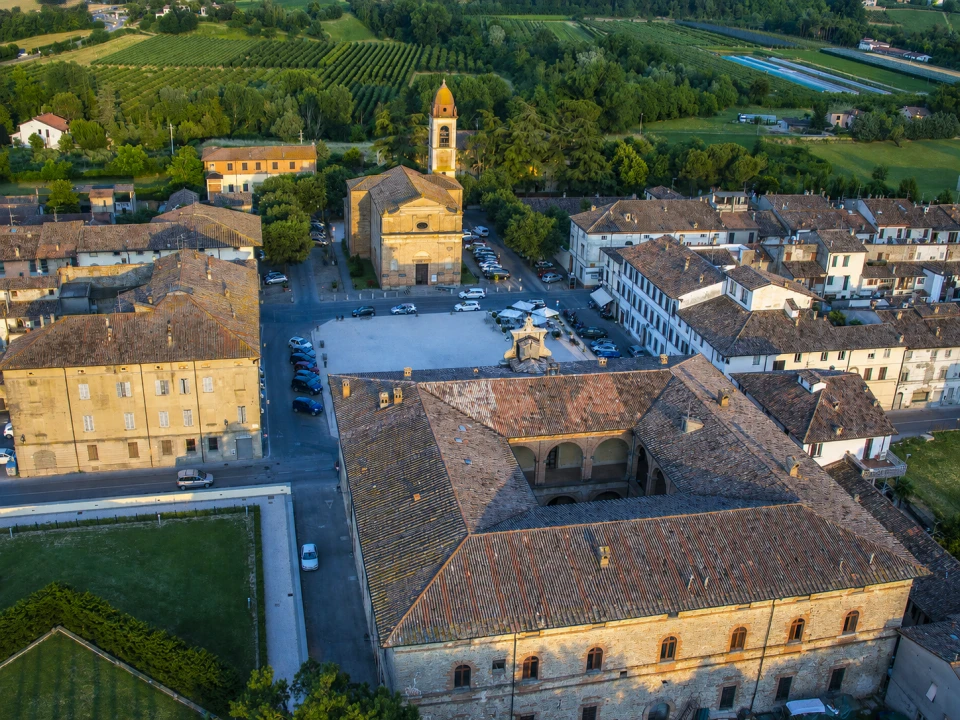

Terra del Sole began as a political idea expressed through architecture. Near Forlì, where the Montone valley opens toward the Romagna plain, Cosimo I de’ Medici envisioned a settlement whose streets and buildings would proclaim the authority of his government. Founded in 1564, the town joined Renaissance ideals of proportion and rational order with the demands of military defense and territorial administration.
Its location mattered. This was the edge of the Medici territories, facing the Papal States, where a new urban center could make sovereignty visible. Today part of the municipality of Castrocaro Terme e Terra del Sole, the settlement occupies a valley setting beside the Apennine foothills. The surrounding landscape placed it between routes crossing the Apennines and the neighboring territories of the papacy.
Construction began on December 8, 1564, with a procession and solemn Mass. The project unfolded over years: the defensive enclosure was completed in 1568, while 1579 marked the town’s inauguration as the seat of the grand ducal commissioner. Those dates reveal the scale of the undertaking. Establishing a functioning capital required housing, government offices, military facilities, and places of worship within a coordinated plan.
Giovanni Camerini played a central role in the design. Baldassarre Lanci, Bernardo Buontalenti, and Simone Genga also contributed to the undertaking as collaborators or successors. Their involvement connects Terra del Sole to the architectural and engineering culture of the Medici court, where artistic invention and practical expertise frequently belonged to the same profession.
The result was a fortified rectangle enclosed by roughly 2 kilometers of walls, approximately 1.25 miles, with 4 projecting corner bastions. Their angular forms accommodated artillery and protected the adjoining defensive walls. Two fortified gateways controlled entry. This geometry embodied a response to changing warfare, as powerful firearms reshaped the relationship between cities and their defenses.
Inside, the main streets of Borgo Romano and Borgo Fiorentino organize movement around Piazza d’Armi. Their width, about 9 meters or 30 feet, corresponds to the height of the neighboring houses. Such proportions brought the ideal city into ordinary experience: residents encountered its governing principles simply by walking between their homes and the central square.
Piazza d’Armi gave that order a public and ceremonial focus. The Church of Santa Reparata faces the Palazzo dei Commissari, also known as Palazzo Pretorio. Religious and governmental authority thus occupied opposing sides of the same civic space. The arrangement expressed a vision of society in which architecture reinforced institutional relationships and made the workings of power physically legible.
That vision included punishment. The commissioners’ palace contained prisons and underground cells, where surviving graffiti offer traces of people caught within the judicial system. These marks complicate the polished image of Renaissance harmony. Terra del Sole housed officials and soldiers, but also defendants and prisoners whose experiences belonged to the same urban order.
Its administrative role continued until 1784, when the province of Florentine Romagna was abolished. Later generations found other ways to preserve and interpret the town. Established in 1972, the Museo dell’Uomo e dell’Ambiente now uses 25 exhibition rooms to explore local history, rural households, agricultural work, craftsmanship, and customs alongside the fortress’s development.
Historical memory also enters the streets through the Palio di Santa Reparata, held on the first Sunday of September. Costumed processions and crossbow competition renew the rivalry between Borgo Romano and Borgo Fiorentino. These modern commemorations give residents an active role in interpreting their inheritance. Terra del Sole’s enduring cultural value lies in this meeting of design and lived experience – a place where an ambitious Renaissance plan remains visible, while museums, traditions, and material traces restore human complexity to its ordered streets.