

Nestled in the rolling hills between mountain air and vineyard slopes in the province of Cuneo, in Piedmont, the sanctuary at Vicoforte draws visitors into a realm of devotion, mystery, and architectural audacity. The centerpiece is a vast elliptical dome – the largest of its kind in the world – crowning a basilica that mixes baroque ambition, spiritual legend, and structural boldness.
The sanctuary’s origins are modest. In the later centuries before the 1600s, a small devotion grew around a painted image of the Virgin Mary and Child on a humble pillar in a forested valley. A local legend says a hunter once struck the image by accident – and that the Madonna miraculously bled. Repentant, the hunter left his arquebus and contributed to building a chapel, which attracted pilgrims over time.
By the late 1500s local religious leaders and rulers embraced the site. In 1596, a formal project was launched to build a grand sanctuary around the original pillar. The plan grew ambitious – not just a church, but a monumental temple in which the faithful, and possibly rulers, might be laid to rest. The work progressed in stages, with interruptions, pauses, and reimagining as political support shifted and architects died.
In the 1700s the Mantuan architect Francesco Gallo took up the challenge of creating a daring dome over the sanctuary’s central space. He designed an elliptical structure with major and minor axes that stretched tens of meters. The geometry was risky – no precedent existed for masonry domes of this shape at such scale. When the time came to remove the supporting scaffolding, Gallo himself reportedly descended into that scaffold to take it down – an act of faith and confidence, since many believed the dome might collapse.
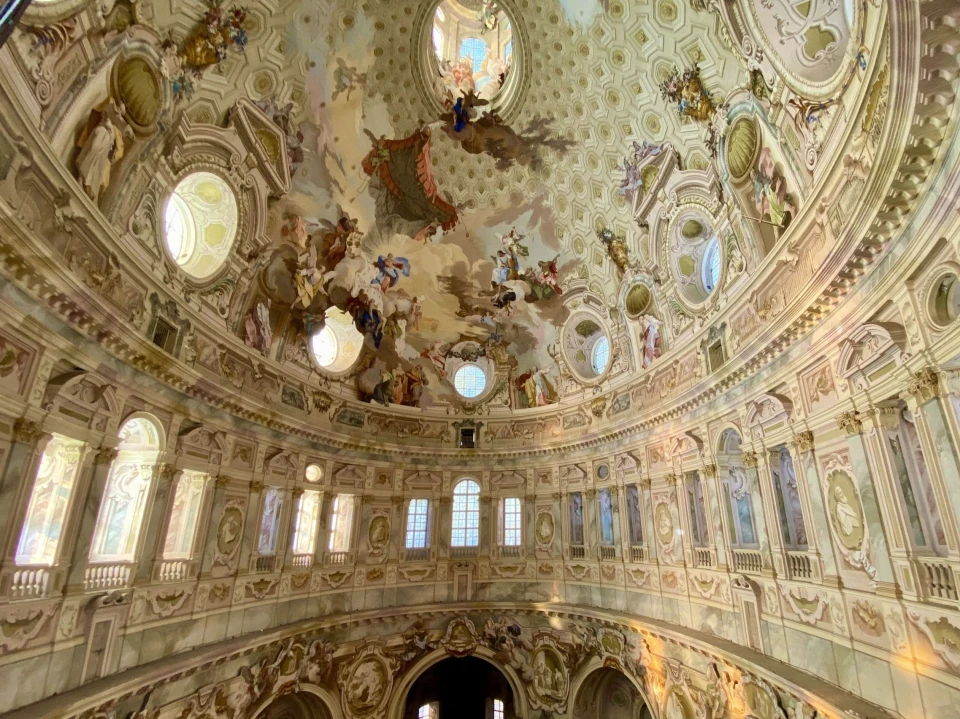
Inside, the dome’s vault is blanketed in frescoes over 6,000 square meters, painted as a single visual program. Angels, celestial realms, allegories, and religious narratives swirl overhead, creating a unified spiritual drama. Mattia Bortoloni and Felice Biella were among the artists who brought those walls to life, working in a concerted vision of baroque space and light.
Today, visitors can join a guided ascent high above the sanctuary floor – climbing nearly 60 meters to traverse narrow walkways and peer out through lantern windows. The climb reveals the dome’s inner curve up close, with its interplay of arches, ribs, and painted surfaces, and offers views over the rooftops of Vicoforte and the surrounding valleys. It’s a rare chance to see architecture from the inside out – to understand how form and structure support art and meaning.
The sanctuary itself is framed by the palazzata – a symmetrical ring of buildings and porticoes built around the forecourt. They once housed pilgrims, clergy, and functions related to liturgy and hospitality. The surrounding complex includes cloisters, chapels, and monastic wings that echo the structure’s long development.
In time the sanctuary was elevated in status – it became a basilica, a symbol of regional pride and spiritual focus. Among its sacred contents are tombs belonging to important figures, including members of royal houses. In recent years, the remains of the last Italian king and his queen were moved to resting places within its walls – adding a modern chapter to its ancient narrative.
Walking inside, one senses layers of time. The central pillar still bears the mark, visible to pilgrims who venerate it as the origin of the sanctuary’s devotion. The dome vault towers overhead, its scale reminding visitors not only of human ambition but also of patience, faith, and craftsmanship. The sanctified geometry of the dome contrasts with mountain horizons, the light filtering through windows, and pilgrimage rituals in the nave below.
This is not a frozen monument. The sanctuary continues to host services, visitors, and special climbs during selected months. Reservations are needed for the dome ascent, and groups are often led by volunteers who guide carefully over narrow bridges and stairs. The climb is physical and symbolic – faith given in motion, art given in risk, devotion given in altitude.
Vicoforte’s sanctuary shows how a humble pillar can inspire a grand architectural vision, how legend and engineering may combine, and how beauty can be raised toward the heavens. The elliptical dome remains both marvel and question – how far can human hands reach into the sky before the weight of wonder becomes a burden for stone?
Standing there, gazing upward, visitors see not only frescoes and ribs, but centuries of devotion, bold design, and a community that dared to build an impossible dome. The sanctuary of Vicoforte is a place where faith wears architecture – and where every ascent, every frescoed vault, every engineered curve speaks of the tension between gravity and grace.