

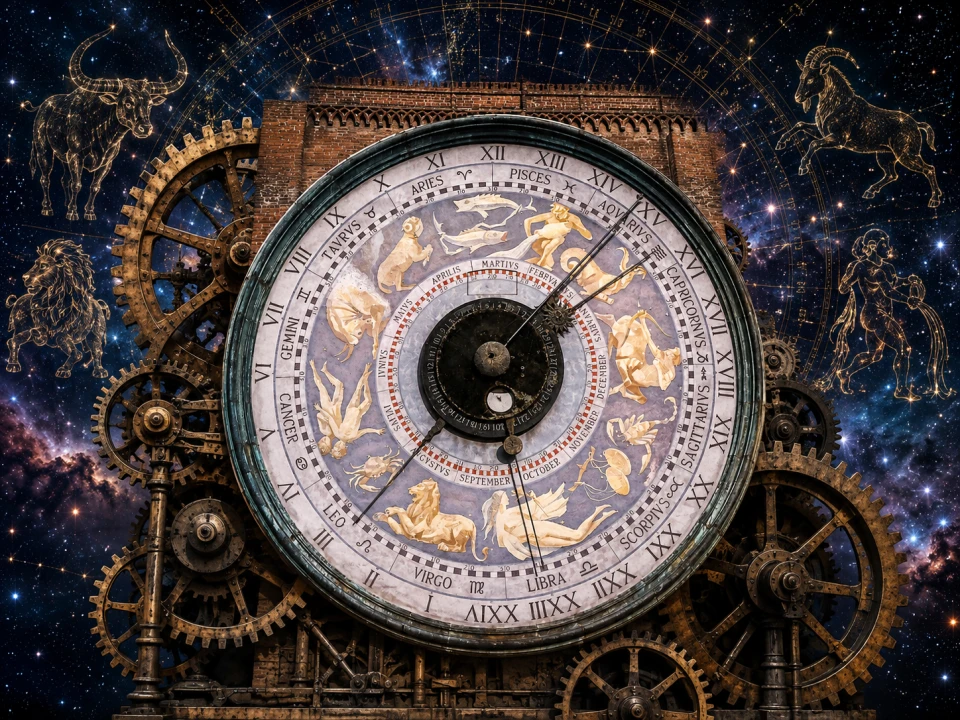

High above Piazza del Comune in Cremona, Italy, an extraordinary machine has been tracking time and the heavens for more than four centuries. The astronomical clock of the Torrazzo is not merely a beautiful Renaissance timepiece. It is essentially a mechanical representation of the sky – an analog astronomical computer created centuries before electricity, electronics, or digital calculation.
The clock was created by Cremonese clockmakers Francesco and Giovanni Battista Divizioli, father and son, with work beginning around 1582–1583, at the very moment when Europe was adopting the Gregorian calendar. The mechanism was completed during the 1580s and, remarkably, the original mechanism remains in operation today.
What immediately makes the clock extraordinary is its size. Its astronomical dial measures approximately 8.2 meters, or nearly 27 feet, in diameter – about 8.4 meters including its copper frame. By comparison, the famous clock faces of London’s Elizabeth Tower, commonly associated with the name Big Ben, are approximately 6.9 meters across. Cremona’s dial is therefore substantially larger.
But size is only the beginning of the story.
The clock does much more than tell the hour. Its elaborate astronomical display represents the celestial sphere and the zodiac, following the apparent movements of the Sun and Moon. Through an ingenious system of gears and indicators, it can display astronomical information including the Moon’s phases, the Sun’s movement through the zodiac, solstices and equinoxes, lunar nodes, and information connected with solar and lunar eclipses.
In other words, someone standing in Cremona centuries ago could look at a building and obtain information that today we would normally expect from an astronomical calendar, specialized software, or an app.
The mechanism is entirely mechanical. Gears translate the passage of ordinary time into several different astronomical cycles, each moving at its own rate. The result is particularly fascinating because the machine has continued performing these calculations across approximately 440 years of scientific and technological transformation.
There is another curiosity hidden behind the spectacular façade. The painted dial people see today is not exactly the one Renaissance residents saw. Its decoration has been restored and repainted several times over the centuries, with the current appearance resulting from 20th-century restoration work. Behind it, however, survives the historic mechanical heart of the clock.
Even maintaining the machine has an old-fashioned dimension. The astronomical clock requires regular manual winding rather than simply drawing power from an electrical system. Inside the tower, visitors can see the mechanism and understand how weights, gears, shafts, and wheels transform mechanical movement into astronomical information.
Its setting is equally exceptional. The clock is mounted on the Torrazzo, the monumental brick bell tower beside Cremona Cathedral. The tower rises more than 110 meters and contains 502 steps, making the journey upward a physical exploration of architecture, astronomy, and the history of timekeeping.
Since 2018, that experience has become even richer through the Museo Verticale, a museum dedicated to the measurement of time housed inside the Torrazzo.
Perhaps the most fascinating thing about Cremona’s astronomical clock is the contrast it embodies. We associate sophisticated calculations with microprocessors, satellites, and computer screens. Yet in Cremona, a machine conceived during the Renaissance continues to model movements in the sky using metal gears and mechanical ingenuity.
More than 440 years later, this remarkable machine is still looking upward.