
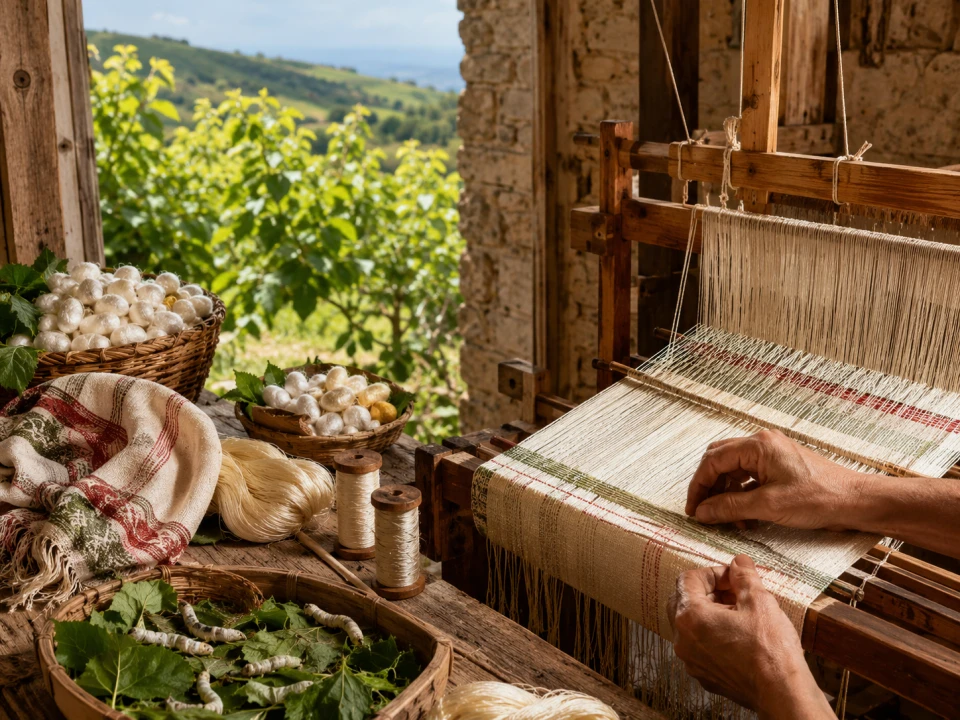

In the hills near Catanzaro, the small Calabrian village of San Floro is protecting one of Italy’s most remarkable craft traditions. Here, among thousands of mulberry trees, silk is still produced through a complete local process – from raising silkworms and gathering cocoons to extracting, dyeing, and weaving the precious thread.
The story begins long before San Floro’s modern revival. Silk production reached Calabria during the Greek-Byzantine period, together with the cultivation of mulberry trees whose leaves provide the silkworm’s essential food. By the 11th century, Catanzaro had already developed a reputation for its silk textiles.
Between the 14th and 18th centuries, silk became one of the foundations of the area’s economy. Mulberry trees spread across the countryside, silkworms were raised by rural families, and looms operated in homes and workshops. Catanzaro emerged as one of Europe’s most respected silk-producing cities, admired for velvets, damasks, brocades, and fabrics enriched with gold and silver threads.
The city’s knowledge also traveled abroad. In 1470, silk artisans from Catanzaro were invited to Tours to help France develop its own production. Their expertise contributed to an industry that would later flourish in other French centers, including Lyon.
Calabria’s silk economy eventually declined under the pressure of taxation, industrial competition, changing markets, and imported raw materials. By the late 19th century, much of the trade had disappeared. Mulberry groves were abandoned or replaced, looms became museum pieces, and techniques once passed from one generation to the next survived mainly in family memories.
San Floro is now reversing that decline. In 2014, Miriam Pugliese, Domenico Vivino, and Giovanna Bagnato founded the agricultural cooperative Nido di Seta. After studying and working elsewhere, the 3 young Calabrians returned home with the goal of rebuilding the traditional silk chain while creating sustainable employment.
The cooperative manages approximately 5 hectares containing more than 3,000 mulberry trees. During the breeding season, silkworms consume large quantities of fresh leaves before spinning cocoons from a single continuous filament. The cocoons are processed in the cooperative’s mill, where the fine fibers are carefully unwound, combined, and transformed into usable yarn.
The work requires patience and sensitivity. Temperature, humidity, leaf quality, and timing influence the worms’ development. Extracting the filament demands precision, while spinning, natural dyeing, and weaving involve skills that cannot be replaced entirely by machinery. Scarves, clothing, jewelry, and textile accessories therefore carry the subtle variations of authentic craftsmanship.
Nido di Seta learned from elderly Calabrians who still remembered traditional methods, while also developing a contemporary agricultural and commercial model. Its network now involves silkworm growers and artisans beyond San Floro, connecting local knowledge with a wider Italian supply chain.
The village’s Silk Museum, housed inside historic Castello Caracciolo, preserves looms, tools, fabrics, and evidence of Calabria’s former silk economy. Visitors can also explore the mulberry grove, observe the silkworms, and follow the transformation from cocoon to finished fabric.
San Floro demonstrates that heritage can become a productive future. Calabrian silk is not a costume preserved for nostalgia. It is a living material shaped by agriculture, design, manual skill, and territorial identity – an ancient thread once again connecting Calabria with the world.