
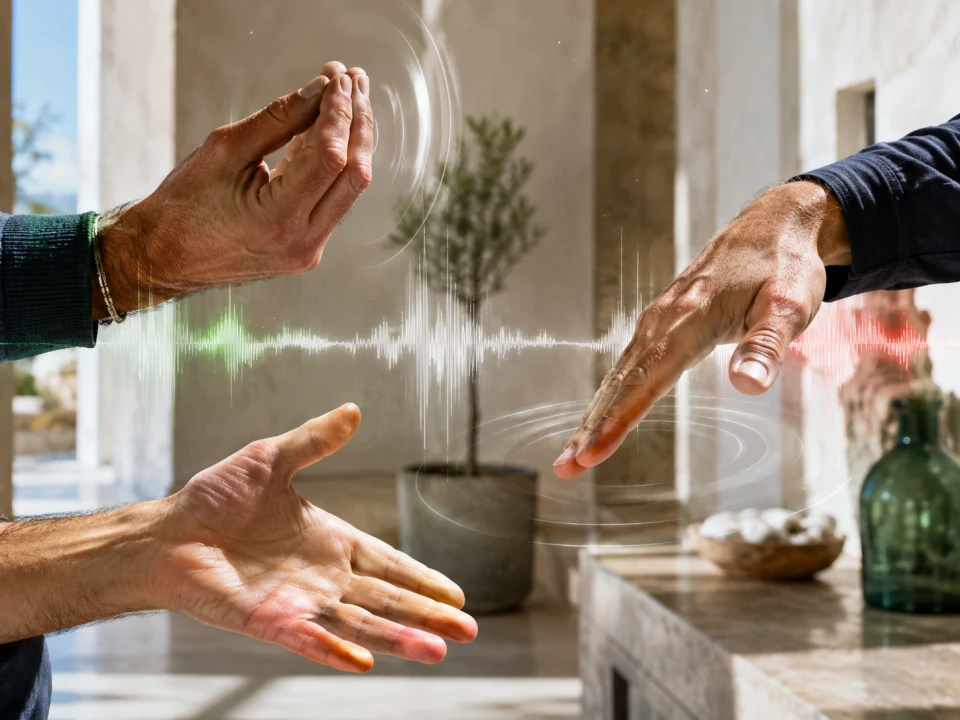

Italian is not spoken by the voice alone. Its rhythm also travels through the hands, shoulders, eyebrows, head, and entire upper body. Watch an Italian conversation with the volume turned off and much of the acoustic information seems to remain visible. Stressed words still appear to receive emphasis, pauses can still be recognized, contrasts remain perceptible, and the conclusion of a sentence is often marked by the body returning to rest.
Italian gestures, in other words, do not merely carry meanings. They also carry sound.
This relationship belongs to the field of kinesics, the study of body movement as a form of communication. Italian gestural culture is usually discussed as if it were a visual dictionary. The famous “pinched fingers” gesture, an open palm, a raised index finger, or a hand moving beneath the chin can express recognizable ideas, questions, reactions, and emotions. Yet this vocabulary is only one part of the story. Gesture also possesses something comparable to rhythm, meter, stress, and phrasing.
When Italians speak, their hands rarely move randomly beside the words. Gestures frequently interact with prosody – the musical organization of speech created by stress, pitch, intonation, pauses, duration, and changes in intensity. The most energetic part of a gesture tends to occur near a prominent element of the spoken sentence.
Imagine someone saying, “Non è possibile” – “It is not possible.” The hand may move downward sharply on “non” if the speaker wants to emphasize the refusal. In another context, the strongest movement may fall on “possibile,” reinforcing disbelief. The gesture acts almost like a percussion beat placed beneath the accented syllable.
Researchers call many of these movements “beat gestures.” They may involve a quick downward motion of the hand, a small movement of the wrist, an index finger striking the air, or a repeated oscillation between 2 positions. Unlike gestures that imitate an object or action, beat gestures do not necessarily have an independent meaning. Their purpose is rhythmic. They mark the elements the listener should notice.
The body therefore becomes part of the sound system. A stressed syllable may be supported by a stronger movement; an elongated vowel may accompany a wider gesture; a rapid sequence of words may produce shorter, faster beats. A speaker can visually underline a contrast, announce the arrival of important information, or separate one part of an explanation from another.
Italian gestures also provide a form of visible punctuation. The hands may rise as a sentence begins, remain active while an idea develops, and return toward the body when the phrase reaches completion. A pause in speech may suspend the gesture in midair. A change of direction can signal an opposition similar to “but” or “however.” A final downward movement may function almost like a period.
This coordination is not mechanical, nor is it exclusive to Italian. Speakers of many languages align gestures with prosodic prominence. Individual personality, geographical origin, emotional intensity, and conversational setting all influence how frequently people gesture. Not every Italian moves in the same way, and no gesture lands perfectly on every stressed syllable.
What makes the Italian case especially fascinating is the visibility and cultural importance of this coordination. Italian communication often gives the body enough freedom to make the underlying rhythm of speech unusually clear. The gesture does not simply translate a word into an image. It amplifies the word’s acoustic force.
This may also explain why Italian can seem musical even before a listener understands it. Its sound is produced not only by open vowels, consonant length, syllabic clarity, and melodic intonation. It is reinforced by a visual rhythm that helps organize the flow of speech.
Italian conversation is therefore a genuinely multimodal performance. The voice provides melody, pitch, and verbal meaning. The hands add beats and accents. The face modifies emotional tone, while posture helps frame the beginning and end of each idea. Together, they create a kind of human orchestration.
Turn off the sound, and the words disappear. Their rhythm, however, continues to move.