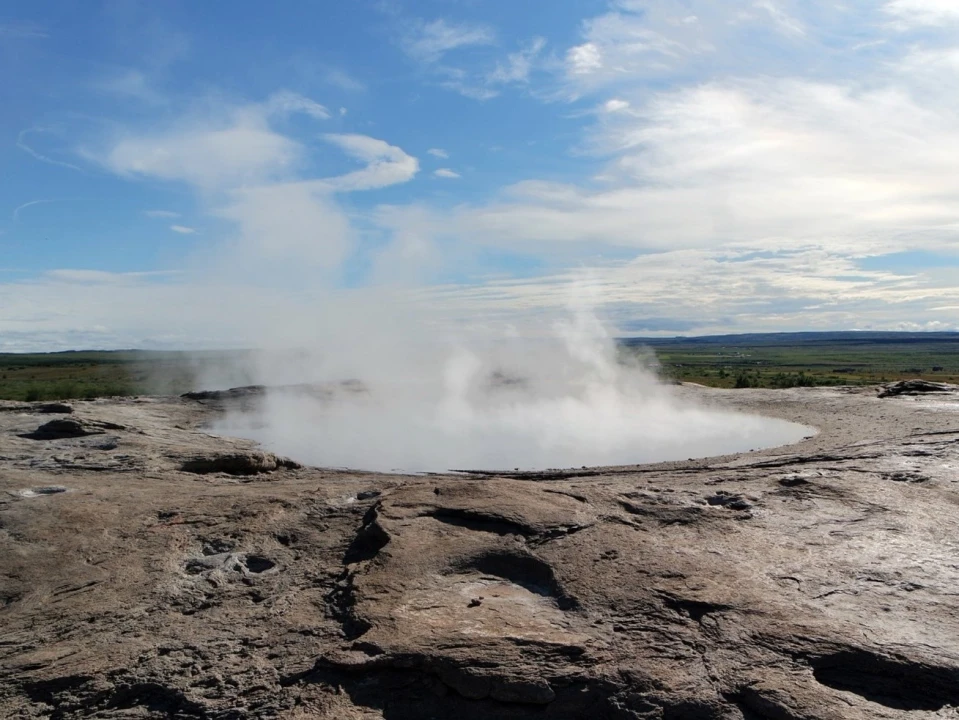

In the hills of Tuscany, between Pisa, Siena, and Grosseto, there is a landscape that once seemed to belong more to the underworld than to the Italian countryside. Steam rises from the ground, hot gases escape through rocky openings, and the Earth reveals an energy normally concealed beneath its surface. For centuries, local inhabitants associated these extraordinary phenomena with supernatural forces, giving the area a name that survives today: the Devil's Valley.
Yet this unusual corner of Tuscany became the birthplace of one of Italy's most remarkable technological achievements. At Larderello, human ingenuity transformed underground heat into electricity, establishing a pioneering role for Italy in the history of renewable energy.
The story begins long before electricity was invented. The geothermal manifestations of Tuscany were known in antiquity, when the Etruscans and Romans recognized the presence of hot springs and mineral-rich waters. Over time, local communities discovered that the same underground activity produced valuable chemical substances, particularly boric acid.
In the early 19th century, French-born entrepreneur François Jacques de Larderel developed innovative techniques for extracting boric acid from geothermal waters. Beginning in 1818, he helped establish an industrial activity that would eventually give Larderello its name.
Previously, the extraction process required substantial quantities of firewood to heat the mineral waters. De Larderel introduced methods that used natural geothermal steam instead, reducing dependence on conventional fuel and demonstrating the practical advantages of harnessing the Earth's internal heat.
But the most extraordinary development was still to come.
On July 4, 1904, Prince Piero Ginori Conti conducted an experiment at Larderello that would become a milestone in energy history. Using geothermal steam to power a small generator, he produced enough electricity to illuminate five light bulbs.
It was the first successful demonstration of electricity generation from geothermal energy.
What began with five bulbs soon developed into an industrial revolution. In 1913, the world's first commercial geothermal power plant began operating at Larderello, supplying electricity to the surrounding area.
This achievement placed Italy at the forefront of a technology that would later spread to countries including Iceland, New Zealand, Japan, and the United States.
The scientific explanation behind the Devil's Valley is equally fascinating. Deep underground, geological processes heat water trapped within permeable rocks. Under suitable conditions, this water produces high-temperature steam that can be brought to the surface through wells and used to drive turbines connected to electrical generators.
Unlike solar and wind power, geothermal electricity can provide continuous generation, regardless of daylight or weather conditions. Its environmental performance depends on the characteristics of the geothermal field and the technologies used to manage emissions and underground resources.
The Tuscan geothermal district remains one of Europe's most important centers of geothermal electricity production. Facilities operated by Enel Green Power have a combined installed capacity of approximately 900 megawatts across Tuscany, producing around 6 billion kilowatt-hours of electricity annually, although output varies from year to year.
Geothermal energy also supports local communities through district heating, industrial applications, and agricultural activities, including greenhouse cultivation.
Visitors to Larderello can discover this unusual relationship between geology and technology at the Geothermal Museum, which documents the history of the area's natural phenomena, scientific discoveries, and industrial development.
Nearby, the natural geothermal manifestations around Sasso Pisano and Monterotondo Marittimo offer another perspective on the forces that made this technological achievement possible. Steam vents, mineral deposits, and altered rock formations create landscapes unlike the rolling vineyards and olive groves usually associated with Tuscany.
The story of Larderello is particularly significant because it challenges familiar perceptions of Italian innovation. Italy's technological heritage is often celebrated through automobiles, design, fashion, and mechanical engineering. Yet the country also played a foundational role in developing a renewable energy technology more than a century before sustainability became a global priority.
From a mysterious valley associated with the Devil to an international reference point for clean-energy innovation, Larderello demonstrates how curiosity, scientific observation, and entrepreneurial vision can transform an apparent natural oddity into a lasting contribution to human progress.
And it all began with five electric light bulbs in the Tuscan countryside.