
In the mountains of northern Sardinia, a small town has become synonymous with one of Italy's most distinctive expressions of traditional craftsmanship. Pattada, located in the province of Sassari, is internationally recognized for its handmade folding knives, objects that combine practical functionality, elegant design, and generations of artisanal knowledge.
The most celebrated of these knives is the resolza pattadese, a folding blade whose unmistakable silhouette reflects the relationship between Sardinia's pastoral traditions and the skills of its metalworkers.
More than a cutting instrument, the resolza is a symbol of regional identity, representing a culture in which everyday objects were expected to be durable, useful, and beautifully made.
Pattada lies approximately 800 meters (2,625 feet) above sea level, in a landscape historically characterized by livestock farming, agriculture, and mountain communities. For generations, shepherds relied on compact folding knives for practical tasks, from preparing food to working with ropes, leather, and other materials.
The knife became an essential companion in rural life, and local craftsmen developed increasingly sophisticated techniques for producing blades that were both reliable and visually distinctive.
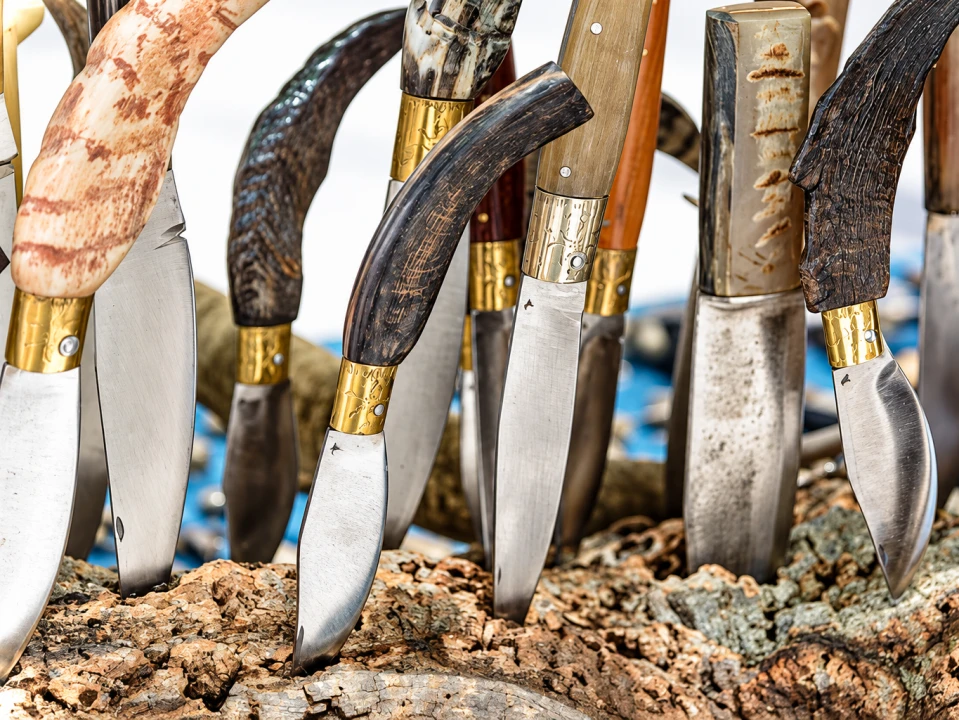
The traditional resolza features a slender, pointed blade, often described as leaf-shaped, that folds into a carefully shaped handle. Its proportions are balanced, with smooth lines that give the instrument an elegance rarely associated with ordinary working tools.
One of its most recognizable characteristics is the handle, traditionally fashioned from ram's horn, although other natural materials may also be used. The horn is selected, shaped, polished, and fitted to the metal components through a process requiring considerable precision.
Because natural horn varies in color, texture, and pattern, each handmade knife possesses its own visual personality.
The blade is generally produced from steel chosen for its ability to retain a sharp cutting edge while remaining suitable for repeated use. Modern artisans may employ different steel compositions, but the essential principles of shaping, grinding, sharpening, and finishing remain central to the craft.
Producing a high-quality resolza involves numerous stages. The artisan first prepares the blade and its tang, carefully establishing the profile and geometry. The handle components are then shaped to accommodate the folded blade, while metal fittings provide structural strength and stability.
Traditional examples commonly use a simple friction-folding mechanism rather than a complex locking system. The quality of the finished knife depends on precise alignment, controlled movement, and the relationship between the blade and handle.
These details may appear minor, but they distinguish a carefully handmade instrument from a mass-produced imitation.
In Pattada, craftsmanship has historically been transmitted within families and small workshops. Young apprentices learned by observing experienced knife makers, gradually mastering techniques that could not be fully explained through written instructions.
The sound of metal being worked, the judgment required to select a suitable piece of horn, and the final polishing of a blade all formed part of an education based on practical experience.
This continuity is particularly important in an era when many traditional crafts face competition from industrial manufacturing and inexpensive imported products.
The reputation of Pattada's knives has extended well beyond Sardinia. Collectors and enthusiasts appreciate them for their technical qualities, while visitors discover an artisanal tradition that remains closely connected to the territory.
However, the resolza should not be understood simply as a decorative souvenir. Its original identity belongs to the working culture of Sardinia, where practical tools developed into recognizable expressions of local creativity.
The knife also illustrates the broader importance of Italian craftsmanship. Across the country, specialized communities have transformed ordinary materials into products distinguished by technical refinement and cultural significance.
Just as Murano is associated with glass, Deruta with ceramics, and Cremona with violin making, Pattada has established an identity rooted in a particular form of manual expertise.
Preserving this tradition requires more than celebrating its history. It depends on supporting working artisans, encouraging younger generations to acquire specialized skills, and recognizing the value of objects made through patient, individual craftsmanship.
Every authentic handmade resolza reflects decisions made by its creator: the curve of the blade, the character of the horn, the precision of the fittings, and the final balance of the instrument.
These qualities cannot be reduced to a production formula.
In a world increasingly dominated by standardized objects, the knives of Pattada remind us that Italian excellence often begins in small workshops, where knowledge passes from one pair of hands to another.
The resolza remains a practical instrument, but it is also a lasting expression of Sardinia's history, landscape, and artisanal imagination.
Its beauty lies not in unnecessary decoration, but in the perfect relationship between form, function, and tradition.