

In Naples, one of the city’s most surprising rooms is not a chapel, a palace, or an underground ruin. It is an aquarium. Hidden inside the Anton Dohrn Zoological Station beside Villa Comunale, the Aquarium of Naples opened on January 26, 1874. More than 150 years later, it remains in its original home, still connected to the sea by an underground channel. It is a living 19th-century idea, still looking out onto the Mediterranean it was built to study.
The place began with an ambitious German zoologist, Anton Dohrn, who saw Naples as an ideal laboratory. The Gulf of Naples offered extraordinary marine variety, while the city itself had about 500,000 residents and drew roughly 30,000 tourists a year. Dohrn persuaded the city to grant him a waterfront plot in the Villa Comunale. In return, he would finance the construction of a scientific station himself. His plan was unusual and wonderfully practical: put a public aquarium on the ground floor, charge admission, and use the income to help support scientific research upstairs.
The Zoological Station welcomed visiting researchers in 1873, before the aquarium opened to the public the following January. Dohrn wanted scientists to observe marine creatures alive, rather than relying only on preserved specimens. Visitors, meanwhile, could see a world that normally remained below the waves. The same building made research visible to the public and helped pay for it – a remarkably modern arrangement for 1874.
The engineering is one of its best curiosities. British engineer William Alford Lloyd, who had worked on public aquariums in London and Hamburg, supervised the installation. Seawater was drawn from the Gulf of Naples, carried through underground channels and cisterns, then circulated through the tanks. The system turned the aquarium into something close to an indoor extension of the bay.
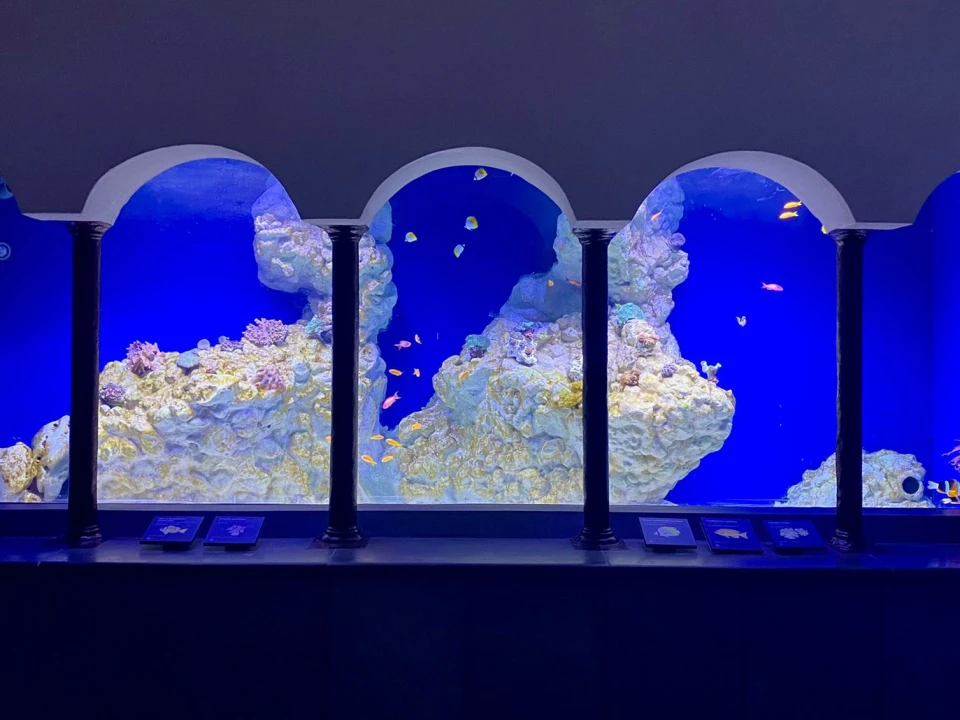
The historic public aquarium covers 527 square meters. Its architecture has changed remarkably little, and the original display tanks remain central. Daylight enters through side windows and skylights, while the subdued interior lets the illuminated water take over. The effect is less like walking through a contemporary attraction and more like entering a carefully preserved theater of marine life, where the Mediterranean is the main character.
Today, visitors encounter about 30 tanks and more than 200 marine animal and plant species, most associated with the Gulf of Naples. The route moves through habitats rather than offering a random collection of fish: rocky coasts, caves and crevices, seagrass meadows, coralligenous environments, open water, and deeper zones. There are also displays that consider changing seas, including tropical formations and species that have entered Mediterranean waters.
The creatures provide plenty of memorable details. Seahorses swim upright, and it is the male that carries the eggs in a brood pouch until they hatch. Octopuses are another local fascination: the station has long been a place where their intelligence and behavior could be observed closely. Moray eels point toward another Naples-area curiosity, the ancient Roman fish-breeding structures preserved in the marine archaeological area of Gaiola at Capo Posillipo. Even a small tank can open onto a much larger history of the coast.
The Naples aquarium is therefore distinctive for more than its age. It is Italy’s first public aquarium, a working window on Mediterranean biodiversity, and a rare survivor of the 19th century whose original purpose still makes sense. Its deepest peculiarity may be this: beneath the calm galleries of Villa Comunale, Naples has kept a piece of the sea indoors – and has been learning from it since 1874.