

For more than a decade at We the Italians, and for more than six years working with people considering a move to Italy through ITS Italy, we have talked - a lot - about the same fascinating, irrational relationship.
Someone comes to Italy on holiday, falls in love with the place, returns to the United States and begins to wonder whether long lunches and photogenic village squares might become a permanent lifestyle. Then they discover Italian property websites and that somewhere in Sicily, Sardinia or an inland village, a house costs less than their kitchen appliances. At that point even rational people begin to believe that renovating a nineteenth-century property from 5,000 miles away should be straightforward, presumably because they have watched enough HGTV.
We know these people rather well. ITS Italy has accompanied more than 160 international families through projects in over 20 Italian towns, while We the Italians has spent more than a decade listening to people who have built a relationship with Italy from the United States. We have seen the dream through renovation, bureaucracy and residency, until someone stops simply loving Italy and has to find a plumber on a Tuesday morning. Depending on the municipality, one may also require a geometra, a fixer, a priest or, in particularly difficult cases, an exorcist.
At some point it occurred to us that we had been talking long enough. So we started counting.
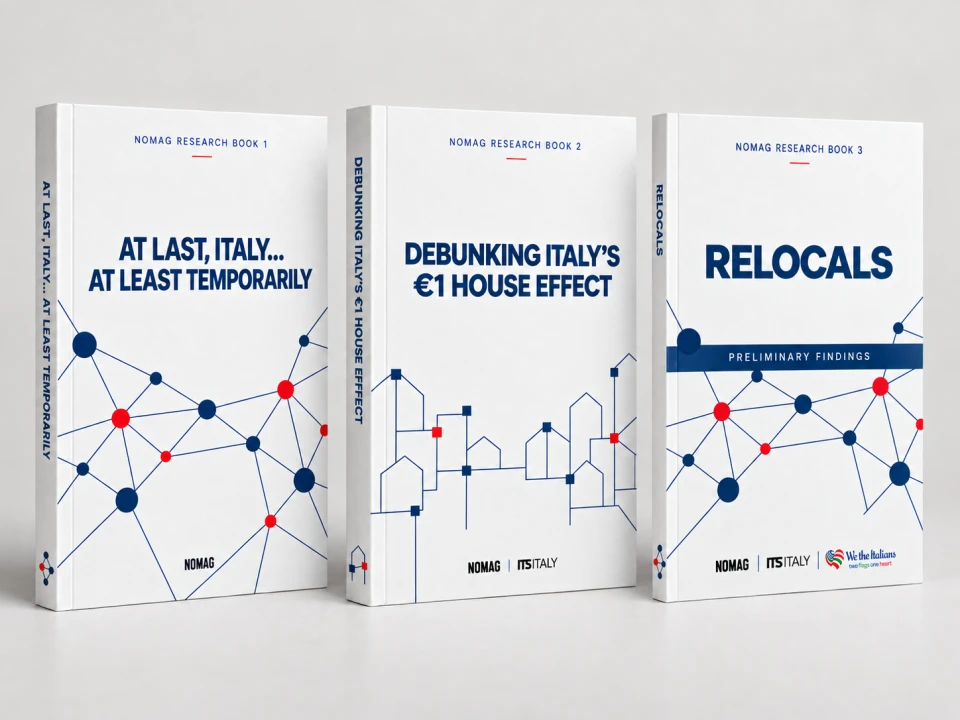
The result is NOMAG Research Books. NOMAG is an independent editorial and research platform focused on digital nomads, international mobility, remote work, relocation and the relationship between people and place, with one foot outside Italy and one inside it.
My suspicion is that we have processed the Italian dream too much. We have taken genuine ingredients - beauty, quality of life, affordable property, human relationships, culture - and turned them into a packaged international product. It is sweet, comforting and, consumed in sufficient quantities, probably capable of causing editorial diabetes. The point is to go back to the raw, quality, ingredients.
The first research, AT LAST, ITALY… AT LEAST TEMPORARILY, started with 1,056 responses from NOMAG's international audience. It is not a census of every digital nomad, but several stereotypes wobble. Only 4.8% described themselves as early-career, while 69.2% were senior, managerial, executive, entrepreneurial or post-career.
They are also, somewhat inconveniently, not particularly nomadic. Almost half prefer one main base with occasional travel, while only 9.9% want to move frequently. A medium-sized city is considered seriously by 49.4%, against 19.6% for a small town or village. After years of imagining digital nomads naturally repopulating remote villages, our audience appears to want something less romantic: a functioning home, decent transport, healthcare and services. The landscape can come afterwards, preferably with a decent spritz nearby.
The American segment is especially interesting here. Among US-based respondents, 67% reported income above €60,000 and 28% above €100,000, yet 85% imagined staying no more than three months. Meanwhile, 21% would consider spending at least €2,000 per month on accommodation, and 87% prefer either an entire private home or a serviced apartment. The Italian Digital Nomad and Remote Worker Visa adds another signal: 35% said it could encourage them to remain beyond 90 days, while 29% were interested but found the rules unclear. Italy, after all, has a distinguished tradition of creating procedures whose existence becomes fully apparent only after one has failed to comply with them.
The second book, DEBUNKING ITALY'S €1 HOUSE EFFECT, moves into another territory Americans know particularly well. Few Italian stories have travelled as well through US media as the €1 house: symbolic prices, abandoned buildings, beautiful villages and, ideally, someone from California explaining that they bought an eighteenth-century property for less than dinner in LA.
Many municipalities achieved something genuinely impressive: they made previously invisible places visible to the world. The problem begins when visibility, transactions, renovation spending, tourism, foreign ownership and demographic regeneration are treated as interchangeable outcomes. They are not. In several famous cases, Americans and other international buyers feature prominently in the property story, while the foreigners who actually make up the resident population often come from different migration patterns. This does not mean the €1-house initiatives failed. It means they should be judged for what they actually changed.
RELOCALS begins where the other two stop. Its first exploratory phase includes 103 international residents, 25 originally from the United States. It begins to show what happens when Italy stops being a destination and becomes everyday life.
Only two respondents are pensioners, 66% are between 35 and 54, and 63.1% generate most of their income outside Italy. More surprisingly, 64.1% say they had not expected to stay as long as they eventually did. Some people arrive with a temporary plan and, despite discovering bureaucracy, transport, housing and the other pleasures that rarely feature in a relocation brochure, they stay.
The contradiction becomes even more interesting when they describe Italy. Human relationships, nature and culture lead the positives. Yet housing and job opportunities are cited as major disadvantages by 78.6%, bureaucracy by 76.7% and transport by 74.8%. And 84.5% say one of the great misunderstandings outside Italy is the idea that living here is a permanent holiday. Apparently the washing machine still breaks 'Under the Tuscan Sun', and there are problems no glass of wine can solve - although it may improve the meeting in which they are discussed.
This is why I find these people more interesting than traditional ambassadors of Italy: they are credible because they are not required to be positive. In fact, 75.7% say that living here has changed the way they talk about the country. They can love Italy and complain about it without finding those positions contradictory, something Italians themselves have practised successfully for centuries.
And perhaps this is where the research becomes most encouraging. We did not start collecting data to prove that the romantic storytelling was wrong. Some of it is wrong, some simplistic and some should probably carry a warning about excessive carbs consumption. But after looking at the numbers, I am more interested in Italy's capacity to attract people, not less. The remarkable thing is that the appeal survives contact with reality.
People discover that Italy is not uniformly cheap, that a €1 house rarely costs €1 (and possibly more than €100k) by the time it becomes a home, and that services matter rather more when you live somewhere than when you visit. Yet tens of thousands continue to consider spending a meaningful part of their lives here, and many who arrive temporarily stay longer than expected. That is not evidence that Italy is perfect. It may be evidence of something more useful: an underlying demand that does not need to be manufactured, only understood better and converted more intelligently.
On September 24 in Rome we will present the first RELOCALS findings. After that, the research goes through at least 12 communities across Italy. The roadshow is part of the research, designed to challenge what the first 103 participants have told us.
After years of telling stories about people who dream of Italy, we would now like to understand who they are, what happens when they arrive and why a surprising number still decide that Italy is worth the trouble.
I am not sure whether that says more about Italy or about them. The next twelve stops may tell us.
We the Italians readers will be able to download the NOMAG Research publications and follow the next stages of the research free of charge. Those who are interested can email at [email protected]