

In a Florentine workshop, a sheet of paper can begin its life almost like a blank canvas and emerge minutes later as an object that can never be reproduced exactly. This is the essence of carta marmorizzata, Florence's celebrated marbled paper – a handcraft in which color, water and highly controlled gestures transform an everyday material into something unique.
The technique did not originate in Florence. Methods of floating colors on liquid developed centuries ago in Asia and became particularly sophisticated in the Ottoman world through the tradition known as ebru. Marbled papers later reached Europe through commercial and cultural exchanges.
Florence, however, provided an exceptional environment in which the technique could flourish.
By the 17th century, decorated papers were increasingly used by European bookbinders. Florence already possessed a sophisticated network of printers, bookbinders, stationers and workshops producing decorative objects. Marbled paper therefore became connected to a wider Florentine culture in which specialized manual skills were applied not only to major works of art, but also to objects used in everyday life.
The process remains surprisingly physical.
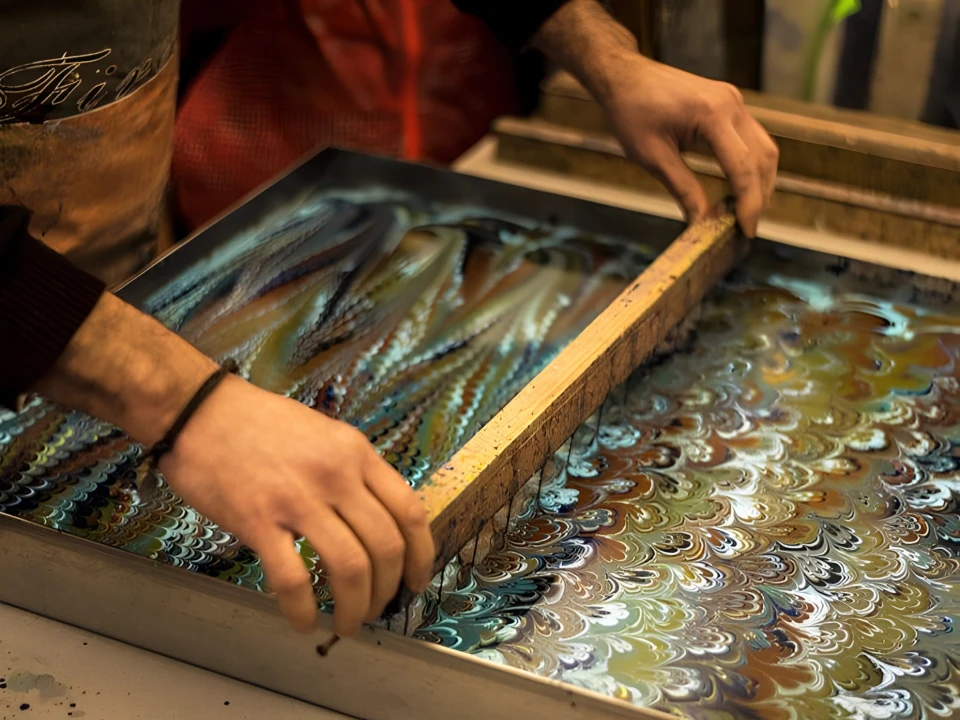
The artisan prepares a shallow rectangular tray containing water that has been thickened so pigments can remain suspended on its surface. Colors are then dropped, sprinkled or carefully distributed across the liquid.
From that moment, the hands take control.
Using simple instruments such as sticks, brushes and combs, the maker draws through the floating pigments. A straight movement can create parallel veins. Repeated movements can produce waves, feathers, curls, fans and increasingly complex geometric patterns.
Pressure matters. Speed matters. Direction matters.
The artisan must understand how the pigments react to one another and how the surface changes with every movement. There is no computer correcting the composition and no machine guaranteeing that the next sheet will look like the previous one.
When the pattern is ready, a single sheet of paper is gently lowered onto the floating design.
Timing is essential. The paper captures the pigments before being carefully lifted from the tray, drained and left to dry. A design that existed for only moments on the surface of the water has become permanent.
And it exists only once.
No 2 genuinely handmade sheets are completely identical. Even when the same artisan uses the same pigments, tools and sequence of movements, subtle variations produce a different result. That individuality is one of the clearest distinctions between traditional marbling and industrially printed paper that merely reproduces its appearance.
The craft also requires considerable preparation that the finished product does not reveal. Pigments must have the correct consistency. The liquid surface must behave properly. Paper must absorb the design without allowing colors to lose their definition.
Experience teaches the maker when something is wrong before an inexperienced eye would notice it.
Historically, Florentine marbled paper became particularly important in bookbinding. It could be used for covers and endpapers, turning the opening of a book into a visual experience. Over time, workshops extended these decorated papers to boxes, folders, albums, frames, desk accessories and other objects.
This adaptability has helped preserve the handcraft.
Today, Florence's historic center still contains specialized workshops and stores where decorative paper is part of the city's living identity. Some designs reflect patterns handed down through generations, while others introduce contemporary combinations of colors and forms.
The distinction between handmade and mass-produced objects has become increasingly important. Modern printing can reproduce the visual appearance of marbling thousands of times at very low cost. What it cannot reproduce is the process itself – the slight unpredictability of floating pigment, the decisions made by the maker and the individuality of every sheet.
That is why Florentine marbled paper belongs so naturally to the story of Italian handcrafts.
Its tools are simple. Its raw materials are modest. Its value comes from knowledge.
Florence is famous around the world for monumental masterpieces created in marble, bronze and paint. But its creative history also survives on a much smaller scale – inside workshops where hands continue to make beautiful objects one at a time.
With carta marmorizzata, the maker has only a few seconds to capture a pattern floating on water.
The result can survive for centuries.