
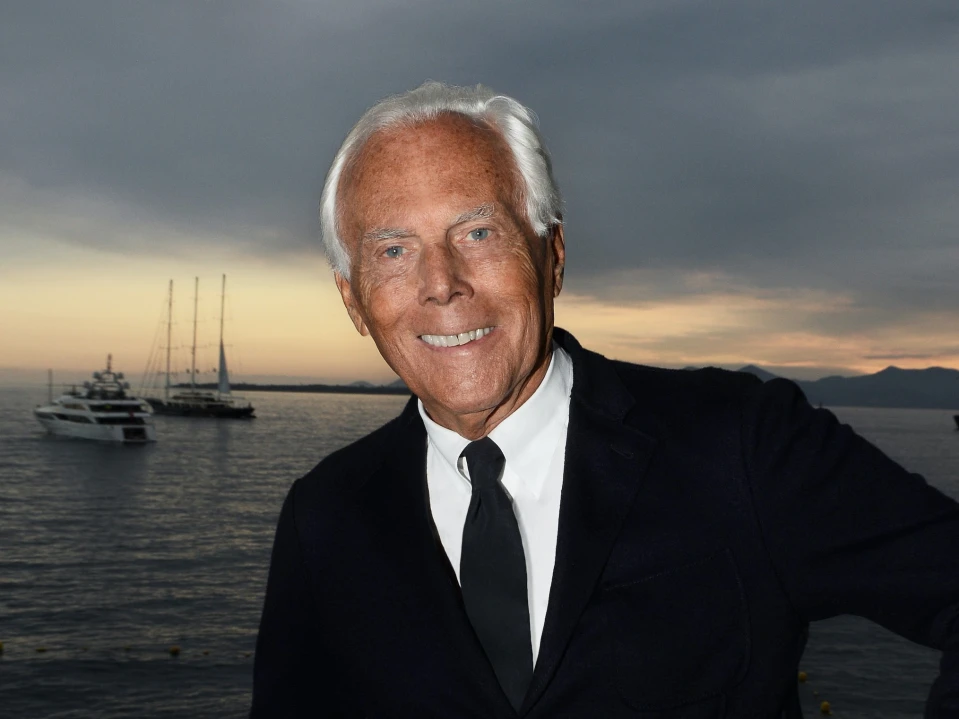

Giorgio Armani, who passed away in Milan on September 3, 2025, was without question one of the greatest figures of our time in both business and the arts. There is no need to underline the influence of the designer from Piacenza in Emilia Romagna – known to all as “the King” – on the world of fashion.
Journalist Serena Tibaldi once wrote: “King Giorgio. An absolute legend of fashion, a universal icon of contemporary style, liberator of women, inventor of trends, looks, and above all, ways of being.”
Patrizia Vacalebri described him as “the king of minimalist style, the inventor of contemporary elegance, admired and celebrated by the public, the press, and celebrities alike.”
But Armani’s role in society and his influence on the modern era went far beyond fashion. “King Giorgio” embodied an inimitable style, a distinctive vision of the world, and a unique, unmistakable way of looking at reality.
This is what gave rise to the idea of the “Armani Code.” As critic Angelo Flaccavento explained: “The vibrant purity of the Armani code is not for everyone, but it wins people over. It feels modern, stripped-down, elegant, yet also warm and human.”
The Armani Code led him to play an authoritative role not only in fashion but also in design, a field where he was both a brilliant pioneer and an endlessly curious explorer. His foray into design emerged naturally, almost inevitably, as an extension of his unmistakable stylistic language.
Leonardo Castiglione captured this perfectly in his essay “When Fashion Breathes Like Architecture”: “Armani never created fashion the way others did. His minimalism – elegant and implacable – breathed with the same rhythm as the great masters of modern architecture. His deconstructed jackets, falling lightly on the body as if the fabric breathed on its own, were small exercises in balance: between void and volume, sartorial memory and futuristic anticipation. Light structures of a building where every seam and fold was an invisible pillar. Every fabric – from cashmere to linen, from velvet to technical cotton – became a building material, clothing not only the body but also the mental space of the wearer.”
This relationship with design became fully explicit, and structurally entrepreneurial, in 2000 with the launch of Armani/Casa.
As Annabelle Dufraigne recalled in a recent conversation with Armani, he reflected on key milestones: “The creation of the brand 25 years ago was without doubt a crucial moment. The opening of the boutique on Corso Venezia in Milan, in the former De Padova showroom, was a turning point for Armani/Casa; it was like taking ownership of Milanese design. And the two presentations at Palazzo Orsini were also fundamental steps, connecting the worlds of fashion and design, emphasizing the dialogue and continuity between the two.”
In 2010 came the debut of the Armani Hotels – luxurious five-star spaces defined by understated refinement. These in turn opened the way for the first Armani-branded residences, once again reflecting the Armani Code’s vision of lifestyle and elegance.
Armani’s bond with the United States was particularly strong. He often recalled with emotion his first arrival in New York: “My first trip to New York was exhilarating. To see the city in person, after dreaming of it and watching it only in movies, left a lasting impression on me. It was the 1970s, America was bursting with energy, and I felt part of it.”
As recently as October 2024, Armani personally inaugurated the brand’s new “universal home” in Manhattan: a 12-story building on Madison Avenue, with eight streetfront windows and nearly 100,000 square feet of space. Inside were the new Giorgio Armani and Armani/Casa boutiques, an Armani Ristorante, and from the fourth to the twelfth floors, the Giorgio Armani Residences – all designed under his direct supervision in collaboration with New York–based Cookfox Architects.
Reflecting on the project, he said: “The Madison Avenue building was completely redesigned, evoking the architecture of the 1940s, which has often inspired me. It stands out for its timeless elegance yet blends seamlessly into its surroundings. My hope is that it communicates, in both architecture and design, my message of subtle restraint and balanced, yet luxurious, beauty. This opening marks a new chapter in a dialogue that began in the late ’70s and has continued ever since.”
On that same occasion, Armani spoke openly about his personal relationship with design: “For me, design is essential. At a certain point in my career, I wanted to explore a new realm, applying the same principles I used in fashion to an important and rewarding challenge. Armani/Casa and the projects I have worked on – and continue to work on – represent a complete experience. They embody my entire idea of lifestyle.”
Armani’s connection with design was thus profound and enduring, reflected in his creations, his ventures, and his life itself.
As designer Francesco Trabucco once said, design means “confronting history.” With that in mind, one cannot forget Armani’s open letter to the fashion world on April 17, 2020. At a time when the industry – and the world at large – was reeling from the shock of the COVID-19 pandemic, Armani, with stunning clarity, offered a vision of meaning and direction for the future:
“This crisis is a wonderful opportunity to slow everything down, to realign everything, to sketch out a horizon that is more authentic and true.”