
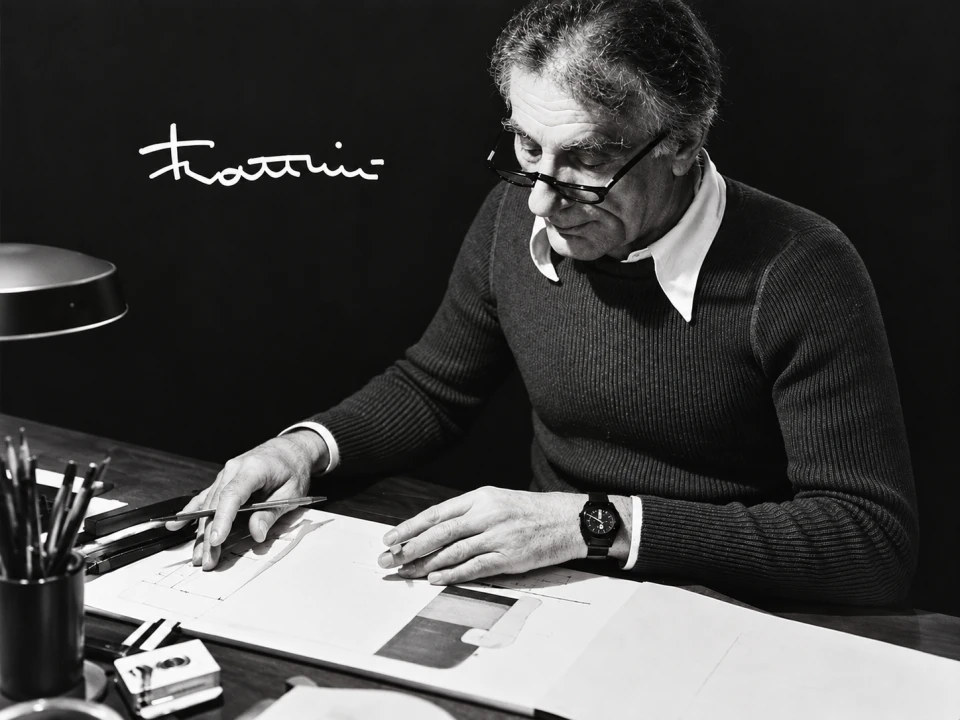

In 2026, we celebrate the centennial of the birth of Gianfranco Frattini, a figure of extraordinary interest whose work remains remarkably relevant within the landscape of Italian design.
Frattini, born in Padua on May 15, 1926, was one of the most significant Italian architects and designers of the 20th century.
Born in the Veneto region but Milanese by adoption, he began working with Cesare Cassina, whom he had met at Giò Ponti’s studio, in 1954, before he was even 30 years old.
His list of collaborations soon expanded to include many other prestigious companies: Kartell, Bernini, Bonacina, Arteluce, Ricci, Progetti, Artemide, and Knoll; then, in the 1980s and 1990s, Acerbis, Bottega Ghianda, and Poliform; and, in the 2000s, Fontana Arte and Porada.
To mention just a few examples of his work, in 1955 the Padua-born architect designed the “Model 836” armchair and modular sofa for Cassina; in 1967, the round, stackable “Model 780” tables; and in 1969, the square “Dalles Model 78” tables with steel frames.
“Albero” was an innovative bookcase that could rotate 360 degrees, combining the typical floor-to-ceiling support post with the concept of a single totem-like modular structure. The piece remains a highlight of the Poltrona Frau catalog to this day.
Particularly important and absolutely distinctive was Frattini’s relationship with wood.
In 1978, after leaving his historic Milan studio on Via Lanzone, the Veneto-born designer moved to a new space on Via Sant’Agnese.
There, he began an extraordinary partnership with master cabinetmaker Pierluigi Ghianda. Through their collaboration, Frattini explored the many possibilities offered by wood, the material at the heart of his work.
After making a crucial trip to Japan, Frattini and Ghianda also turned their attention to the Amazon in the 1980s, where they identified new types of wood to introduce into original artisanal and architectural solutions.
In 1974, inspired by Frattini’s experience in Japan and conceived as a tribute to the country’s refined woodworking tradition, the “Kyoto” coffee table was created. Made of beechwood with an orthogonal lattice structure, its more than 10,000 joints, organized according to a modular system, have helped make it a signature piece in the Poltrona Frau collection.
Equally fundamental to Frattini’s work was his relationship with light, which he considered part of the architectural framework – a kind of instrument for defining space.
In 1970, together with Livio Castiglioni, he designed the “Boalum” lamp, an extraordinary project positioned at an imaginary intersection between a lighting fixture, a piece of furniture, and a work of art.
Last May, the ADI Design Museum in Milan hosted the presentation of the catalogue raisonné of Frattini’s design works from 1953 to 2003. The book is part of a series that Silvana Editoriale has dedicated to the great masters of Italian design for approximately a decade.
Edited by Silvana Annicchiarico in collaboration with Studio/Archivio Gianfranco Frattini, the volume opens with an extensive introduction by the curator outlining the various stages of Frattini’s professional life.
The essay recounts how Frattini began his professional career with an assignment from Giò Ponti in 1953, the same year he graduated from the Polytechnic University of Milan: overseeing the construction site of the Royal Hotel in Naples.
It was an old Neapolitan hotel that required a complete reconstruction.
As the young architect approached the hotel construction site, he reportedly said: “First, I have to understand it.”
Frattini is also said to have remarked on other occasions: “Every material has its own language, and it must be respected.”
This respect for existing reality and his desire to reach the essence of things consistently characterized his way of working. He would begin with the detail – which he considered the starting point of any project – and from there arrive at the final overall vision.
The episode involving the Royal Hotel in Naples is particularly illuminating. It also provides a valuable key to understanding a fundamental passage in “Gianfranco Frattini. Design 1953–2003.”
It is a passage that seems especially significant and, in a broader sense, emblematic of the continuing relevance of the designer and architect.
In her essay, Silvana Annicchiarico perceptively observes that Frattini’s work embodied “not the heroism of rupture, but the patience of adjustment.”
In an Italy that had only recently emerged from the devastation of World War II, there was a sense of civic responsibility in picking up the thread of history without tearing it apart, avoiding traumatic leaps into the unknown and connecting memories of the past with hopes for the future.
Today, amid profound changes affecting the economy and society as a whole, Italy stands out as a country extraordinarily rich in innovation.
Yet this is a very particular and distinctive kind of innovation. It does not necessarily produce disruptive breakthroughs. Instead, it advances through continuous and gradual improvements – incremental and layered changes produced by the constant, determined refinement of everyday work.
Perhaps, upon closer examination, the spirit of contemporary Italy contains more traces of Frattini’s thinking and work than we usually imagine.
Ultimately, in many respects, even today we remain instinctively and culturally more inclined, across virtually every sphere of life, toward the patient work of adjustment and modernization than toward heroic gestures of rupture.