


The space economy is a fascinating sector of tremendous interest and growing relevance.
Until just a few years ago, this field was reserved exclusively for government bodies and international agencies. Today, it has become a fully established industry, encompassing a vast array of businesses of every size and type.
Within this landscape, a highly competitive and technologically advanced Made in Italy sector has emerged, with design serving as a particularly valuable resource.
One especially compelling business story is that of Spacewear, a young company based in Italy’s Marche region. Founded by four partners with backgrounds in fashion, automotive engineering, and aerospace, it combines aerospace engineering, tailoring expertise, and advanced computing to create smart suits and high-performance garments for astronauts.
Corinna Sperandini, Spacewear’s co-founder and CEO, describes the philosophy behind the project: “Spacewear was founded in 2021 with the goal of bringing innovation to the textile and apparel sector, a cornerstone of Italian manufacturing that has remained tied to outdated practices and ways of thinking that are contributing to its decline. We chose to go into space because it is the most demanding environment, one where research and development are more than just words. Space is the most challenging and hostile environment for human beings. Creating clothing and equipment that support their ability to live and work there, while ensuring protection and comfort, is the ultimate challenge. The most complex aspect is introducing new capabilities and functions while meeting NASA’s stringent safety requirements. On a practical level, the task is to determine which capabilities are useful to astronauts, how to deliver them in a single garment, and how to achieve them through fabrics and the integration of miniaturized, noninvasive devices.”
The startup achieved its first major success on June 29, 2023, when Galactic 01, the first commercial flight operated by Virgin Galactic, the company founded by British entrepreneur Richard Branson, launched from Spaceport America in New Mexico.
Known in Italy as “Virtute-1,” it was the first suborbital mission with an Italian crew, made possible through an agreement between the Italian Air Force and Virgin Galactic, in collaboration with Italy’s National Research Council, or CNR.
On board, Colonel Walter Villadei wore Spacewear’s Smart Flight Suit 1, an innovative smart suit that continuously monitors an astronaut’s biometric data in real time.
Essentially, the garment functions as a wearable electrocardiograph: lightweight and breathable, the suit records the wearer’s cardiac activity simply by being worn.
Its pockets, tested to withstand accelerations of up to 9 Gs, also carried small vials for experiments conducted by Italian universities. A specially designed fastening system secured them so they would not float away when the pockets were opened in microgravity.
The following year, on January 18, 2024, Walter Villadei served as the pilot of SpaceX’s Crew Dragon spacecraft on the Axiom-3 mission to the International Space Station, or ISS. The Italian component of the mission was named “Voluntas.”
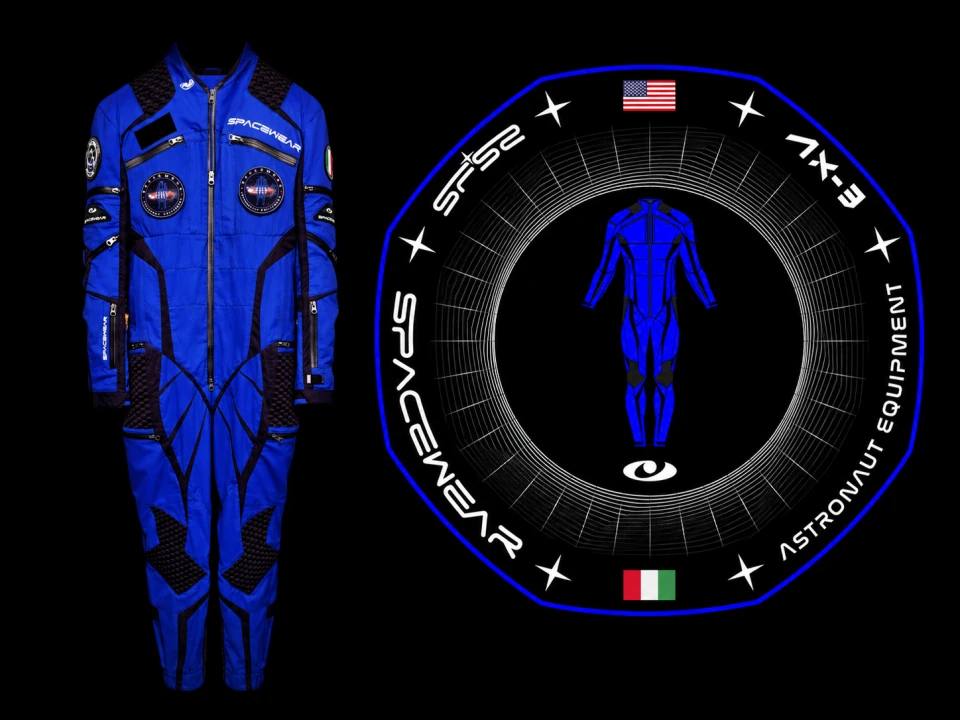
The astronaut was equipped with another Spacewear product, Smart Flight Suit 2, the first Italian interactive wearable suit approved by NASA and the Federal Aviation Administration for use aboard the ISS.
The garment weighs less than one kilogram, or about 2.2 pounds – what the apparel industry might describe as “shirt weight.” It is a unique, multifunctional garment designed for around-the-clock use, with temperature-regulating, breathable, antibacterial, and flame-resistant properties.
This product embodies what makes the company distinctive: its ability to bring advanced technological expertise and exceptional tailoring skills together in unexpected and remarkable ways, guided by contemporary design.
An ordinary stretch fabric, even a cutting-edge one, would not meet the stringent flame-resistance requirements of the applicable standards.
Spacewear’s solution for Smart Flight Suit 2 therefore draws on the extraordinary craftsmanship of its team. The suit consists of approximately 200 pieces, cut and assembled to give the body the same freedom of movement that a stretch material would provide.
It is an outstanding example of high-tech fashion, featuring an ergonomic design inspired by concepts associated with so-called “automotive hype” – design that emphasizes performance.
These exceptional technical and tailoring capabilities, combined with an instinctive focus on astronauts’ needs, reflect the enduring legacy and unmistakable character of Italian design, with its natural commitment to placing people at the center of every project.
During activities inside spacecraft and space stations, fit, freedom of movement, and the feel of materials against the body play a fundamental role in the crew’s well-being.
This is where Italian design culture, with its distinctive attention to ergonomics, form, and detail, meets the specific demands of aerospace research.
Spacewear’s suits naturally meet the requirements dictated by each mission’s objectives, while also adapting to the bodies and needs of the people carrying it out.
For the Marche-based company, space is a challenge, a testing ground, and a laboratory. Its ambition is to bring the results achieved through its design, technology, and expertise back into everyday life on Earth.
As Corinna Sperandini explains: “The advances embodied in our suits have dual-use applications, and applying the results of our research here on Earth is one of our goals. Consider water conservation, for example, which is essential aboard the space station and equally necessary on our planet. The long-lasting antibacterial properties we test in our suits, worn for days during training, sleep, and work aboard the International Space Station, allow them to remain perfectly clean. Made with 50% cotton, they are environmentally conscious products.”