
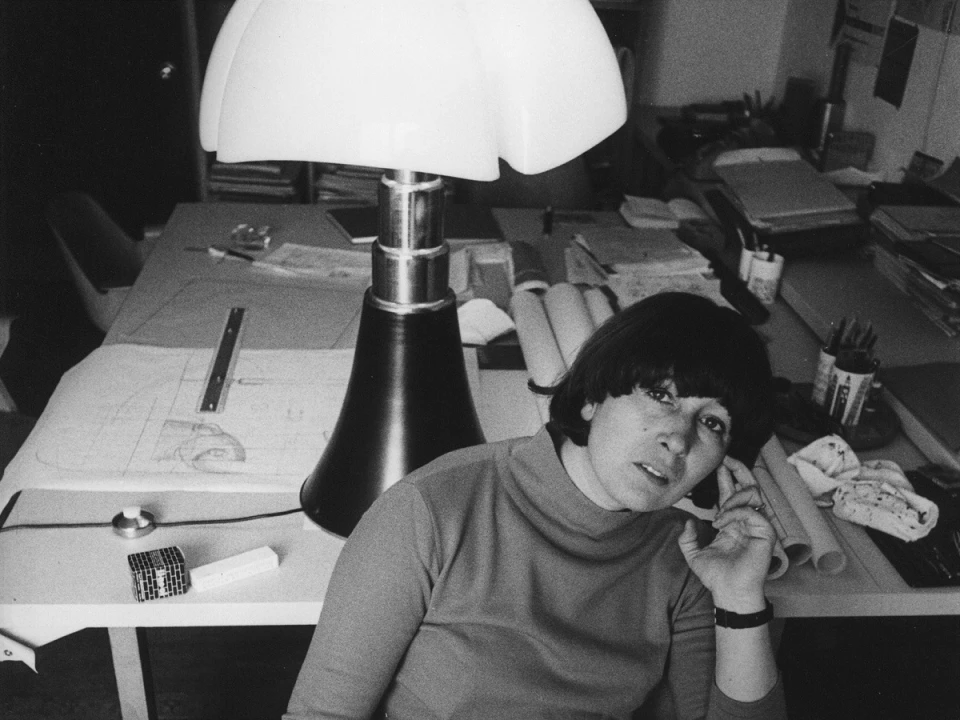

Gae Aulenti stands as one of the most important and original figures in the history of Italian design. Born on December 4, 1927, in Palazzolo dello Stella, in the Friuli Venezia Giulia region, Gaetana Emiliana Aulenti – “Gae” to everyone – earned her degree in architecture from the Politecnico di Milano in 1953 and became a leading voice in the field starting in the 1960s.
The career of this architect, designer, and artist unfolded across multiple paths, from interior and furniture design to major architectural projects, such as transforming Paris’s Gare d’Orsay into a museum. Transversality, multidisciplinarity, and eclecticism are defining traits of Gae Aulenti’s work, and she stated clearly and meaningfully that she had “no desire to be a specialist in anything,” wishing instead to live as a nomad “from one place to another, from one job to another.”
In this 2025, now drawing to a close, the sixtieth anniversary of one of her most historic design creations is being celebrated – a piece that has taken on an almost manifesto-like significance for the designer: the Pipistrello lamp.
Aulenti designed the Pipistrello in 1965 for the Olivetti store in Paris, and it was produced by Martinelli Luce. The Olivetti store itself was an extraordinary project – a space conceived to evoke the piazza of an ideal Italian city, characterized by enveloping curves, white plastic laminate surfaces, a red cladding for the central column, and a Senufo anthropomorphic sculpture as a symbolic element.
In this exceptional setting, poised between the metaphysical and the theatrical, the Pipistrello found its natural habitat, fully expressing its originality and helping create a unique and captivating atmosphere, one bordering on the surreal.
The lamp enters the environment not only as a technical device but also – and above all – as a kind of living organism: the shape of its white methacrylate diffuser evokes the silhouette of the winged nocturnal animal without ever becoming an explicit reference. The designer conceived the Pipistrello as an artifact halfway between a technological invention and an architectural work: the base as foundations, the telescopic stem as trunk or column, the diffuser as a capital.
This tripartite verticality gives the lamp a strong architectural rigor, a tacit structural order that enhances the freedom of its design. Its footprint reveals a carefully calibrated construction, in which the complexity of the curves finds perfect balance: the imagination and sensuality of the forms coexist seamlessly with the discipline and precision of the rapidograph.
The project’s extreme modernity is also evident in the difficulties encountered in bringing it to life. Some components of the lamp, as well as the telescopic mechanism, posed extremely demanding challenges – nearly impossible given the molding technologies and production methods available in the 1960s.
The creation of the Pipistrello, consequently, was anything but easy and came only at the end of a rather painful development process. It is said that the project was proposed to Elio Martinelli by Sergio Camilli, founder of Poltronova, who presented it with a phrase that has since become legendary: “Gae has this lamp she needs to make…”. The project then remained in Martinelli’s drawers for months: the telescopic stem was difficult to engineer, and the diffuser with its sinuous flaps was nearly impossible to mold.
After its debut in the Olivetti store, the Pipistrello spread its wings, becoming a cult object and establishing itself internationally. Over time, the lamp has been developed in numerous variants – initially in agreement with the designer and later continued by Martinelli Luce: aluminum finishes, reduced sizes, cordless versions, and models for workstations.
For its sixtieth anniversary, the lamp has been reissued in an elegant and striking limited-edition White Matt celebratory version.
Emiliana Martinelli has recalled how Gae Aulenti impressed those around her with her personal charisma, determination, and authority, as well as with her professional talent, which allowed her to visualize a project in its entirety from the outset, without hesitation.
The Pipistrello faithfully reflects the nature of its designer: it is not conciliatory, not decorative, not timid; it is independent, rigorous, capable of conversing with its surroundings while maintaining its autonomy without ever becoming hostile to its environment.
In the lamp, one finds much of Gae Aulenti herself: her passion for theater, for staging, for installations, as well as her absolute mastery of technical drawing and construction – a virtuous combination of imagination and rigor, freedom and order.
Today, sixty years after its creation, we can say that the Pipistrello retains all its relevance, vitality, and driving force. In fact, in the Contemporary world – in our Society of Complexity – the project finds a truly ideal habitat, thanks to its intricate nature as a rigorous micro-architecture, a scenographic object, a quasi-metaphysical figure, and a futuristic lighting device.
Ultimately, no one has ever captured the meaning, destiny, and essence of the Pipistrello better than its creator: “I would like an object we design to last a hundred years, because we want it that way, just as we desire an Egyptian or Mayan object. The idea of durability is, for me, a profound and moral idea. That is why a designer, even when creating an object destined for production and for a future he or she cannot fully know, must design it as though it were meant for a specific place: such is the case of my Pipistrello lamp, created many years ago for the Olivetti store in Paris.”