
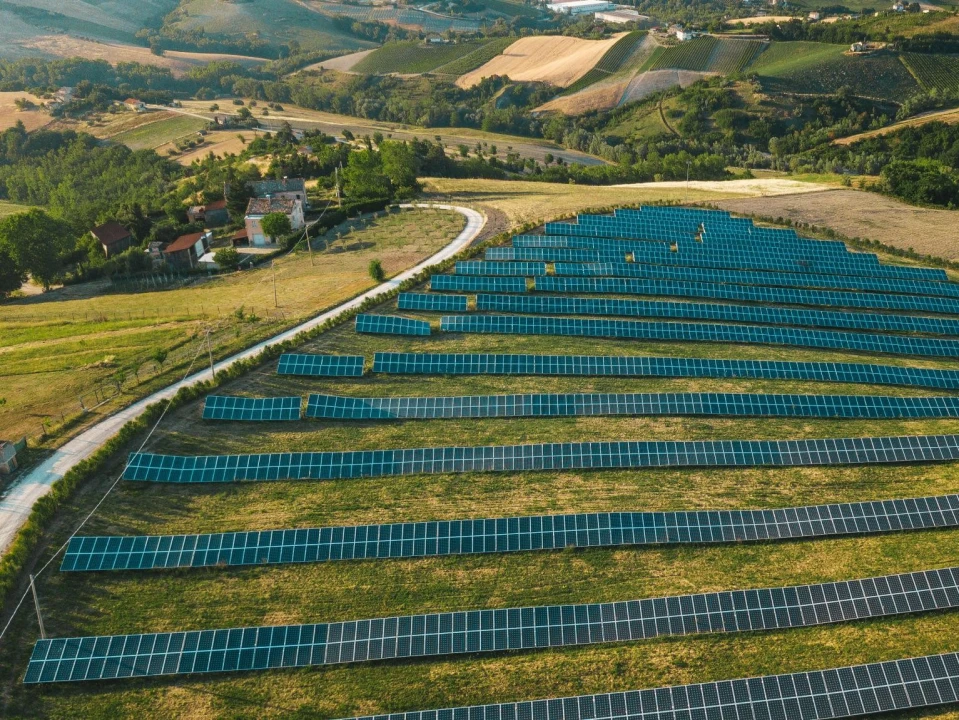

A few weeks ago, during a working session on an energy project tied to a region in southern Italy, I found myself in a situation that, more than any theoretical analysis, captures the moment we are living through. Around the table were local entrepreneurs, engineers, a U.S.-based investor, and - just as importantly - a personal connection to Italy that went beyond business.
At a certain point, the conversation shifted from numbers to perspective. No longer about the return on investment, but whether that model could be replicated, scaled, and sustained over time. In other words, whether it was truly industrial.
That’s when it became clear to me that the energy transition - at least for those actually building it - has already changed in nature. It is no longer a topic for conferences or strategic plans, but an operational choice that requires vision, capital, and execution.
And, above all, relationships.
In recent months, I’ve increasingly found myself working on projects that bring together energy, territory, and industrial development. Energy communities, hydrogen initiatives, integrated models that link production and consumption. Across all these contexts, one constant emerges: technology is not the issue. The real challenge is building an economic model that holds up.
And it is precisely on this front that the relationship between Italy and the United States is evolving.
For a long time, we viewed this relationship through the lens of exports. Today, however, the question that keeps coming up in working groups is different: how can we build pieces of the value chain together that will still make sense in five or ten years?
This is not a semantic shift. It is a shift in mindset.
In the United States, this evolution has been accelerated by clear policy choices that have brought energy back to the center of industrial policy. In Italy, the path is more fragmented, but for that very reason it offers interesting opportunities for those who know how to navigate between the public and private sectors.
In my work, this dynamic has become increasingly evident. I often find myself acting as a bridge between worlds that struggle to communicate on their own: local companies with strong technical expertise but limited scale, and international counterparts - often American, sometimes Italian American - with financial capacity and a broader vision.
When that balance is achieved, it is extremely powerful.
Because Italy, in this space, brings a level of design and project quality that is far from guaranteed. The ability to integrate energy, manufacturing, and territory stems from a unique industrial history - one built on districts, specialization, and adaptability.
The United States, on the other hand, brings scale, speed, and an investment culture that can turn an idea into an industrial platform.
The Italian American community fits squarely into this space.
Not as a symbolic presence, but as a concrete accelerator. A network of relationships that helps reduce distance, build trust more quickly, and make possible deals that might otherwise remain on paper.
In the project I mentioned earlier - which, for obvious reasons, I cannot detail - it was precisely this element that made the difference. The presence of an American counterpart with Italian roots helped overcome, in just a few weeks, roadblocks that would normally take months to resolve. Not through shortcuts, but through cultural alignment.
And when you are working on energy investments - where timelines are long and capital commitments are significant - that kind of acceleration is decisive.
Take energy communities, which in Italy are now entering a more concrete phase. They are not just an environmentally sustainable model, but a new way of organizing energy production and consumption. However, to become truly impactful, they must find a scalable and economically viable structure.
Or consider hydrogen, often framed as a promise of the future, but already today a field of industrial experimentation. Here too, the challenge is less technological than it might seem: it is about building supply chains, infrastructure, and business models.
These are exactly the contexts in which a structured collaboration between Italy and the United States can generate real value.
Of course, anyone working on these projects is well aware of the less straightforward side of the Italian system - regulatory complexity, permitting timelines, fragmented decision-making. These are not minor issues; they directly affect the economic feasibility of projects.
But precisely for this reason, working with international partners can become a source of discipline as well as opportunity.
Over the years, I have developed a conviction that grows stronger with each project: the energy transition will not be won on technology, but on governance. On the ability to bring together different stakeholders, with different interests, around a shared vision.
And this is where the relationship between Italy and the United States can take a leap forward.
No longer just a commercial relationship, but a platform for industrial co-development, where capital, expertise, and culture intersect.
If this happens - and the signals are there - the Italian American community will play a central role. Not as a reflection of shared origins, but as an active part of a contemporary economic process.
Because, in the end, the real question is not whether we will continue to collaborate.
The question is whether we will be able to do so on a more ambitious level.
Energy, today, is one of the few areas where that leap is both possible - and perhaps necessary.