

Ciauscolo is one of Italy’s most distinctive cured meats, a product that immediately challenges expectations. Unlike most salami, which are firm and sliced, this specialty from the Marche region is soft, spreadable, and designed to be enjoyed in a completely different way. Its uniqueness lies not only in texture, but in history, production methods, and flavor – all deeply tied to rural life in central Italy.
The origins of ciauscolo go back centuries, with documented references appearing as early as the late 1600s, although its roots are likely even older. The name itself is believed to derive from the Latin word “cibusculum,” meaning “small food” or “snack,” a reflection of how it was traditionally consumed by farmers during long working days. In an agricultural society where nothing was wasted, ciauscolo was a practical solution – a way to transform leftover pork cuts into a nutritious and ready-to-eat product.
Today, ciauscolo is protected by IGP status, obtained in 2009, which guarantees that it is produced according to strict regional guidelines in specific provinces such as Macerata, Ancona, Fermo, and Ascoli Piceno. Annual production is relatively limited, estimated at around 600 tons, reinforcing its identity as a niche, high-quality product rather than a mass-market salami.
The production process is carefully structured but still strongly rooted in tradition. It begins with selected pork cuts, primarily shoulder, belly, and trimmings from ham and loin. The meat is first rested under refrigeration for 2–10 days to reach optimal conditions, then finely ground multiple times – often two or three passes – until it reaches a very smooth, almost creamy consistency. This fine texture is one of the defining characteristics of ciauscolo, setting it apart from coarser cured meats.
After grinding, the mixture is seasoned with salt, black pepper, garlic, and wine, creating a balanced aromatic profile. The seasoned meat is then stuffed into natural casings and tied by hand, a step that still reflects artisanal practices. The curing process is relatively short compared to other salami – typically a minimum of 15 days at temperatures between 8°C and 18°C – which helps preserve its softness and moisture. In some cases, a light smoking phase is added, contributing subtle complexity to the final flavor.
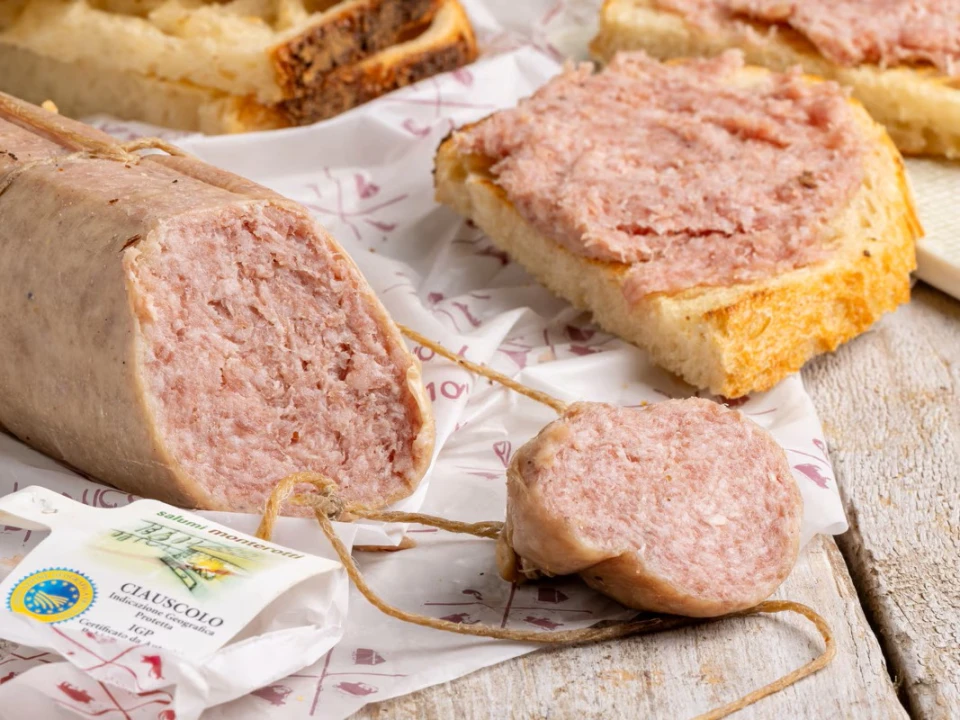
Visually, ciauscolo is cylindrical, usually weighing between 400 g and 2.5 kg, with a uniform pink–red interior. But its most remarkable feature is its texture. High fat content – in some traditional recipes up to 70% of the mixture – ensures a spreadable consistency similar to pâté. This softness is not a flaw but a defining quality, carefully controlled through the balance of lean and fatty cuts.
The flavor of ciauscolo is equally distinctive. It is savory but not aggressive, with a delicate sweetness from the pork and a gentle aromatic lift from garlic and pepper. Unlike aged salami, it never develops sharp acidity or excessive dryness. Instead, it remains smooth, rounded, and approachable, making it appealing even to those who might not typically enjoy cured meats.
Traditionally, ciauscolo is eaten simply – spread on slices of bread, often slightly toasted. This method highlights both its texture and its flavor, turning a humble product into a deeply satisfying experience. It can also be paired with local cheeses or used as a base for more elaborate dishes, but its true identity lies in its simplicity.
One of the most interesting aspects of ciauscolo is how it reflects a specific way of life. It was never designed as a luxury product, but as a practical, everyday food. Over time, however, it has moved beyond its rural origins and gained recognition in modern gastronomy, appearing in high-end kitchens while still maintaining its original character.
In a country known for its diversity of regional foods, ciauscolo stands out because it breaks the rules. It is neither fully fresh nor fully aged, neither sliced nor cut, but spread. It represents a different approach to charcuterie – one that values texture as much as flavor and tradition as much as technique.