

When people think of Europe’s great chocolate traditions, Switzerland and Belgium usually dominate the conversation. Yet the continent’s oldest continuously preserved chocolate-making method survives hundreds of miles farther south, in the Sicilian town of Modica.
Here, master chocolatiers still produce chocolate using a centuries-old technique introduced during Spanish rule and inspired by the methods the conquistadors encountered among the Aztecs in Mexico. More than a regional specialty, Modica chocolate is a living piece of European culinary history that has remained remarkably faithful to its original process for over 400 years.
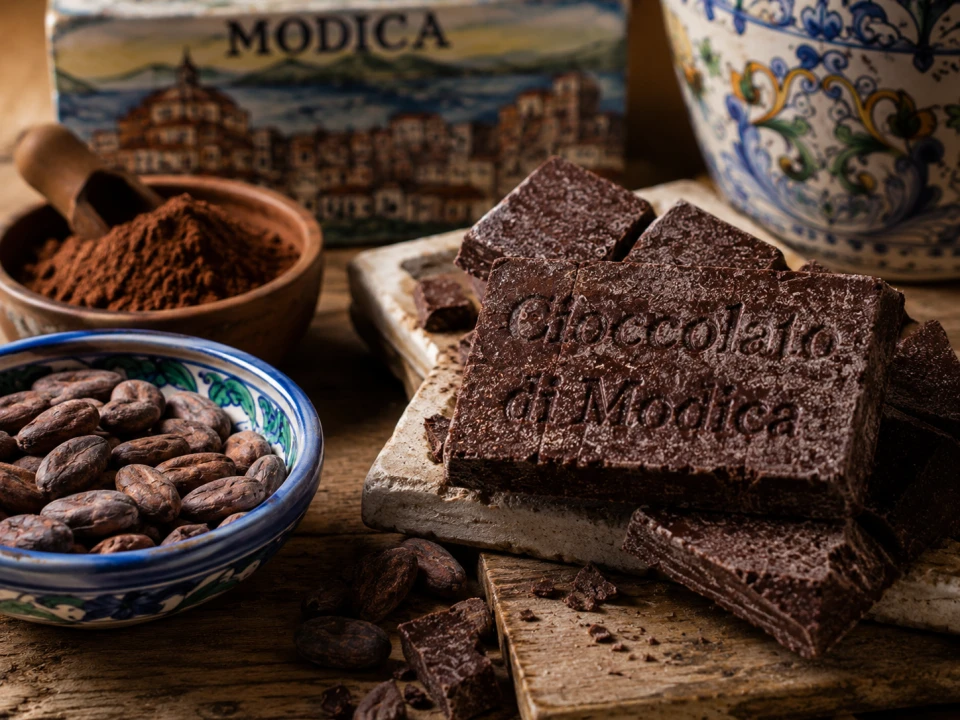
The uniqueness of Modica chocolate lies in how it is made. Unlike modern chocolate, which undergoes high-temperature refining through a process known as conching, Modica chocolate is worked at relatively low temperatures, generally below 45°C. Because the sugar crystals never fully dissolve into the cocoa mass, the finished bar retains its signature grainy texture and an exceptionally intense cocoa flavor. The result is a product that tastes strikingly different from industrial chocolate, preserving aromas and characteristics that closely resemble some of the earliest chocolate preparations ever produced in Europe.
This extraordinary tradition arrived in Sicily during the 16th century, when the Spanish Crown governed the island. Spanish administrators brought back cocoa-processing techniques learned in Central America, particularly from the Aztec civilization, adapting them to European ingredients while preserving the essential manufacturing process. Modica, then the capital of one of the most influential counties in the Kingdom of Sicily, became the center where this knowledge was safeguarded and passed from generation to generation. While chocolate production elsewhere evolved through industrial innovation during the 18th and 19th centuries, Modica retained its original artisanal identity.
The city's commitment to authenticity has earned international recognition. In 2018, Cioccolato di Modica became the first chocolate in Europe to receive Protected Geographical Indication (PGI) status from the European Union, certifying both its geographical origin and its traditional production method. Today, dozens of local producers continue crafting bars according to strict specifications that exclude conching and preserve the distinctive cold-processing technique.
Modern consumers can choose from classic varieties flavored with cinnamon or vanilla – echoes of the earliest recipes – alongside versions enriched with pistachio, citrus peel, sea salt, chili pepper, almonds, or local herbs. Despite these contemporary interpretations, the heart of the product remains unchanged: cocoa, sugar, craftsmanship, and patience. Every bar reflects centuries of accumulated knowledge rather than industrial standardization.
For Sicily, Modica chocolate represents far more than a celebrated dessert. It is proof that Italy's gastronomic excellence is deeply rooted in history, capable of preserving techniques that disappeared elsewhere centuries ago. While other European nations built their reputations on innovation, Sicily safeguarded an ancient tradition that still offers a direct connection to the earliest chapter of chocolate making on the continent. That continuity makes Modica not simply one of Europe's finest chocolate destinations, but arguably the guardian of its oldest surviving chocolate heritage.