

Hidden among the lush green valleys of the Ligurian Apennines, just a short distance from the sea and the bustling port city of Genoa, lies the charming village of Campo Ligure. This small Italian town preserves one of the country's most precious artisanal traditions: the ancient art of gold and silver filigree.
Here, time seems to move at a gentler pace, measured by the rhythmic tapping of tiny tools and the warm glow of open flames. In Campo Ligure, craftsmanship has never been simply a profession—it is a calling passed down from generation to generation, transforming cold metal into delicate works of art that resemble lace woven from strands of light.
The story of filigree in Campo Ligure is a remarkable chapter in Italy's artisan heritage. Although the technique itself—its name derived from the Latin words filum (thread) and granum (grain)—dates back thousands of years to the civilizations of the Middle East, Greece, and ancient Rome, it was in Campo Ligure that the craft reached one of its highest expressions beginning in the late 19th century. In 1884, local master craftsman Antonio Oliveri, after learning the intricate techniques in Genoa's historic workshops, opened the first independent filigree studio in his hometown. His decision transformed the village. Within a few decades, filigree became the economic, social, and cultural heart of the community. Dozens of workshops flourished, and the entire town specialized in the painstaking craft. Women, whose nimble fingers were particularly suited to the work, became masters of the delicate process of filling the intricate designs, working alongside men to produce extraordinary creations.
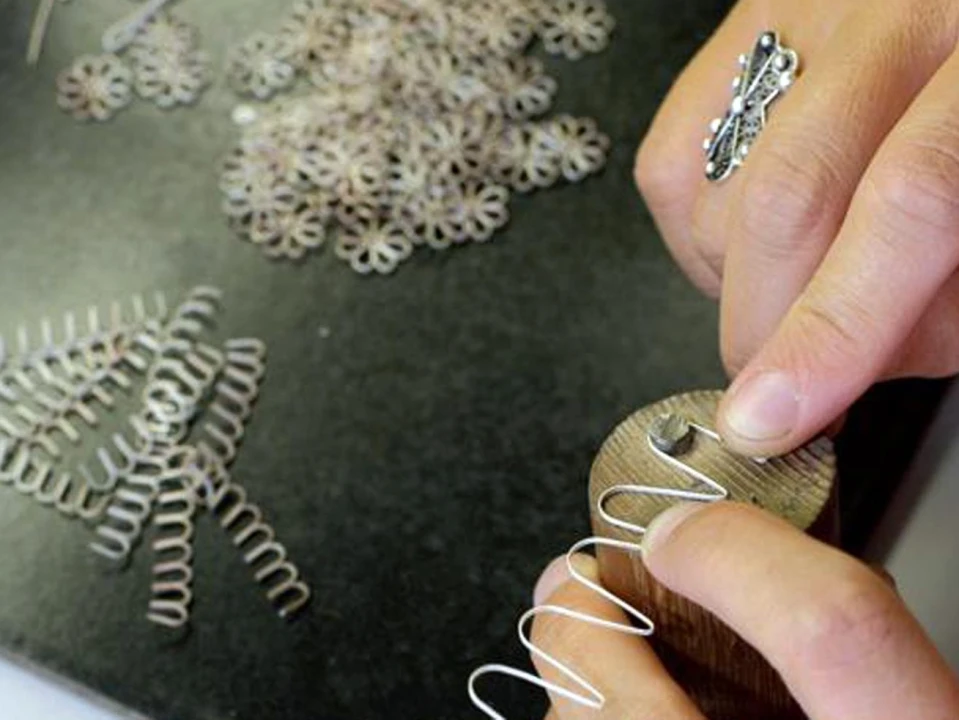
What makes Ligurian filigree truly unique is that its manufacturing process has remained almost unchanged for more than a century and is still carried out entirely by hand. Everything begins with precious metal that is melted, cast, and repeatedly drawn through progressively smaller holes until it becomes wire measuring only a fraction of a millimeter in diameter. The real magic comes during the twisting process, when two fine wires are tightly intertwined to create the distinctive textured pattern that reflects light from countless angles.
The artisan then shapes the structural outline of the jewelry by hand, forming elegant flowers, leaves, butterflies, or intricate geometric patterns. Inside these tiny silver or gold frames, microscopic spirals of twisted wire are carefully positioned using miniature tweezers known locally as bruscelle. It is a task demanding extraordinary patience, precision, and a steady hand, where even the slightest movement can alter the final result. Finally, the entire piece is joined with a small flame torch, permanently bonding the delicate components without melting away their ethereal appearance.
The excellence of Campo Ligure's filigree has earned international recognition. Today, the village proudly hosts the Pietro Carlo Ferrando Filigree Museum, home to an extraordinary collection of masterpieces from around the world. Wearing a piece of Campo Ligure filigree is more than wearing an elegant jewel—it is carrying a living piece of Italy's artistic heritage. It is a celebration of human ingenuity, where the strength of gold and silver is transformed into the visual lightness of lace, preserving a centuries-old tradition that continues to enchant admirers across the globe.