
The Italian and American health - care systems represent two models of excellence, each with unique characteristics and distinct strengths. Italy, with its National Health Service, is recognized for its universality, accessibility, and focus on social equity, guaranteeing care for all citizens regardless of economic status. The United States, on the other hand, stands out for technological innovation, cutting - edge scientific research, and the ability to attract resources and talent from around the world, serving as a driving force in neuroscience, digital health, and health - care management practices.
In an era when health is increasingly interconnected and global, the exchange of knowledge and experiences between the two systems is not just an opportunity but a necessity. Integrating Italy’s universal approach with America’s innovative drive can generate a model that combines equity and excellence, accessibility and innovation, human - centered care and technological power.
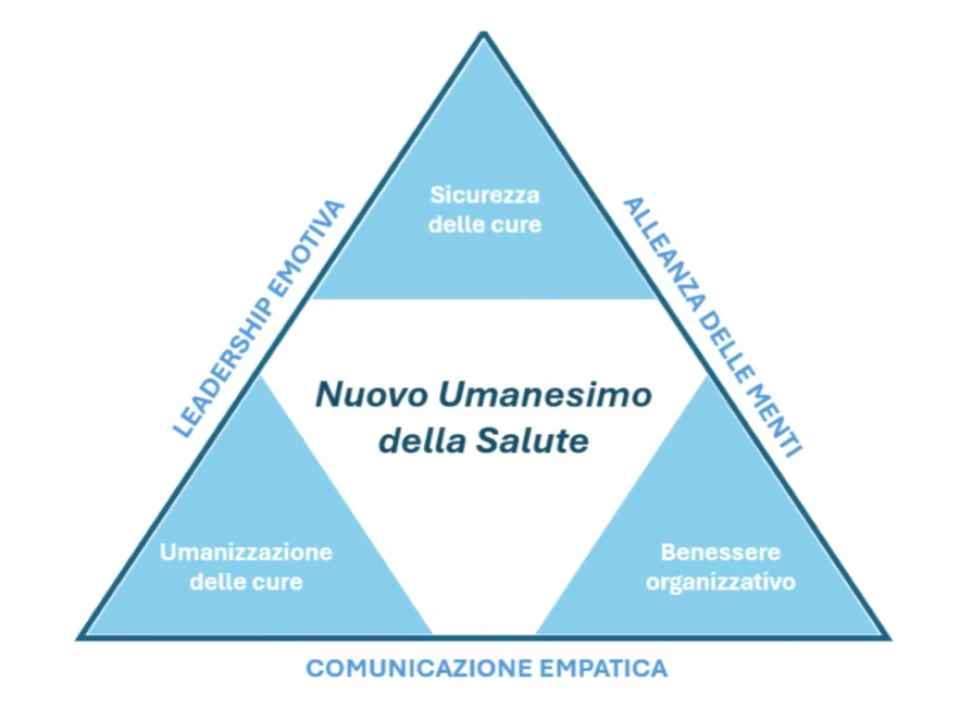
It is within this context that we introduce the idea of a New Humanism in Health: a philosophical and scientific vision that bridges diverse health - care systems with the ultimate goal of promoting human well-being - physical, mental, and social - expressed through the model of the “Triangle of Health.”
This multi - dimensional concept is rooted in the bio-psycho- social model introduced by the World Health Organization and further enriched by the contributions of medical humanities and medical anthropology. It redefines the very notion of care as a deeply human act - integrating scientific knowledge with philosophical wisdom to build a future in which health is both a universal right and a shared responsibility. Our mission is to transform the very concept of health, making it a cornerstone of a fairer and more sustainable society.
Our vision is to spark a cultural and philosophical revolution in health care, grounded in the idea of a “New Humanism in Health,” where the dignity and uniqueness of the suffering individual are placed at the center of every reflection and practice.
Within this vision, the role of neuroscience applied to leadership is crucial for educating a new generation of healthcare professionals - individuals able to navigate the complexities of the modern world with ethical and behavioral competence. Neuroleadership provides tools to enhance collaboration, innovation, and effectiveness in healthcare organizations, creating environments where every team member feels valued and actively involved in the healing process.
The goal is to move beyond national boundaries and positively influence global healthcare practices, promoting a model of care that is not only technologically advanced but also profoundly human. We aim to build a healthcare system that not only addresses the challenges of the present but is also prepared to lead the future - toward an era where safe care is synonymous with respect, understanding, and compassion for humanity in all its forms. This includes fostering new classes of healthcare leaders who embody this vision. Idealrealists who strike a balance between rationality and emotion, ethics and science.
Our goals, consistent with the vision of a New Humanism in Health, include:
- Humanizing care: Developing a more mature, multi - dimensional concept of health that integrates biomedical, bio - psycho - social, and systemic ecological approaches.
- Organizational well-being: Ensuring a continuous commitment within health - care organizations to promote balance, proactivity, and the well-being of healthcare workers.
- Safety of care: Making patient safety the top priority of all care processes, improving quality of services and outcomes through concrete actions.
The tools identified to achieve these goals include:
- Empathetic communication (la comunicazione empatetica)
To humanize medical practice, special emphasis is placed on the patient experience, empathetic understanding, and effective communication between doctors and patients. Listening, storytelling, and critical reflection are recognized as essential elements of care. - Emotional leadership (la leadership emotiva)
In contrast to traditional Taylorist management models, recent research - especially in the U.S. - has introduced approaches to human resource management based on emotional intelligence. By fostering healthy work environments, organizations can see tangible benefits in performance and results. - Alliance of minds (l’alleanza delle menti)
This refers to the coordination of efforts and knowledge among two or more individuals in a spirit of harmony, aimed at achieving a common goal. It highlights the importance of collaboration, sharing, and mutual understanding.
In recent decades, medicine has witnessed increasing specialization and subspecialization to provide greater expertise in treating complex diseases and conditions. While this has advanced clinical precision, it has also led to the “pervasion of technology in medicine,” weakening symbolic and relational dimensions in the doctor - patient relationship.
Alongside scientific progress, we must also work on culture - placing at the center the vision of a “New Humanism in Health,” which represents a paradigm shift. It reaffirms health as an inestimable value and common good. To translate these principles into practice, we need a collective effort - healthcare professionals, institutions, and communities - developing a cultural pathway enriched by scientific, anthropological, and philosophical perspectives.