

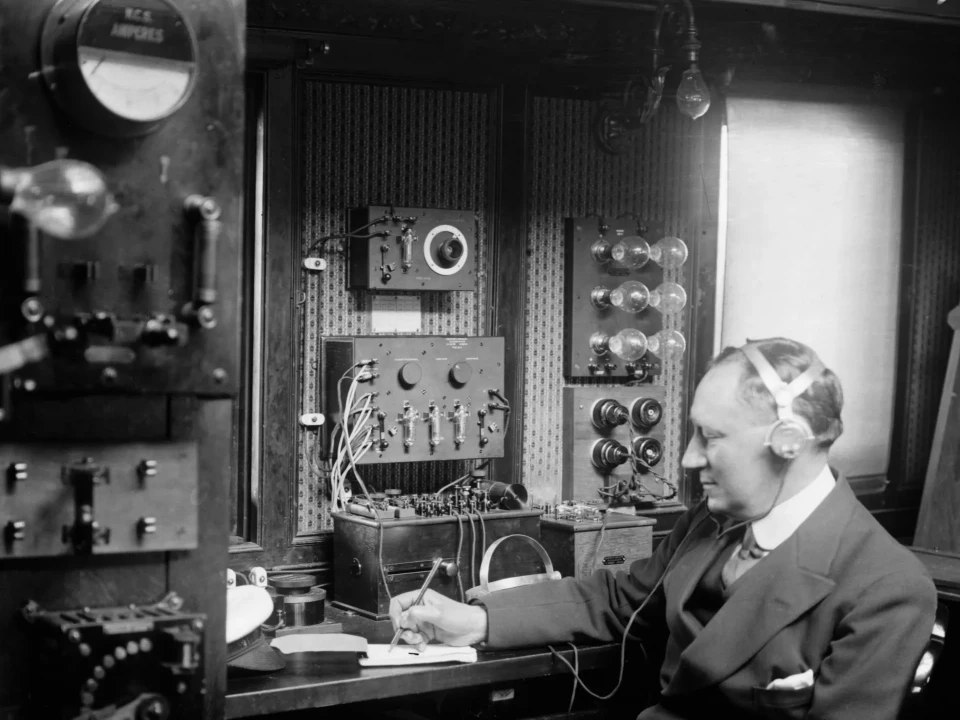

In the hills outside Bologna, a young Italian experimenter began a series of investigations that would eventually transform global communications. Guglielmo Marconi, born in Bologna on April 25, 1874, developed practical wireless telegraphy systems that made it possible to transmit information across increasingly long distances without physical connections. His achievements helped lay the foundations for radio communication and changed the way people, ships, governments, and businesses exchanged information.
Marconi grew up in a family that encouraged his scientific curiosity. His father, Giuseppe, was Italian, while his mother, Annie Jameson, came from an Irish family. As a young man, he developed a strong interest in electricity and electromagnetic phenomena, studying the work of scientists such as James Clerk Maxwell, Heinrich Hertz, and Augusto Righi.
The scientific principles underlying radio waves had already been established before Marconi began his experiments. Maxwell had developed the theoretical framework of electromagnetic waves, while Hertz demonstrated their existence experimentally during the late nineteenth century.
Marconi's decisive contribution was to transform these discoveries into a practical communication system capable of transmitting signals over useful distances.
In 1895, at his family's Villa Griffone estate in Pontecchio, near Bologna, he conducted experiments using electromagnetic waves to send telegraphic signals without wires.
He improved the performance of his equipment through the use of antennas, grounding systems, and sensitive receiving devices. According to the traditional account, he successfully transmitted a signal beyond a hill on the family property, demonstrating the possibility of communication without a direct visual connection between transmitter and receiver.
Recognizing the commercial and technological potential of his work, Marconi moved to Britain in 1896, where he filed a patent application for improvements in transmitting electrical signals and impulses.
His British patent, granted in 1897, became an important milestone in the development of practical wireless telegraphy.
That same year, he established the Wireless Telegraph and Signal Company, later renamed Marconi's Wireless Telegraph Company.
The company played a major role in developing wireless communication equipment and services, particularly for maritime applications.
Ships represented one of the most promising environments for the new technology. Before wireless telegraphy, vessels at sea had extremely limited possibilities for communicating with the outside world.
Marconi's systems allowed messages to travel between ships and coastal stations, improving navigation, commercial operations, and emergency communications.
One of his most celebrated achievements occurred on December 12, 1901, when he reported receiving the Morse code letter S at Signal Hill in Newfoundland, transmitted from Poldhu in Cornwall, England.
The experiment suggested that radio signals could travel across the Atlantic Ocean, challenging contemporary expectations about their range.
Although the exact circumstances and technical interpretation of the reception have been debated by historians, the experiment became an important symbolic milestone in wireless communication.
Marconi continued developing more reliable long-distance systems. In 1902, he demonstrated transatlantic reception aboard the steamship Philadelphia, and subsequent improvements helped establish regular commercial wireless services.
His work received international recognition in 1909, when he shared the Nobel Prize in Physics with German physicist Karl Ferdinand Braun for their contributions to the development of wireless telegraphy.
The importance of wireless communication became particularly evident during maritime emergencies.
When the RMS Titanic sank in April 1912, its wireless operators used Marconi equipment to transmit distress signals. Nearby vessels received the messages, contributing to the rescue of survivors.
The disaster demonstrated both the life-saving potential of wireless technology and the need for better international regulations governing maritime communications.
Marconi's research continued during the following decades, including experiments with shortwave transmission and directional radio systems.
His innovations contributed to the development of broadcasting, maritime radio, aviation communications, and the broader technological foundations of modern wireless networks.
He died in Rome on July 20, 1937, leaving a legacy that extended far beyond the equipment he personally designed.
Today, Villa Griffone houses the Marconi Museum, preserving the memory of the experiments that began in the Bolognese countryside.
Marconi did not discover electromagnetic waves or single-handedly invent every technology associated with radio. His extraordinary achievement was developing, demonstrating, and commercializing practical wireless communication systems at a time when transmitting messages without wires still seemed almost impossible.
From maritime safety to international broadcasting and today's mobile communications, the consequences of that breakthrough remain fundamental.
The story of Guglielmo Marconi demonstrates how scientific knowledge, engineering creativity, and entrepreneurial determination can combine to produce an invention capable of changing the world.