

Long before Bitcoin, blockchain and digital wallets, bankers from Liguria were experimenting with an idea that sounds strikingly familiar today: money that did not need to exist physically in order to have value.
Between the late 1500s and early 1600s, Genoese financiers developed and used the scudo di marco, also known as the scudo di fiera. It was not a cryptocurrency in the technological sense, of course. There were no computers, cryptography or decentralized servers. But the financial logic behind it presents remarkable parallels with the virtual currencies of the 21st century.
The scudo di marco was essentially a unit of account. No sovereign mint produced coins bearing that denomination. A merchant could not put a scudo di marco in his pocket. Instead, it existed in ledgers, transactions and agreements among bankers.
Its value was connected to respected gold currencies circulating in European financial centers, including those associated with Spain, Genoa, Florence, Venice and Naples. The system gave merchants a common financial language at a time when Europe was crowded with different coins, weights, metallic standards and exchange rates.
The Genoese made this system particularly powerful through the famous exchange fairs known collectively as the fairs of Bisenzone. Despite the name's association with Besançon, the fairs moved between locations over time, and Piacenza became one of their most important centers. They were generally held 4 times a year.
What began as commercial fairs increasingly became financial markets. Eventually, enormous transactions could be completed with little or no physical money changing hands.
That transformation reflected something deeply Ligurian.
Genoa had built its power on trade, navigation and finance. Its geography offered little agricultural land compared with many Italian regions, but it opened directly onto the Mediterranean. Generations of Ligurians therefore learned to turn ships, information, credit and capital into economic resources.
By the 16th century, Genoese bankers had become central players in European finance. During the period sometimes called the “Age of the Genoese,” roughly 1557–1627, they played an especially important role in financing the Spanish monarchy and moving capital across Europe.
The scudo di marco fitted perfectly into this culture of financial ingenuity.
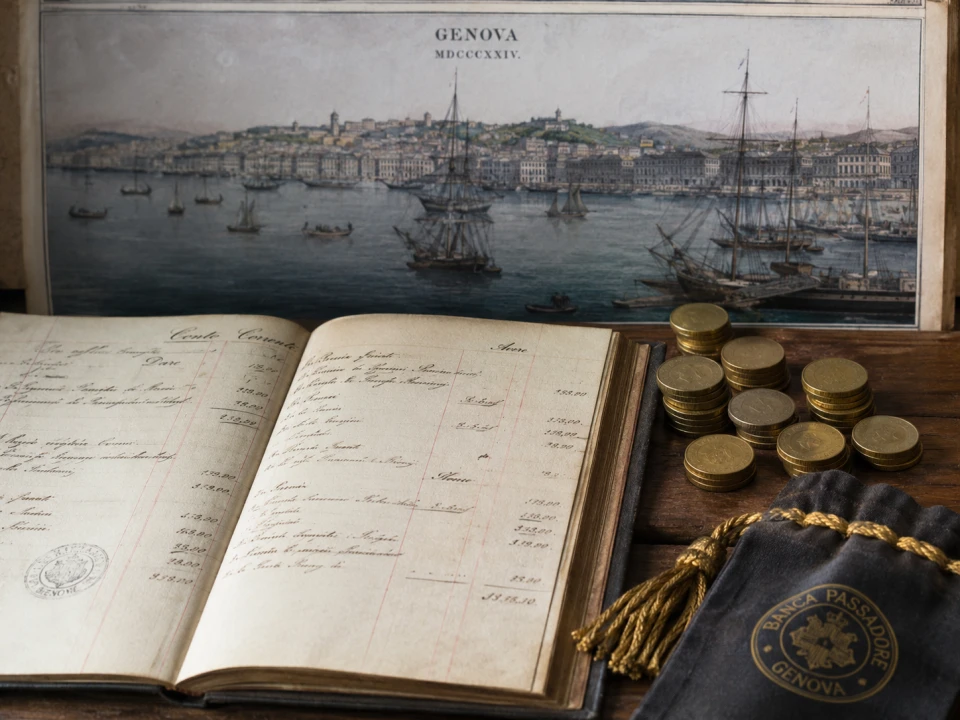
A restricted group of qualified bankers, the mercanti di conto, established exchange rates and supervised operations at the fairs. Transactions were recorded in account books and debts could be offset against credits. Rather than transporting large quantities of gold and silver across dangerous roads, participants could settle enormous balances through accounting.
This is where the comparison with cryptocurrency becomes fascinating.
Bitcoin, introduced in 2008 through the famous paper published under the pseudonym Satoshi Nakamoto, also separates monetary value from physical coins. Bitcoin transactions are recorded on a distributed ledger – the blockchain – and verification is performed by the network rather than by a conventional central bank.
The Genoese obviously had nothing comparable technologically. Their “network” consisted of merchants and bankers, their database was made of paper ledgers, and their system depended heavily on reputation and established rules.
Yet the conceptual similarity is difficult to ignore.
Both systems demonstrate that money ultimately depends on collective agreement. A scudo di marco had value because a sophisticated community of financial operators accepted it, recorded it and trusted the procedures governing it. Bitcoin has value because participants accept its protocol, its scarcity and its decentralized transaction system.
There is also an important difference. Cryptocurrency attempts to replace trusted intermediaries through mathematics and cryptography. Genoese finance did almost the opposite – it depended heavily on a small community whose reputation was itself the guarantee.
In one system, trust is encoded. In the other, trust was personal.
But both emerged from the same fundamental question: can people exchange value efficiently without constantly moving physical money and without depending entirely on a sovereign authority?
Four centuries before digital finance, Ligurian bankers had already found one remarkable answer.
That should not be surprising. From maritime insurance and international credit to bills of exchange and sophisticated banking networks, money has always occupied a special place in Genoese history.
Today cryptocurrency travels through invisible global networks at digital speed. In 17th-century Europe, Genoese financiers achieved something conceptually similar with ledgers, quarterly meetings and extraordinary financial discipline.
The technology changed completely.
The Ligurian instinct for making money move without actually moving the money did not.