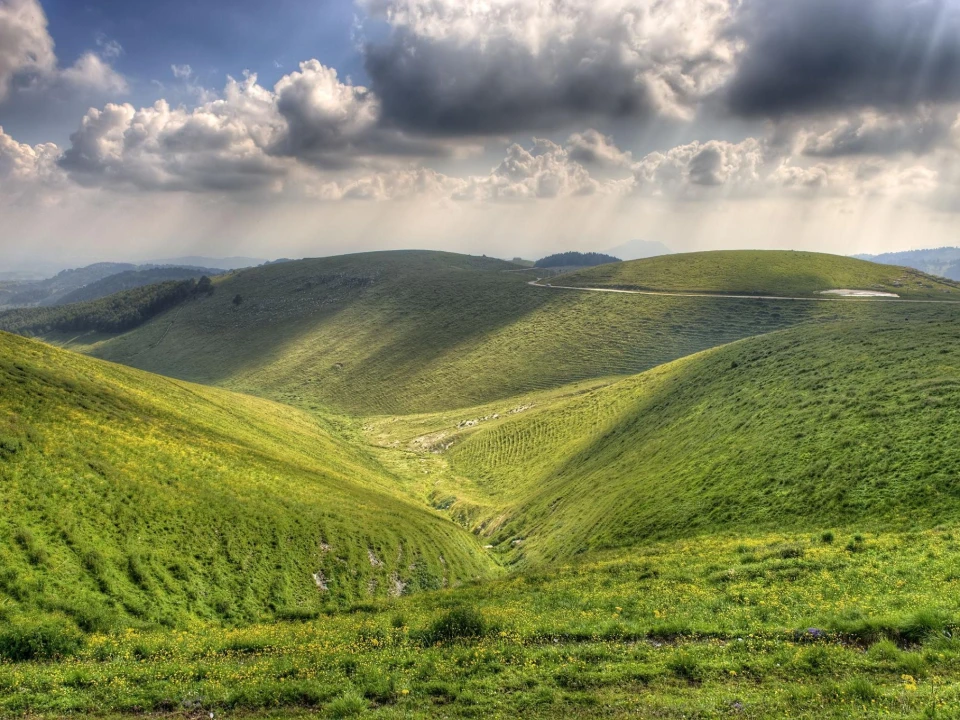

Just north of Verona, where the vineyards and cultivated plains of the Veneto gradually give way to mountains, lies a landscape that tells a story stretching back millions of years. Lessinia is a world of limestone plateaus, deep valleys, ancient forests, fossil deposits, and high-altitude pastures, where geology and human history have developed an extraordinary relationship.
Although less internationally famous than the Dolomites or Lake Garda, Lessinia represents one of northern Italy's most fascinating natural environments. Its distinctive character emerges from the interaction between geological forces, biodiversity, and centuries of mountain traditions.
The Lessinia Regional Natural Park, established in 1990, protects approximately 10,000 hectares of territory in the northern part of the province of Verona. The protected area includes upland landscapes, forests, valleys, and remarkable geological formations.
Much of the region consists of sedimentary rocks formed when this part of Italy was covered by ancient seas. Over millions of years, marine organisms accumulated on the seabed, contributing to the formation of the limestone layers that characterize the landscape today.
Subsequent geological movements lifted these deposits, while water, erosion, and changing climatic conditions gradually sculpted the terrain.
The result is an exceptional example of a karst environment, where water dissolves limestone and creates caves, sinkholes, underground channels, and unusual rock formations.
One of the most spectacular examples is the Ponte di Veja, a monumental natural stone bridge created by the collapse and erosion of an ancient cave system. Its impressive limestone arch demonstrates the extraordinary architectural forms that nature can produce without human intervention.
Another remarkable destination is the Valle delle Sfingi, where large limestone blocks have been shaped by erosion into formations resembling mysterious sculptures.
These geological features make Lessinia an open-air classroom for understanding the processes that have shaped the Italian peninsula.
The area's paleontological heritage is equally extraordinary.
The famous fossil deposits of Bolca, on the eastern edge of the Lessinia region, preserve exceptionally detailed remains of marine organisms dating to the Eocene epoch, approximately 50 million years ago.
The fossils include fish, crustaceans, plants, and other organisms that once inhabited a warm tropical marine environment.
Many specimens are so well preserved that their anatomical details remain clearly recognizable, providing scientists with valuable information about ancient ecosystems and the evolution of marine life.
The fossil collections associated with Bolca have attracted scientific interest for centuries and remain internationally important for paleontological research.
Lessinia's natural diversity extends far beyond its geological heritage.
Its forests contain beech trees, maples, and other mountain species, while open grasslands and rocky environments provide habitats for a variety of birds, mammals, and plants.
The region's changing elevations and environmental conditions create a mosaic of ecosystems, each supporting different forms of life.
Large mammals, including wolves, have returned to parts of the wider Lessinia landscape in recent decades, highlighting both the ecological significance of the area and the challenges of coexistence between wildlife and traditional livestock farming.
Human activity has also shaped the region for centuries.
The highland pastures, known locally as malghe, reflect a long history of seasonal grazing and dairy production. During warmer months, cattle traditionally move to mountain pastures, where their milk contributes to the production of distinctive local cheeses.
Among the area's best-known products is Monte Veronese, a Protected Designation of Origin cheese closely associated with the agricultural traditions of the Verona mountains.
The cultural identity of Lessinia also reflects the historical presence of Cimbrian-speaking communities, whose Germanic linguistic heritage influenced local place names, architecture, and traditions.
This combination of natural and cultural elements gives the territory an identity that cannot be understood through scenery alone.
For visitors, Lessinia offers opportunities to explore walking trails, discover traditional mountain settlements, observe wildlife, and experience landscapes that change dramatically with the seasons.
Spring brings flowering meadows, summer opens the high pastures, autumn transforms the forests, and winter can cover the plateau with snow.
Yet the value of Lessinia goes beyond outdoor recreation.
Its fossils, karst formations, biodiversity, and pastoral landscapes demonstrate the importance of protecting environments where geological history and human activity remain deeply interconnected.
In a country celebrated for its artistic monuments and historic cities, Lessinia reminds us that Italy's natural heritage is equally extraordinary.
Here, the landscape itself is a monument, created over millions of years and continuously enriched by the relationship between nature and the communities that inhabit it.