
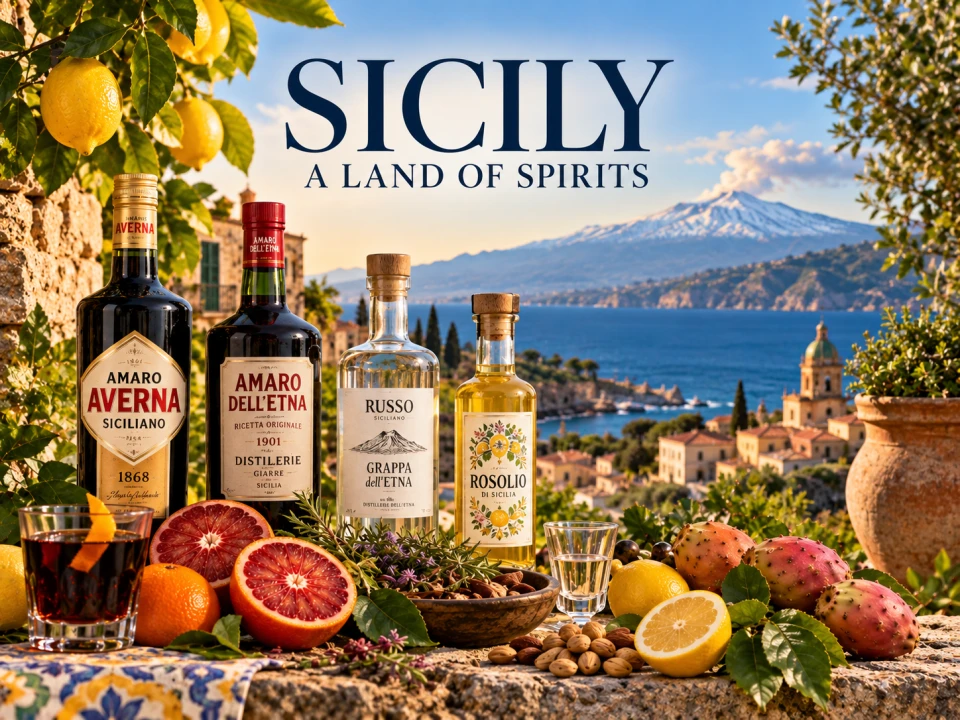

Sicily does not have a single signature spirit. It has an entire landscape of them. Bitter herbal amari, delicate rosolios, grappa made from the remains of the island’s vineyards, prickly pear distillates and intensely aromatic citrus liqueurs transform Sicily’s extraordinary agricultural diversity into something that can be poured into a glass.
The island’s best-known contribution is probably amaro, the bittersweet herbal liqueur traditionally served after a meal. Sicilian amari are particularly expressive because their recipes can draw on ingredients that grow naturally in a Mediterranean environment – citrus peel, roots, herbs, flowers, spices and aromatic plants.
The classic example is Averna, whose history begins in Caltanissetta, in the center of Sicily. During the first half of the 19th century, monks at the Abbey of Santo Spirito developed an herbal recipe. In 1868, the monk Frà Girolamo gave it to Salvatore Averna, a textile merchant who had supported the local community. Averna began preparing the drink for guests at his family residence, Villa Xiboli, before turning it into a business.
His son Francesco expanded production and introduced Averna at exhibitions in Italy and abroad. In 1895, King Umberto I awarded Francesco Averna a gold medal, and in 1912 King Victor Emmanuel III authorized the company to display the royal coat of arms on its label. The drink eventually reached the United States and became one of the most internationally recognizable Sicilian amari.
Its personality remains unmistakably Mediterranean – dark, rich and bittersweet, with herbal, citrus and caramel-like sensations rather than the aggressive bitterness found in some northern Italian amari.
On the opposite side of the island’s spirits story stands Mount Etna. Here, volcanic soil, vineyards, citrus orchards and wild vegetation have produced a distinct culture of distillation.
Amaro dell’Etna dates its original recipe to 1901. Its story is associated with Giuseppe Calì Tabuso, a distiller and shipowner in Macchia di Giarre, near the port of Riposto. His ships exported Etna wine and grape pomace and returned from European ports carrying spices and botanicals. These ingredients were combined with plants from Etna and the Catania plain and alcohol derived from local grape material.
Today the recipe contains 26 herbs, fruits, roots and flowers. Bitter orange and Sicilian licorice are among its dominant flavors, and the liqueur has an alcohol content of 29%. Its profile combines citrus freshness, herbal bitterness, sweetness and earthy notes that suit both after-dinner drinking and modern cocktails.
Its history even connects Sicily with America. According to the producer’s historical records, Amaro dell’Etna traveled to the United States with Italian emigrants. During Prohibition, from 1920 to 1933, quantities were reportedly concealed in barrels presented as olive oil.
A few miles away, Santa Venerina preserves another important chapter. Distillerie dell’Etna dei Fratelli Russo traces its origins to 1870 and today remains an active historic distillery in eastern Sicily. In the early 20th century it processed wine lees and pomace, producing alcohol and cream of tartar, some of which was exported to the United States. After World War II, the family expanded into brandy and grappa.
Its Grappa dell’Etna eventually developed into a range of white, barrel-aged and aromatic grappas. Grappa is produced by distilling grape pomace – the skins, seeds and other material remaining after winemaking – making it a natural partner to Sicily’s vast wine culture.
Even more Sicilian is acquavite di ficodindia, a spirit distilled from prickly pear fruit. Few products express the island more immediately. Prickly pears grow across Sicily, often along stone walls and dry hillsides, producing sweet, aromatic fruit under intense summer sun. Distillation turns that familiar landscape into a clear spirit with delicate fruit notes.
Then there is rosolio, one of Sicily’s oldest domestic liqueur traditions. It was historically produced in monasteries and private homes by macerating aromatic ingredients in alcohol with sugar and water. In Sicily, rosolio has been prepared since at least the 16th century and traditionally appeared at weddings, baptisms, family celebrations and visits from honored guests.
Despite its name, rosolio does not have to contain roses. Sicilian versions can use lemon, orange, mandarin, cinnamon, anise, mint, fennel, coffee, almonds, pistachios, mulberries, prickly pears or other local ingredients. That flexibility makes rosolio less a single beverage than a method for preserving the aromas of a place.
Citrus is particularly important. The Limone di Siracusa PGI comes exclusively from the Femminello variety grown in designated areas of the province of Syracuse. The variety accounts for more than 30% of Italy’s annual lemon production and is prized for its juice and oil-rich peel – precisely the qualities required for aromatic lemon liqueurs.
Elsewhere, blood oranges, mandarins and Etna lemons provide equally distinctive material for infusions and bitters.
Sicilian spirits therefore tell several stories simultaneously. They speak of monasteries and family kitchens, vineyards and volcanic slopes, ports and emigration, citrus groves and wild herbs. They can taste bitter, sweet, resinous, floral, citrusy or intensely herbal.
What connects them is Sicily itself. On an island where agriculture, history and geography change dramatically within a few miles, the bottle becomes another form of map – one made from alcohol, fruit, herbs, roots, tradition and time.