
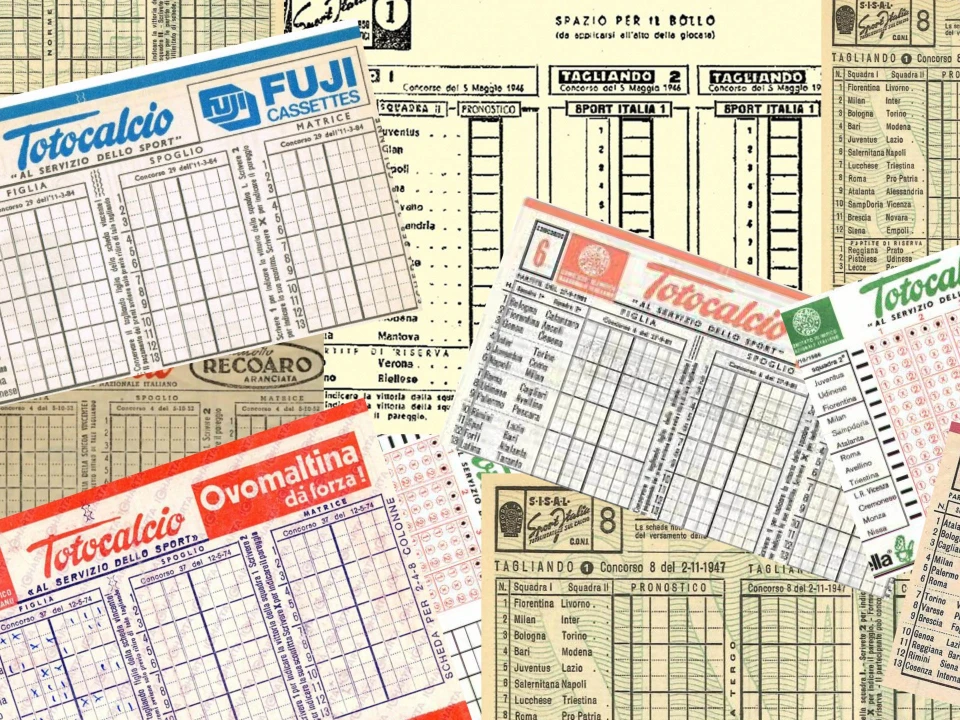

There is an object that, from the postwar years onward, slipped into Italians’ pockets every week as naturally as a wallet or a set of keys. It was a thin sheet of paper, originally cream-colored, with thirteen lines and three boxes marked with symbols: 1, X, 2. It was called the schedina - the betting slip - and it carried the name of a game that shaped Italy’s social, cultural, and even linguistic history after World War II: Totocalcio.
Totocalcio was officially born on May 5, 1946, eighty years ago, when Italy was still clearing the rubble of World War II. The idea came from Massimo Della Pergola, a Milanese journalist inspired by British football pools, which were already popular in England. The Italian National Olympic Committee embraced the project enthusiastically, seeing it as a tool with a dual purpose: to raise funds for national sports - not just soccer - and to offer Italians a small weekly dream at a time when dreams cost little but meant everything.
The mechanism was as simple as it was appealing: players predicted the outcomes of thirteen soccer matches from Serie A and Serie B, choosing for each one a home win (1), a draw (X), or an away win (2). Anyone who correctly guessed all thirteen results won the top prize, the legendary “tredici (thirteen).” The odds were extremely low - on average, about one winner for every 4.5 million tickets played - but that didn’t discourage anyone. On the contrary, within a few years the schedina became a collective ritual.
In the 1950s and 1960s, Totocalcio became a true mass phenomenon, profiting from the huge success of soccer in Italy. Every week, millions of Italians went to local betting outlets - small tobacco shops and bars scattered across the country - to fill out their slips with a pen. It became a ritual gesture, almost sacred. Some people studied sports newspapers for days, others consulted almanacs and statistics, while many relied on superstition or dreams. On Friday evenings and Saturday mornings, lively debates over predictions filled taverns, cafés, and barbershops: the derby, the big match, the hardest game to call, the risky pick. It became a shared language that crossed social classes, generations, and regional boundaries.
Especially until the 1970s, Totocalcio was more than just a game. It represented a tangible hope of changing one’s life in an Italy that was still poor and undergoing transformation. Hitting the “tredici” was the dream of social mobility: a new home, a brand-new Fiat 500, a family vacation by the sea. And even when the jackpot didn’t come, the betting slip remained a symbol of collective participation in the life of the country. Everyone played: factory workers and professors, homemakers and shopkeepers alike.
The Totocalcio slip became so famous that it entered the imagery and language of cinema, literature, and everyday speech, with a cultural impact few popular phenomena can claim. Italian comedy films, in particular, immortalized Totocalcio as a mirror of the national soul: actors like Alberto Sordi, Nino Manfredi, and Ugo Tognazzi often portrayed characters for whom the betting slip symbolized hope for a better life.
Enduring expressions entered common language. “Fare tredici (to guess all the thirteen results)” became synonymous with an extraordinary stroke of luck, an almost impossible feat achieved. “Giocare la schedina (Playing the slip)” became a metaphor for any risky gamble in life. Even today, eighty years after its invention, an Italian might say of someone who has had incredible luck, “Ha fatto tredici,” even if they have never set foot in a betting shop or filled out a slip.
Between the 1950s and the 1980s, Totocalcio reached its peak. Prize pools grew, winners became public figures, and their stories filled newspapers and TV news. There was the retiree from Naples who won everything with a ticket that cost just a few lire, and the family from Turin that shared the winnings among twelve factory coworkers. Real stories turned into urban legends, feeding the collective dream of a country that still believed in fate and luck as democratic forces, capable of knocking on anyone’s door.
Then the 1990s marked the beginning of Totocalcio’s decline. The arrival of instant lotteries - scratch-off tickets offering cash prizes - and above all the SuperEnalotto, launched in 1997 with enormous jackpots, drew players away from the old game. But the hardest blow came with the liberalization of sports betting: suddenly Italians could wager on any sporting event in the world, with variable odds, through hundreds of agencies and eventually online. The Saturday betting slip, with its fixed thirteen predictions, suddenly seemed outdated, slow, and limited.
Soccer itself changed. The rise of pay TV meant that Serie A and Serie B matches were no longer all played on Sundays but spread across different days, disrupting the schedules on which Totocalcio had been built. The identity of the game crumbled along with its foundations.
Today, Totocalcio still exists, but it is only a shadow of its former self. There are fewer players, smaller prize pools, and fewer places where slips can be found. Yet in a changing Italy, that cream-colored slip with thirteen lines remains a valuable historical document. It tells the story of a country that, for fifty years, turned eleven players against eleven into a collective ritual of hope - one that united Italy beyond fandom and politics, around a sheet of paper and three possibilities: 1, X, 2. And around the dream of one day being able to say: Ho fatto tredici.