

Italy has always been a land where music and movement are woven into daily life. Among the many traditional dances that reflect this deep bond, one stands out for its energy, humor, and unmistakable rhythm – the Saltarello. Born in central Italy and once spread across the peninsula, the dance still carries the flavor of village squares, rustic festivals, and gatherings where music turned everyday moments into celebrations.
The very name of the Saltarello comes from the Italian verb saltare, meaning “to jump.” That single word captures the essence of the dance: lively leaps, quick footwork, and movements that shift suddenly between grace and playfulness. Unlike more formal court dances, the Saltarello has always belonged to the people. It was a way to release energy, flirt, and show off both rhythm and stamina, often lasting until the small hours of the night.
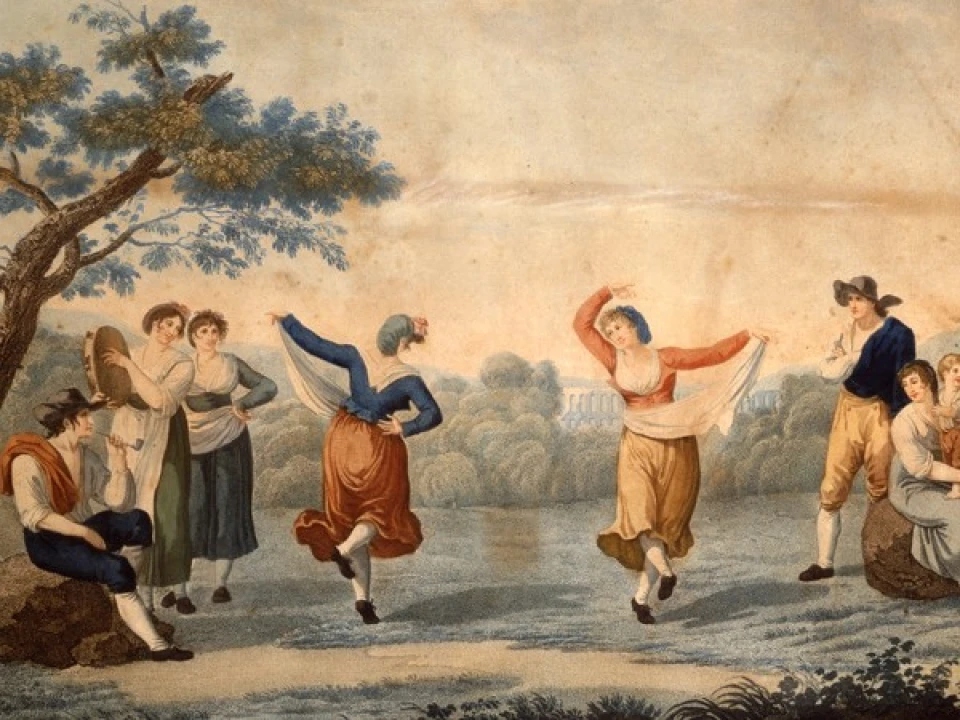
Traditionally, the Saltarello was accompanied by instruments that mirrored its vigor. Tambourines set the pace with sharp beats, while rustic flutes, accordions, and later guitars filled the air with melodies that rose and fell like waves. In some areas, the music featured string instruments like the calascione, a long-necked lute whose deep, resonant sound gave weight to the otherwise light and playful steps. The music often began at a moderate tempo, then accelerated, challenging the dancers to keep up. This change of pace added excitement, creating moments where the floor seemed to pulse with collective joy.
The steps of the Saltarello are simple at their core but rich in variations. Partners circle each other, exchange playful advances, and break into sudden leaps. A dancer may tease with quick turns or mock retreats before springing forward again. Hands clap in rhythm, feet stamp to emphasize the beat, and the whole performance becomes a conversation expressed through movement. Because of this, the dance was not only entertainment – it was also a social ritual. Young men and women could exchange glances and gestures in ways that words might not allow.
The Saltarello differs depending on the region. In Lazio, near Rome, it often features strong stamping and a bold, earthy quality. In Abruzzo and Marche, it can be more light-footed, almost aerial, with leaps that suggest freedom and exuberance. Each area added its own accent, shaped by local customs and the instruments at hand. What unites all versions is the underlying spirit – a refusal to stay still, a constant push toward vitality and laughter.
Through the centuries, the Saltarello has crossed paths with other musical traditions. During the Renaissance, its rhythms influenced courtly compositions, and traces of the dance appear in works written for noble audiences. Later, as guitars and mandolins became more widespread, the Saltarello adapted once again, blending old folk patterns with new sounds. Even today, contemporary folk groups experiment with it, mixing traditional percussion with modern fingerpicking techniques, showing how a dance born centuries ago can still inspire creativity.
Yet the Saltarello is more than a historical curiosity – it continues to live wherever people gather to celebrate community. At village feasts, folk festivals, and cultural events, the familiar beat of the tambourine draws dancers into the circle. Elderly couples show the younger generation how to leap and stamp, while children try to imitate the rhythm with wide-eyed enthusiasm. The result is less about perfect choreography and more about shared joy.
Watching or joining a Saltarello today feels like stepping into a timeless current. The gestures are playful, sometimes exaggerated, but always full of heart. The dance does not require polished skill – only a willingness to let the rhythm move you. In that way, it remains faithful to its origins as a dance of the people, uniting generations through sound, movement, and laughter.
The Saltarello tells a story that words cannot capture alone. It is a story of flirtation and rivalry, of humor and freedom, of communities that used dance to affirm life even in hard times. Its rhythm continues to echo in the squares of central Italy, inviting anyone who hears it to leap, stamp, and surrender to the joy of movement.