
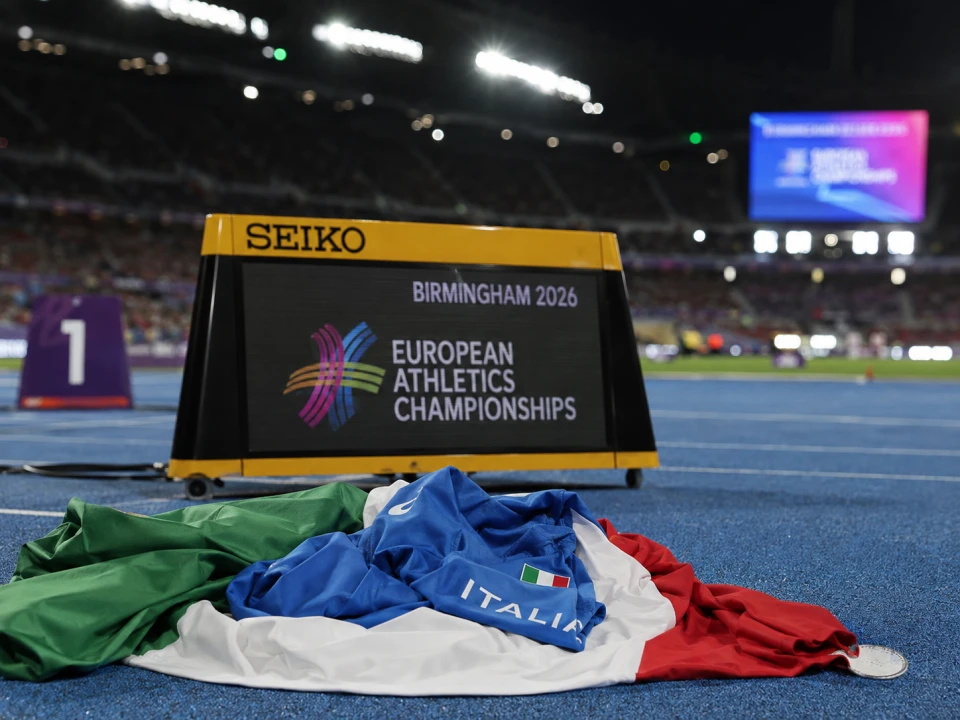
Italy finished the 2026 European Athletics Championships in Birmingham exactly where it had finished two years earlier in Rome – at the top of Europe.
The Azzurri won the final medal table with 22 medals – 10 gold, 6 silver and 6 bronze – ahead of host Great Britain, which collected 19 medals with 9 gold, and Germany, third with 21 medals but only 6 golds. Italy also won the points standings with 226 points, ahead of Great Britain with 211.5 and Germany with 196, equaling its record of 45 finalists.
The triumph was decided dramatically on Sunday, August 16, when Italy produced two gold medals and a bronze in the closing stages of the championships.
Larissa Iapichino delivered one of the defining performances. The 24-year-old became the first Italian woman ever to win the outdoor European long jump title. On her opening attempt, Iapichino landed at 7.00 meters, with a slightly excessive +2.1 wind. That jump proved enough in an extraordinarily close competition. Britain's Jazmin Sawyers finished second with 6.99, while France's Hilary Kpatcha took bronze with 6.98.
Iapichino's victory also completed unfinished business from Rome 2024, where she had won silver.
Then came the relays. Alessandra Bonora, Anna Polinari, Alice Mangione and Eloisa Coiro earned bronze in the women's 4x400 in 3:23.57, returning Italy to the European podium in the event for the first time in 10 years.
The final race produced an even bigger moment. Edoardo Scotti, Luca Sito, Mohamed Soudassi and Lorenzo Benati won Italy's first European men's 4x400 title in history, clocking 2:59.16 and defeating Great Britain by just 0.03 seconds. The British finished in 2:59.19. Italy had already broken the national record in the heats with 2:58.10.
That victory pushed Italy past Great Britain for first place in the medal table.
But Birmingham was much more than one unforgettable evening. The 10 Italian titles came across an exceptional variety of disciplines.
Nadia Battocletti completed a remarkable distance double by winning both the 5,000 and 10,000 meters. Gianmarco Tamberi successfully defended his European high jump crown, while Leonardo Fabbri repeated his continental victory in the shot put. Dariya Derkach won the women's triple jump, and Andy Diaz triumphed in the men's event.
Italy's strength extended well beyond the stadium. Massimo Stano and Sofia Fiorini won the men's and women's marathon race walk titles respectively, demonstrating once again the depth of Italy's race walking tradition.
There were medals throughout the team. Micol Majori took bronze in the 5,000 meters, Matteo Sioli bronze in the high jump, Fausto Desalu bronze in the 200 meters and Andrea Dallavalle bronze in the triple jump. Francesco Fortunato, Alexandrina Mihai and Pietro Riva were among Italy's silver medalists.
The comparison with the recent past confirms that this is no isolated success. After dominating the home European Championships in Rome in 2024, Italy has now won the European medal table for a second consecutive edition – this time away from home and in front of a British crowd.
Birmingham 2026 confirmed something even more significant: Italian athletics is no longer dependent on a handful of champions. From sprints to distance running, jumps, throws, race walking and relays, Italy has built the deepest and most competitive national team in Europe.