
Little Italy has long stood as one of the most recognizable symbols of the Italian American experience in the United States. Although the neighborhood's residential population has evolved over the decades, its historical significance remains unquestioned.
Today it is home to the Italian American Museum, located in the historic former Banca Stabile building on Mulberry Street, where generations of visitors learn about the lives, struggles, and achievements of Italian immigrants who helped build New York City. That legacy has become the focus of a public debate after Little Italy was omitted from a recently released New York City map highlighting immigrant neighborhoods.
Among the first community leaders to respond was Dr. Joseph V. Scelsa, founder and president of the Italian American Museum. Calling the omission "a terrible mistake," Scelsa emphasized that Italian Americans remain an important part of New York City's identity. "Italian Americans are still a major population in New York City," he said. "To not recognize where Italian Americans came from and settled is a terrible mistake." While expressing disappointment, Scelsa also stressed that recognizing one immigrant community should never diminish another. "To respect one is to respect all," he said, adding that he hoped the exclusion was simply an oversight.
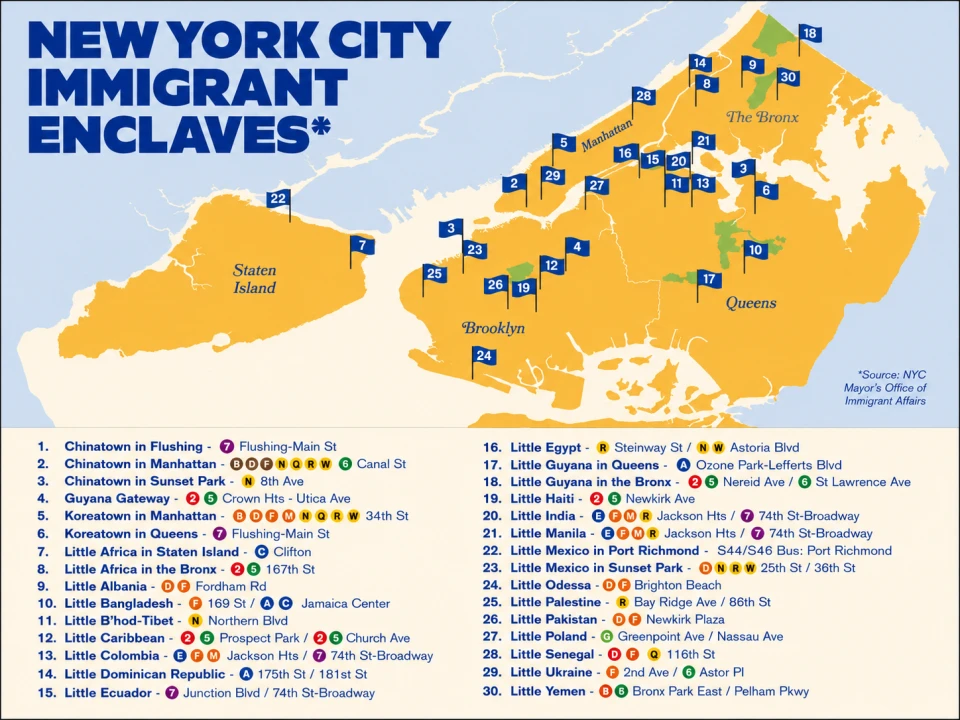
The map, which circulated online during New York City's mayoral campaign, identifies dozens of neighborhoods associated with immigrant communities from around the world. City officials have explained that the project was intended to highlight areas with significant contemporary immigrant populations rather than serve as a comprehensive historical record of every immigrant neighborhood that has shaped the city over the centuries. They also noted that the project originated before the current administration and may continue to evolve over time.
For many Italian Americans, however, the issue extends beyond demographics. Little Italy represents one of the most influential chapters in American immigration history. Beginning in the late nineteenth century, hundreds of thousands of Italians arrived in New York through nearby Ellis Island. Many established their first homes in the streets surrounding Mulberry, Grand, Hester, and Canal, creating a neighborhood filled with family businesses, churches, mutual aid societies, schools, social clubs, newspapers, and cultural institutions. From there, generations of Italian Americans spread throughout New York City and across the United States, while Little Italy remained an enduring symbol of those beginnings.
Although the neighborhood is much smaller than it was during its peak, it continues to attract millions of visitors every year. Its restaurants, bakeries, specialty food stores, annual Feast of San Gennaro, and historic streetscape remain closely associated with Italian heritage worldwide. The Italian American Museum further reinforces that legacy by preserving documents, photographs, artifacts, and personal stories that illustrate the contribution of Italian immigrants to New York and the nation.
The omission prompted a response from the New York City Council Italian Caucus, whose members expressed concern that one of America's best-known immigrant neighborhoods had been left out of a project celebrating New York's diverse communities.
In a joint statement, the caucus declared, "You cannot tell the story of immigrant New York while airbrushing out one of the city's most recognizable and historically significant immigrant communities." The council members also emphasized that Italian Americans should not be viewed simply as part of the city's past. "Italian Americans are not a footnote in the history of New York. We are one of the city's foundational immigrant communities whose neighborhoods, churches, businesses, and traditions helped shape this city into what it is today." They concluded by affirming a principle shared by many community organizations: "Respect for one community should never require erasing another."
Several Italian American organizations echoed that perspective, arguing that the discussion is fundamentally about historical recognition rather than competition among immigrant groups. They noted that New York's identity has always been built by successive generations of newcomers and that preserving the memory of earlier immigrant communities strengthens, rather than weakens, appreciation for those arriving today.
Community leaders also pointed out that Little Italy is only one part of a much broader Italian American story throughout the five boroughs. Neighborhoods including Belmont in the Bronx, Bensonhurst and Dyker Heights in Brooklyn, Howard Beach in Queens, and numerous communities on Staten Island have each played significant roles in preserving Italian language, traditions, religious celebrations, entrepreneurship, and family life. Together, these neighborhoods reflect more than a century of Italian American contributions to New York's economic, cultural, civic, and social development.
Historians frequently note that immigrant neighborhoods naturally change over time. Irish, German, Jewish, Italian, Chinese, Puerto Rican, Dominican, Caribbean, South Asian, Latin American, and many other communities have each left lasting marks on the city's landscape as populations moved and new arrivals established themselves elsewhere. Because of that evolution, many observers believe that maps documenting immigrant New York can recognize both contemporary demographic realities and the historical neighborhoods that helped define earlier generations.
For supporters of Little Italy's inclusion, the neighborhood's importance cannot be measured solely by current census figures. It represents the place where countless Italian immigrants began their American journey, where traditions were preserved during periods of hardship, and where subsequent generations maintained a visible connection to their heritage. The continued presence of the Italian American Museum, together with longstanding cultural events and historic institutions, demonstrates that Little Italy remains an active center of Italian American history rather than simply a destination for tourism.
The discussion surrounding the map has therefore become an opportunity to reflect on how New York tells its own story. As one of the world's great immigrant cities, New York has been shaped by people arriving from every continent. Recognizing the neighborhoods that welcomed those communities is part of preserving that shared history. For many Italian Americans, including Little Italy among those neighborhoods would acknowledge not only the past, but also the living legacy that continues to educate residents and visitors through its institutions, traditions, and enduring cultural presence.