
The Southern Italian region of Calabria is home to three thousand years of history including that of the indigenous Itali people who lent their name to what would later become the great nation of Italia. Home to the largest source of biodiversity in Italy, Calabria was also once considered a “Promised Land” for various cultures.
As the modern world struggles with terms such as “integration,” “refugees,” and “citizenship,” we could learn a lot from the Calabrian example of hospitality. It might sound hard to believe that an ancient land, often referred to as “the old country” by emigrants who left over a century ago, could become a region that hosted an almost utopian atmosphere for ethnic groups searching for a better life.
This sense of hospitality allowed what we would now describe as refugees to preserve and celebrate their own identity while also embracing their adopted homeland.
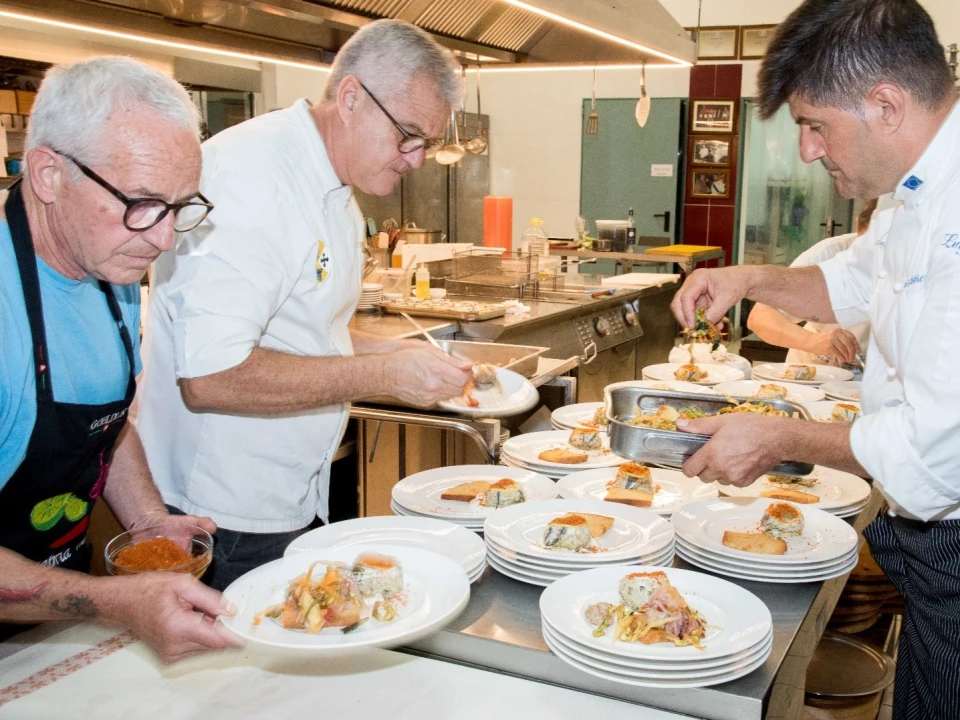
Calabria’s main minority languages are Arbëreshë (originating in Albania), Calabrian Greek, and another language called Gardiol, an Occitan language which hails originally from Northern Italy in Piemonte. In addition to state and government initiatives to preserve these languages, there is an association called the Associazione Regionale Cuochi Pittagorici APS (A.R.C.P. APS), working to preserve and honor their identity through cultural/culinary/educational events.
The association’s president, Archeo-Chef Salvatore Murano, Owner of Max Trattoria Enoteca in Cirò Marina, Calabria says “The association has always demonstrated how cooking is the only way to make everyone get along. It represents the language, the culture, and the costumes of each people.” And it is with this spirit that the association holds several annual events, including an international forum which combines the region’s most emblematic chefs with archeologists, global experts, journalists, and scholars to demonstrate the rich cultural patrimony that both lesser-known cuisines and languages offer. Additional members of the association include: Chef Gaetano Alia, Chef Ercole Villirillo, Chef Mario Mellino, Chef Michele Alessio, Chef Luigi Ammirati, Chef Daniele Viola, Chef Giuseppe Cammastra, Chef Antonio Franzé, Chef Vincenzo Cannatà, Chef Luigi Quintieri, Chef Vincenzo Murano, Chef Pierluigi Vacca, Chef Rocco Ianni , Chef Rocco Agostino, Chef Maurizio Mercurio, Chef Filippo Giampiero Monterosso, Chef Paolo Caridi, Chef Emanuela Crescenzi, Chef Antonella Torcasio, Chef Daniele Campana, Chef Giuseppe Mannarino, Chef Ferdinando Sestito, Chef Giuseppe Pizzata, and honorary members including Dame Amy Riolo, Dr. Aldo Longo, Francesca Straticò, Esq. and Journalist Silvestro Parise.
Since the beginning of its history, Calabria has always hosted different ethnic groups with varying religions and languages, while inviting them all to the table, both literally and figuratively speaking. What’s unique about Calabria’s ethnic minorities, even today, is that they have both maintained their unique identities and participated in the larger Calabrian/Italian culture as well. In addition, these various groups, by living in Calabria, have been able to preserve their original languages which are no longer spoken that way in their countries of origin.
From the 8th century BCE until the beginning of the Roman Empire in the 3rd century BCE, Greeks came to Southern Italy in search of the promise land and set up several of their most important cities, or polis, in Calabria. Crotone, the ancient Kroton, for example, was home to the Pythagorean school of philosophy, nutrition, medicine, mathematics, and music.
The Greeks that were born in Calabria always practiced the Greek Orthodox faith, and you can still visit their churches today. The ancient version of Greek that was and still is spoken in Calabria was the language of Homer and other classical thought leaders. Nowadays in Greece, however, modern Greek is spoken instead, but in Calabria you can still listen to how some of the world’s most important Greek minds spoke. This includes the female poet Nossis (Nosside) of Locri, who was one of the most significant voices of the Hellenistic period who wrote in the same form of Greek that is still spoken there today. While it is true that Calabrian dialects and food include ancient Greek influences, the language itself is one which has stood the test of time and gives us a window from which to view both the ancient world and the marvels that took place on Italian soil.
The Arbëreshë community arrived in Calabria between the 15th and 18th centuries and has meticulously preserved their own identity through language, Eastern Catholic religion, costumes, rights, and traditional food while at the same time integrating completely into Calabrian culture at large. Over the years they have shared their traditions and celebrated holidays with the entire community – exchanging recipes and flavors while strengthening ties in their new homeland.
In terms of cuisine, the shëtridhlat: a type of fresh pasta, is one of the most beloved by the the Arbëreshë community and is even listed among the Slow Food Foundation for Biodiversity’s Ark of Taste. Made skillfully by hand, this pasta is created from carosella flour (an ancient wheat from Southern Italy), semolina, hot water and extra virgin olive oil. It is traditionally served with the local poverelli beans cooked in a traditional terra cotta pot and enjoyed on Sundays.
The Occitans (Occitani) of Calabria are perhaps the least known of a unique ethno-linguistic minority located in Guardia Piemontese, San Sisto and San Vincenzo La Costa in the province of Cosenza. They originally came to Calabria in the 13th and 14th centuries to flee religious persecution. The Occitans practice the Waldensian religion, which is one of the oldest Evangelical churches in existence - a 12th century Protestant denomination with roots as a "proto-Protestant" movement.
The Occitan language (Gardiol or Gardiolo in Italian) is a version of Occitan which is considered “severely endangered” by UNESCO. While this group did experience persecution in the 16th century during the Roman Inquisition, they have survived, been able to preserve their language and culture. Today the towns hosting the Occitans are a cultural hub known for collaborating with other Occitans in Piedmont and France. Known as “cucina Valdese” in Calabria, the cuisine of the Waldensian settlers combines comforting classics from Piedmont and their adopted homeland in the province of Cosenza such as Piedmontese Bread Soup and others.
By continuing to study, research, create meals, and host events with members of each of
Calabria’s ethnic minority groups, the Associazione Regionale Cuochi Pittagorici APS offers a wider lens into understanding the rich and varied 3,000 years of Calabrian and Italian history that rarely get discussed, but offer a model of conduct for those who aim to both preserve their own cultures and fully enjoy life in their adopted lands.