
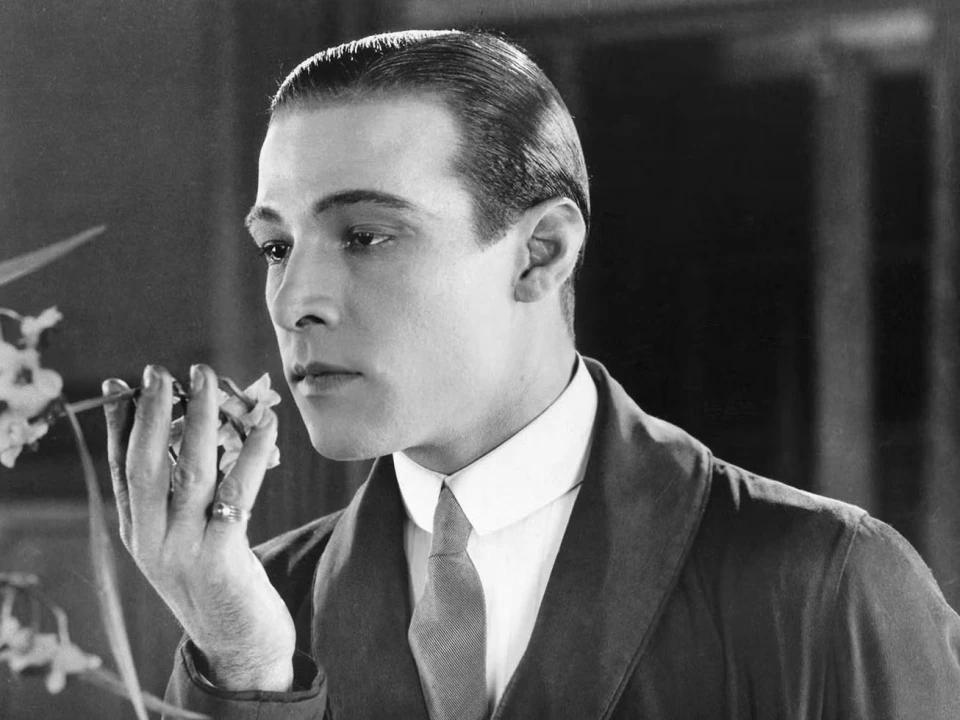
One hundred years ago, on August 23, 1926, Rodolfo Valentino died at New York’s Polyclinic Hospital. He was 31. The Italian-born actor’s death, following complications after emergency surgery, produced a public reaction extraordinary even by the standards of the silent-film era.
In the days that followed, tens of thousands of mourners gathered in Manhattan to pay their respects. Accounts differ on the exact total, but the crowd was so large that police struggled to control it. Valentino’s funeral Mass was held on August 30 at St. Malachy’s Church in New York, before his remains continued west for a second ceremony and burial in Hollywood. The public grief helped create one of the first modern legends of celebrity mourning.
Valentino had arrived in the United States from Italy in 1913. In Hollywood, he became an international star through silent films that made him a symbol of romance, elegance, and screen charisma. His success carried a particular meaning for Italian Americans. At a time when immigrants from southern and eastern Europe faced nativism, prejudice, and restrictive immigration quotas, an Italian-born performer had reached the center of American popular culture.
His role should be understood with nuance. Valentino was not a diplomat, and he did not alter formal relations between Italy and the United States. Hollywood also shaped his image through the stereotyped “Latin Lover” label, which could reduce a complex performer to an exotic fantasy. Yet his fame still created cultural visibility. For many Italian Americans, he demonstrated that an immigrant from Italy could become admired across the country and recognized around the world.
Valentino’s story therefore became a form of cultural connection between the two nations. Italy was the place of his birth, language, and early identity; the United States was where he built his career and became a global icon. His death in New York made that connection unmistakable. It transformed a personal immigrant journey into a shared symbol of Italian presence in American life – a legacy that continues to resonate a century later.