

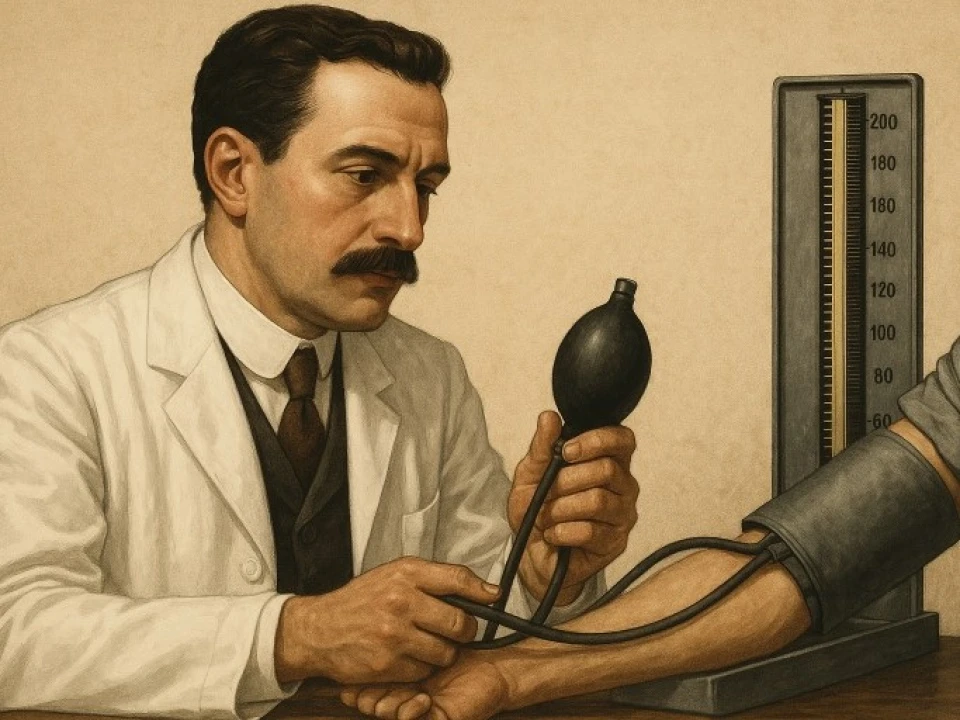
Scipione Riva-Rocci (1863–1937) gave the world the first practical way to measure arterial pressure at the bedside. In 1896, the young Italian physician described a simple device in a Turin medical journal: an inflatable cuff wrapped around the upper arm, a rubber bulb to raise pressure, and a vertical mercury column to show the number.
Compared with earlier, awkward instruments that squeezed a finger or relied on estimates, his sphygmomanometer was cheap, portable, and – crucially – numerical, as it turned “hard pulse” and “soft pulse” into millimeters of mercury. The method was simple: the cuff was inflated until the radial pulse at the wrist disappeared; the height of the mercury at that instant was taken as systolic pressure.