
Transatlantic Enlightenment explores the shared Enlightenment heritage linking Italy and the United States, from the eighteenth century to the present. Each article examines the ideas, people, institutions, that have shaped this enduring transatlantic dialogue. (Edited by Amedeo Arena)
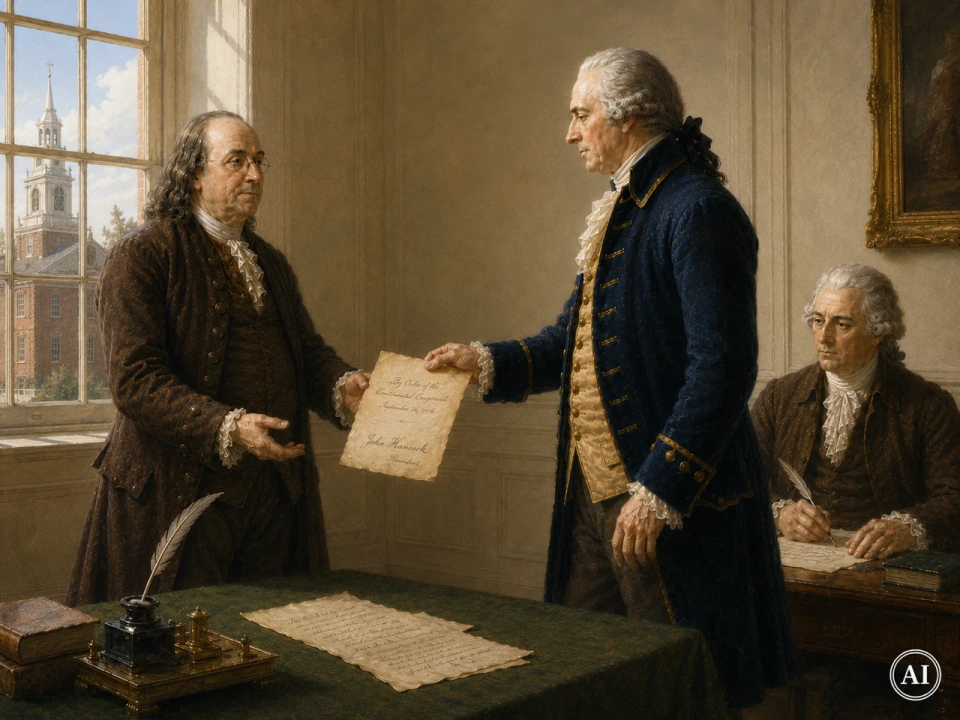
September is an especially fitting month in which to revisit the transatlantic Enlightenment. On September 26, 1776, less than three months after declaring independence, the Second Continental Congress appointed Benjamin Franklin as one of its commissioners to France, giving the Declaration a new transatlantic dimension and turning its principles into the basis of an international diplomatic mission.
Two hundred and fifty years later, the ideas surrounding the Declaration will once again be debated on both sides of the Atlantic. Between September 2 and October 1, 2026, nine events will connect Naples, Vico Equense, Ischia, San Francisco, New York, Detroit, and Philadelphia, exploring the intellectual relationship between Italy and the United States and demonstrating the continuing vitality of the transatlantic Enlightenment.
The series will begin on September 2 with From Independence to the Republic: A Transatlantic Perspective on 1776 and 1946, organized by the Consulate General of Italy in San Francisco as part of the America250 celebrations. The round table will bring together American and Italian perspectives on two pivotal moments: the Declaration of Independence and the institutional referendum that transformed Italy from a monarchy into a republic. Examining 1776 and 1946 together highlights how constitutional change is rarely a single event. It is a process through which political communities redefine their values, institutions, and collective identity.
On September 4, the Accademia Filangieri di Partenope will hold a conference at Castello Giusso in Vico Equense entitled From Philadelphia to Vico Equense in the Age of Enlightenment: The Filangieri-Franklin Correspondence. The location has particular significance: Filangieri spent the final period of his life in Vico Equense, where he received from Benjamin Franklin a copy of the newly adopted United States Constitution. The meeting will therefore reconnect the correspondence with one of the places in which its final chapter unfolded.
Naples will then host three consecutive events. On September 15, the Museo Civico Gaetano Filangieri will host the international conference Projects of Liberty: Italy and the United States 250 Years after the Declaration of Independence. The museum, founded by Filangieri’s grandson, preserves the letters sent by Franklin to the Neapolitan philosopher, offering a rare documentary foundation for reflection on Enlightenment exchange. The program will be organized around two themes, Art and Architecture and Democracy and Rights, ranging across different periods and fields to bring Palladio, Jefferson, Mazzei, Filangieri, and Franklin into a broader discussion of the cultural and political connections between Italy and the United States.
On September 16, the De Marsico Library of Castel Capuano will host the conference The American Declaration of Independence Then and Now: A Transatlantic Dialogue between Naples and the United States. The initiative, involving legal and Italian-American institutions, will consider the historical meaning and contemporary relevance of the Declaration. Its setting in one of Naples’s most distinguished legal libraries also reflects the essential role of cultural institutions in preserving the sources through which constitutional traditions can be studied and renewed.
The following day, the Circolo Canottieri Napoli will host the fourth annual Culture and Philanthropy event organized by the Fondazione Rocco Giuseppe e Figli ETS. Under the patronage of the National Italian American Foundation and the Accademia Filangieri di Partenope, its theme will be Life, Liberty and the Pursuit of Happiness. The program will combine a cultural discussion with a philanthropic section devoted to initiatives supporting underprivileged communities. This conjunction is especially meaningful: Enlightenment principles acquire their fullest significance when intellectual reflection is connected with concrete forms of solidarity.
On September 18, the Ischia International Festival of Philosophy will present a roundtable at the Albergo della Regina Isabella in Lacco Ameno. Entitled Liberty and Happiness between Filangieri and Franklin, it forms part of the Festival’s broader theme, Freedom: Can We Be Free Together? The discussion will take its starting point from the volume Citizen of All Places, Contemporary of All Ages: The Universality of Gaetano Filangieri’s Thought. The question posed by the Festival captures a central tension in modern constitutionalism: how individual freedom can coexist with the institutions and obligations required by life in a political community.
The program will continue in New York on September 24. The Columbus Citizens Foundation is planning an evening devoted to the enduring influence of the Italian Enlightenment on the founding of the United States, marking the 250th anniversary of American independence. The program will highlight Cesare Beccaria, Filippo Mazzei, and Gaetano Filangieri. Taken together, these figures show that Italy’s contribution cannot be reduced to a single text or direct line of influence. It emerged from a broader circulation of arguments about equality, criminal justice, good government, and the reform of legislation.
On September 27, the Dante Alighieri Society of Michigan, under the auspices of the Consulate of Italy in Detroit and in collaboration with the Historical Diplomatic Archives of the Italian Ministry of Foreign Affairs and International Cooperation, will host Across Oceans, Shared Dreams: Italy and America in Dialogue. An exhibition at Marygrove in Detroit will retrace significant stages in American history and Italian-American relations. It will be followed by the online talk Enlightening Exchanges between America and Italy: Linking Minds Across Cultures Since 1776, focusing on Pasquale Paoli, Filippo Mazzei, and the Filangieri-Franklin correspondence. The event will also commemorate the 80th anniversary of the Fulbright Program, one of the most successful modern instruments of transatlantic intellectual exchange.
The series will conclude on October 1 at the Historical Society of Pennsylvania in Philadelphia with The Filangieri-Franklin Correspondence, an event jointly organized by HSP and the Consulate General of Italy in Philadelphia. It will combine a talk on this transatlantic intellectual dialogue with a temporary exhibition of original materials, including selected letters from Filangieri to Franklin and the first copy of The Science of Legislation to reach the American statesman. Bringing these documents together in Philadelphia, the city imagined as an “asylum of virtue,” will complete the geographical and intellectual journey begun a month earlier.
These nine encounters tell a common story: the transatlantic Enlightenment was not a one-way transmission of ideas, but a conversation involving individuals and communities. Two and a half centuries later, that conversation continues. Its enduring vitality may lie precisely in its unfinished character: liberty, equality, happiness, and good government remain projects that every generation must examine, reinterpret, and pursue anew.
*picture: Benjamin Franklin receives his appointment as Commissioner to France from the Second Continental Congress, Philadelphia, 26 September 1776 (Historical reconstruction generated with AI).