
On February 27th, 2026, in the heart of New York, the aromas of Campania filled the halls of the Hotel Seville Nomad Hyatt. Day two of the “Culture Campania” presentation was hosted by the Region of Campania, in collaboration with ITALEA Campania, an initiative of the Italian Ministry of Foreign Affairs and International Cooperation.
This article continues our three-part series, celebrating the region’s cuisine while highlighting the living memory and ancestral wisdom of its people. Throughout the day, I conducted a series of exclusive interviews, offering a deeper look into the richness of Campania and the people devoted to safeguarding its living heritage.
Dott.ssa Rosanna Romano, Director General for Cultural Policies and Tourism of the Campania Region, shared the vision behind bringing Campania’s living traditions to New York: “I am Rosanna Romano, the Director General for Cultural Policies and Tourism of the Region of Campania. I participated in this mission on behalf of the region because we strongly wanted to bring the excellence of our territory to New York. Fifteen operators from Campania joined this initiative, representing hotels, non-hotel accommodations, maritime services, ground transportation, rental services, and food and wine itineraries that highlight the richness of our region. They offer experiential tourism, including visits to wineries and local producers. These experiences create meaningful emotions while showcasing a destination rich in the experiences it can offer visitors.
Campania is culture, it is the sea, and it is nature. We offer routes through inland landscapes, villages, and hidden places, as well as walking paths along the coast and in the interior—authentic communities that are still waiting to be discovered. We are known for our extraordinary food and wine traditions, but what truly defines us is the humanity of our people, their customs, and their sense of belonging. Many of our religious processions, passed down from generation to generation, remain living expressions of our identity.
We also preserve important agri-food traditions. There are dishes prepared only during specific periods of the year, linked to family customs and seasonal rituals. Among these, the “grain carts” represent an extraordinary element of our intangible heritage, telling the story of ancient agricultural rites that are performed to bless the harvest. This is what we call our living heritage.
We have collected these traditions in a catalog that includes the days and dates when they will take place. This allows Italian Americans and the global diaspora to return to their ancestral towns through roots tourism, reconnecting with their origins and sharing these traditions with their children and grandchildren. In this way, heritage becomes not only memory, but a living bridge between generations and between Campania and the world. “
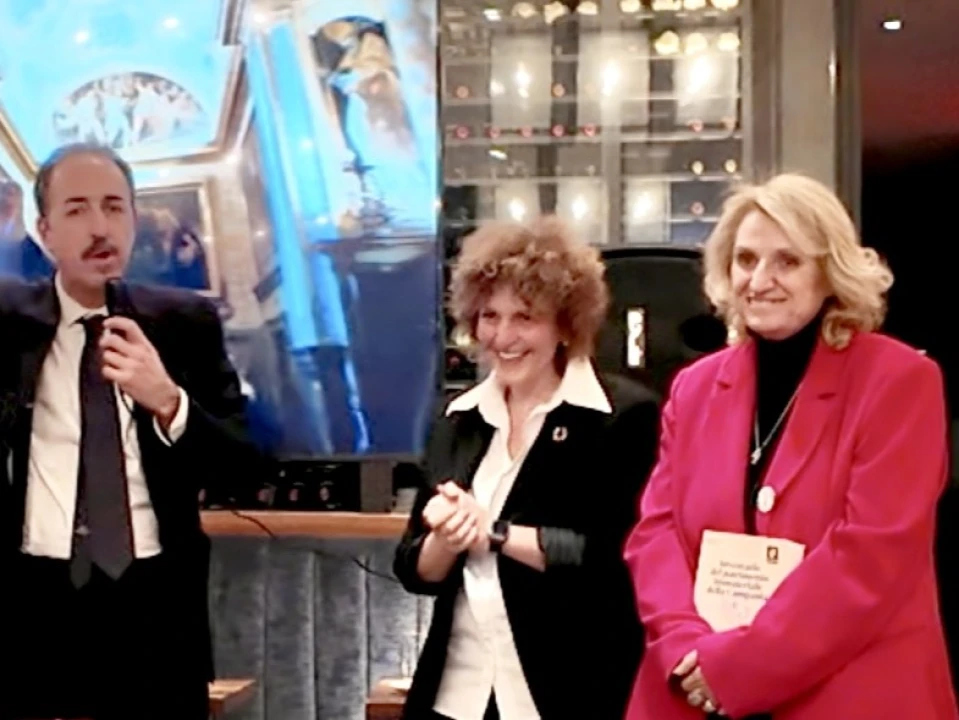
Upon my conversation with Dott.ssa Romano, accompanied by Dott. Ciro Adinolfi, Manager at the Tourism Board of Salerno for the Region of Campania, I reflected on the presentation portion of the day; a quiet yet powerful moment that captured the essence of everything she had shared with me. At the close of the presentation, Dott.ssa Romano handed a copy of Campania’s cultural event catalog to the youngest attendee—the custodian of heritage, the guardian of memory. The simple act of passing the catalog to the youngest amongst us reminded me of the ancient Egyptian scribe Thoth—the original custodian of memory and morality, whose sacred role was to preserve energy, knowledge, and legacy across time and the afterlife. This act served as a ceremonial ritual. A transmission of the human story, a bridge between past, present, and future—a world between worlds.
It reflected the very essence of cultural anthropology storytelling—my life’s passion through La Media New York. In weaving deep threads into the tapestry of our shared humanity, we discover deeper dimensions that live within ourselves. Preserving the sacred, the ancestral, and the living legacy of culture transforms transient moments in time into memory that endures beyond lifetimes. This is a transcendence of space and time, frozen in a time capsule. Its power shapes the beautiful mosaic of our identity, illuminating our potential and guiding our path as we move into the future. For if we do not know where we come from, how can we know where we are going? This is the power of legacy.
If this gesture symbolized the transmission of memory, the next conversation revealed how that heritage is actively carried forward through global initiatives and collaboration.
Continuing my exploration of Campania’s living heritage, I had the pleasure of speaking with Dott.ssa Sara Roversi, Head of ITALEA Campania and Founder of the Future Food Institute, who shared: “Hi everyone, I’m Sara Roversi. I’m the President of the Future Food Institute, the Permanent Secretary of the Coordination of the Emblematic Communities of the Mediterranean Diet, and I also serve as the President of ITALEA Campania for the Ministry of Foreign Affairs and International Cooperation. I’m very proud of that.
Today we are here in New York to move forward many of our missions. First of all, we are promoting the living heritage of the Mediterranean Diet, which in 2026 will celebrate the first International Day on November 16. We will bring together chefs from across the Mediterranean and around the world, because the Mediterranean Diet has been supported and promoted by countries at the United Nations, recognizing it as a heritage that promotes healthy living, good for people and good for the planet.
The Mediterranean Diet was born in the Campania region, in Pollica, where we protect and safeguard an important part of this UNESCO heritage. It is the epicenter of many of these initiatives, and I am proud to connect the Campania community here today.
In the United States, and especially in New York, there are many people who continue to safeguard these traditions in their homes, in their kitchens, and in their communities. Our role is to build bridges. I always say that I am a weaver. I weave connections between people, territories, and cultures. This is my work, and I am very proud to be here with this entire Campanian family.”
While these initiatives connect the Mediterranean to the world, their roots remain grounded in a very specific place. Mayor Stefano Pisani leads the town of Pollica, a charming municipality nestled in Cilento, a subregion of Salerno in Campania. Cilento is celebrated for its rich cultural heritage, breathtaking landscapes, and as the birthplace of the Mediterranean Diet—an area where tradition, cuisine, and ancestral memory are woven together. Here, tradition and innovation meet.
To better understand the birthplace of the Mediterranean Diet and the spirit of this community, I spoke with the heart of Pollica itself—Mayor Stefano Pisani who shared: “Hello everyone, I am Stefano Pisani, the Mayor of Pollica. Pollica is a small municipality in southern Italy, in the Campania region, where, in the post–World War II period, a beautiful experiment was born: the Mediterranean Diet — a lifestyle that has been inscribed by UNESCO on the Representative List of the Intangible Cultural Heritage of Humanity, not only of Pollica but of the entire world.
This has led us to travel throughout the Mediterranean, creating international connections with Spain, Greece, Croatia, and Portugal, and later choosing to frequently visit the United States. Here in New York, we have seen many meaningful developments for both our community and Italy. First of all, we reconnected Pollica with its community of Italians living abroad, and we rediscovered our traditions, our cultural heritage, that is alive here in America as well. For us, it has truly been beautiful to reconnect with our roots in America.
In the United States — particularly in New York — we have been able to bring together a series of initiatives, especially through our work at the United Nations, continuing to ensure that the Mediterranean Diet becomes a shared heritage for all. Recently, we achieved a wonderful result. Imagine this: a small Italian municipality managed to convince the United Nations that there should be one day each year dedicated to the Mediterranean Diet. And so, November 16 is now the International Day of the Mediterranean Diet.
For us, it is a beautiful celebration. In Pollica, on November 16, we organize a magnificent communal table. Just this past November 16, in 2025, we hosted 700 people all having lunch together at one very long table, where we shared the beauty of being together, the quality of the food, and the joy of laughter — conviviality being an integral part of the Mediterranean Diet.
We have added many other initiatives as well, including those we continued to develop during this trip to New York. And do you know what we are preparing for? We are getting ready to celebrate the first International Day of the Mediterranean Diet in 2026 right here in New York. So don’t miss what will happen in New York this year — we will surprise you all. This is a bit of our way of doing things in Pollica. We are very creative, as Italians tend to be.
We have also shared around the world how the Mediterranean Diet helps us live longer. In Pollica, we coined a simple idea inspired by the American scientist Ancel Keys: ‘Eat well and stay well.’ And we added to it: ‘Eat well, stay well, and save the planet.’ In short, we are trying to convince everyone — and science tells us it is true — that if we eat well, we feel well, and we also help save the planet.
In a way, the Mediterranean Diet is almost perfect. What makes it imperfect is us, when we occasionally let good habits slip and allow ourselves to get carried away by delicious Italian desserts and wonderful pasta dishes.
And UNESCO also recognized Italian cuisine in its entirety as an Intangible Cultural Heritage of Humanity — the first national cuisine in the world to receive this designation. In short, we’ve tried it all — the only thing that remains for me to do is what every Italian mayor does: invite you. And you know where? To his own home. I invite you to Pollica, which is my home.”
A tasting of Campania’s finest culinary delights brought the region’s culture to life. The menu was crafted by Chef Giuseppe Di Meglio of Hotel Regina Isabella Resort in Ischia, recognized by Travel + Leisure Italy’s Best Awards 2025. He was joined by renowned New York Chef Fabrizio Facchini.
Later in the day, I spoke with Chef Giuseppe Di Meglio, who shared his passion and vision with me: “I am Chef Giuseppe Di Meglio from the Regina Isabella Resort in Ischia. We have been meeting here in New York these past nights with menus created to celebrate the Campania Region and its traditional products, while reimagining them in a modern way to delight the palates of all guests. For example, today for our light lunch we served puttanesca with the addition of toasted pine nuts — a sauce typical of southern Italy, made with capers, olives, anchovies, and cherry tomatoes. Becoming a chef has been my lifelong ambition. Thanks to my experiences around the world — here in the United States, and especially in Ischia at the Regina Isabella — I have had the opportunity to come to New York to be part of this wonderful experience and event. I am proud to be Italian, especially from southern Italy, but at the same time, I consider myself a citizen of the world, because in the end it is through food, through cuisine, and through culture that we truly define ourselves as global citizens.”
As the afternoon drew to a close, the flavors of Campania lingered—not only on the palate, but in memory. I recalled a story told to me by an old friend, a native of Cilento. An image appeared in my mind’s eye: he was a curious child explorer, searching for treasures in the sands on the crystalline beaches of Cilento. The ancestral wisdom within him, which permeated the land, is the soul’s recognition mirrored back to us, calling us home to ourselves. In the sands of Cilento, the tribal connection to our primal existence runs deep, as the subregion is home to the Cilento and Vallo di Diano National Park, whose archaeological sites have been inscribed on the UNESCO World Heritage List since 1998. With traces of human settlement dating back to the Paleolithic era, this ancient land served as a cultural crossroads between the Greek settlements of Magna Graecia and the Lucanian civilization—among the earliest known civilizations in southern Italy.
In Cilento, the picturesque Mediterranean coastline meets the endless sea, stretching toward a horizon that seems to dissolve into infinity. This sacred space—this is the land of the art of gastronomy, where the essence of human connection meets ancient wisdom. This is Michelangelo’s creation, the touch of God, the spark of thought. In all its mystique, resting in the cradle of civilization—this is Campania.