Transatlantic Enlightenment explores the shared Enlightenment heritage linking Italy and the United States, from the eighteenth century to the present. Each article examines the ideas, people, institutions, that have shaped this enduring transatlantic dialogue. (Edited by Amedeo Arena)
If there is one thing ideas are simply incapable of doing, it is standing still. They need to circulate, and sooner or later they always find a way, even when an ocean lies in between. That is precisely what happened in the eighteenth century, when ideas travelled from Philadelphia, in the British colonies in America, through Paris to Naples, before crossing the Atlantic once again. Their journey tells us something about the progress of science, but above all it reveals the connection between a brilliant Neapolitan woman of science and one of the Founding Fathers of the United States: Benjamin Franklin.
“Mademoiselle, from your latest letter I see that you are still not satisfied with my diligence, although, after the reproaches you addressed to me, I have redoubled my attention and my efforts to keep you promptly informed of everything new that has appeared in the field of physics.”
These are the somewhat timid words with which the French abbé Jean-Antoine Nollet opens the first of his nine “Letters on Electricity, in Which the Latest Discoveries Made in This Field and the Consequences That May Be Drawn from Them Are Examined”, published in Paris in 1753.
The letter was addressed to a young Neapolitan woman who had given him quite a scolding in writing. That one of Europe’s best-known scientists should find himself writing about scientific matters to a woman, and in such a tone, was remarkable enough at the time. But the mademoiselle in question was no ordinary correspondent. She was Maria Angela Ardinghelli, one of the most brilliant women of science of her generation.
Ardinghelli was born in Naples in 1730, into an old Florentine family whose branch was by then of modest means. She nevertheless received a literary education. She studied English and French and, by the age of fourteen, had already mastered Latin. She then turned to science, studying under some of the leading scholars of the Kingdom of Naples. Her expertise eventually earned her admission to the exclusive circle of Ferdinando Spinelli, Prince of Tarsia, who had established a scientific and literary academy in his palace, complete with a library and a well-equipped physics cabinet.
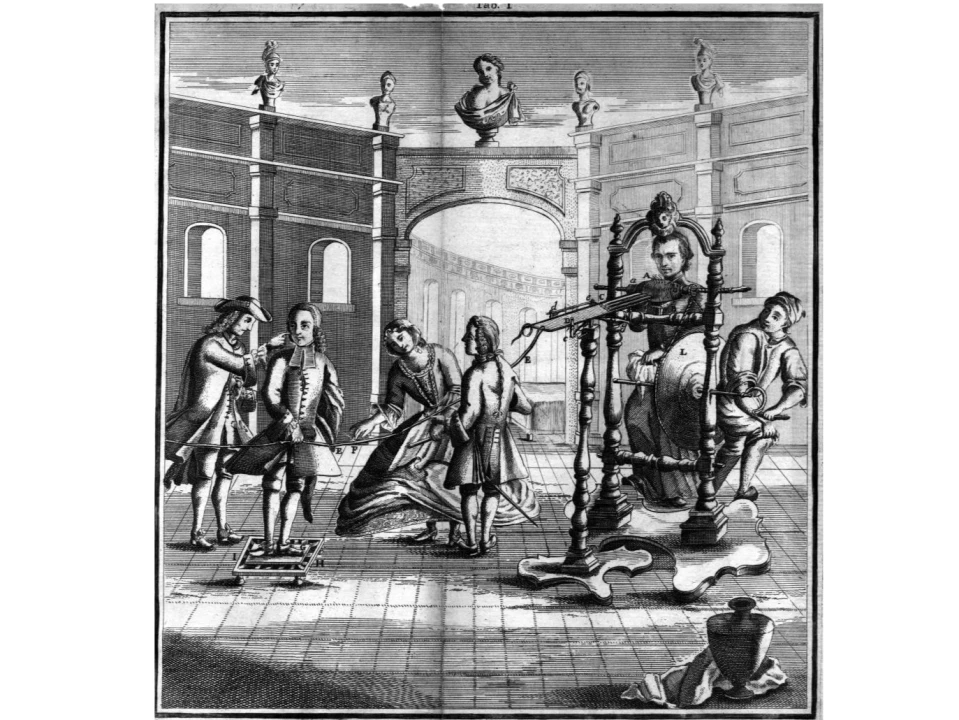
It was in that palace that electricity, with all its mysterious phenomena, made its appearance on the Neapolitan scene at least as early as 1747. Thanks to the public demonstrations given by Peter Johann Windler, halfway between spectacle and experiment, Naples joined one of the great scientific fashions sweeping across Europe. But Neapolitan audiences who came to watch displays of electrical discharges and sparks could also see a very young Maria Angela Ardinghelli personally operating the electrical machines and questioning the demonstrator, in Latin, about the nature of electricity.
In 1749, Nollet spent some time in Naples during a journey through Italy and met Ardinghelli, who, despite her youth, was already working on a translation of a treatise by the English scientist Stephen Hales on physiology and blood circulation. Nollet was impressed by her knowledge, describing her as “a very virtuous young woman who in a short time has made great progress in physics.”
A correspondence began between them that would continue for roughly twenty years and encompass dozens of letters. Later evidence indicates that Nollet wrote Ardinghelli some seventy letters, mostly on scientific subjects and especially on electrical phenomena.
And this is where Benjamin Franklin enters the story.
During the first half of the eighteenth century, electricity was one of the great scientific wonders of the age, a phenomenon whose nature still remained to be deciphered. In the British colonies of North America, Franklin had developed a new interpretation of electrical phenomena, drawing in part on his own experiments. He argued that lightning and artificially produced electricity were manifestations of the same phenomenon.
His findings, communicated in letters to the English naturalist Peter Collinson, rapidly crossed the Atlantic and reached France. In May 1752, Thomas-François Dalibard arranged a celebrated experiment at Marly-la-Ville providing a spectacular confirmation of Franklin’s hypothesis.
News of the experiment also reached Naples, where the attentive Ardinghelli read about it in the Gazette de France of May 27, 1752. But she was no passive observer. She wanted to understand exactly what had happened and wrote to Nollet with three precise questions: Was the phenomenon real? How had the discovery been made? And were the conclusions scientists were drawing from it justified?
At this point, the story becomes particularly interesting. Nollet, one of Europe’s leading specialists on electricity, had developed a theory of his own, one that differed from Franklin’s, and he was not prepared to accept the American scientist’s conclusions without reservation.
An intense scientific controversy followed. Nollet began to challenge Franklin’s ideas shortly after the French publication of Franklin’s Experiments and Observations. In May 1752, he asserted before the Académie royale des sciences that he had published the analogy between thunder and electricity before Franklin’s work appeared. In June, he read a memoir by his correspondent Dutour offering critical reflections on several propositions drawn from Franklin’s work.
Anyway, Ardinghelli’s questions provided the starting point for the first of nine letters in which Nollet examined the latest discoveries in electricity and challenged Franklin’s interpretation more systematically. Published in 1753, the Letters on Electricity were addressed to several scientific interlocutors, with a number of them directed to Franklin himself. The first, however, was addressed to Ardinghelli, with the passage from which our story began.
This is the crucial moment in reconstructing the journey of these ideas. An idea that had originated in Philadelphia crossed the Atlantic, was put to the test in France, and reached Naples through the pages of a newspaper. From there, a woman of science asked one of the leading participants in the debate to explain and defend his position, establishing herself as an active interlocutor in the scientific conversation.
Nor did the story end in Naples. In March 1753, Peter Collinson wrote to Franklin that he hoped Nollet’s Letters had reached him safely. By 25 October that year, Franklin was himself sending Nollet’s book to Cadwallader Colden. The path of the debate had therefore come full circle.
In 1761, Ardinghelli anonymously published an Italian translation of Nollet’s Letters on Electricity in Naples. Her decision to translate Nollet should not, however, be taken in itself as evidence that she endorsed his position in the controversy with Franklin.
As for Franklin and Nollet, their disagreement belongs to a period in which the experimental study of electricity remained very much an open field, and both men contributed to the development of modern knowledge of the subject.
But this was not simply a controversy between two celebrated men. Maria Angela Ardinghelli was an active part of the exchange. The Republic of Letters depended on people willing to read, question, translate, and connect distant intellectual worlds. Ardinghelli was one of them.
Photo credit: Maria Angela Ardinghelli (centre) taking part in an electrical demonstration at the palace of the Prince of Tarsia in Naples. Engraving from Petrus Joannes Windler’s Tentamina de causa electricitatis (Naples, 1747), plate I. Source: Wikimedia Commons.
* Neapolitan electronic engineer, Member of the Union of the Scientific Italian Journalists